
Erik Visits an American Grave, Part 1,999
 By
By This is the grave of Benjamin Roberts.
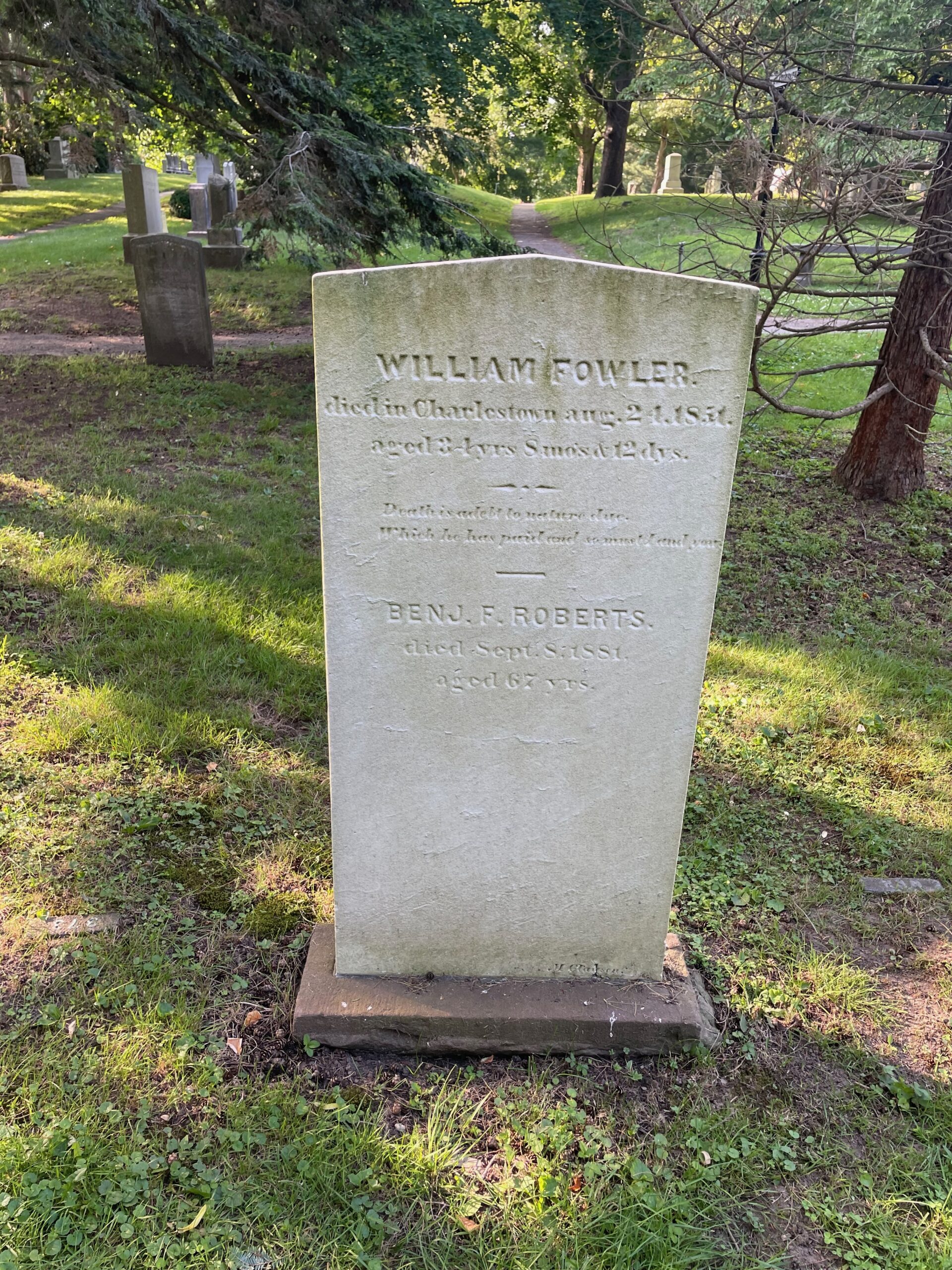
Born in Boston in 1815, Roberts grew up in the small Black middle class of that city at that time. His father was a servant–but about the most successful servant in the country. In fact, in 1827, he wrote a book about it, called The House Servant’s Directory. That was the first commercially published book by a Black person in American history. And just because you were a servant did not mean that you were a subservient person. Both sides of his family had long histories in protesting segregation in Boston. So that’s the world Benjamin grew up in.
Roberts was apprenticed out to a shoemaker when he was around 14. But like his family, he became an active fighter for equality in Boston and the United States. He became a core person in the fight to reject the premise of the American Colonization Society that the races can’t live together in the US. They wanted to send Black people out of the United States, back to Africa, and founded Liberia to do this. There were lots of white supporters of this idea, such as Henry Clay, and some Black supporters as well who saw no hope in this country. I’m not really criticizing the latter for this, though the actual attempts to take over Liberia were colonial exercises and a complete disaster, but I get it. What’s important though is that the large majority of Black people who commented on such ideas were forcefully opposed to it. They weren’t Africans. They were Americans. They wanted equality in the land where their ancestors were brought against their will. So people such as Roberts pushed for civil rights and education as how to create equality between the races.
In 1838, Roberts opened the Anti-Slavery Herald. No copies of this newspaper exist, so it’s hard to know exactly what was in there but the title tells us most of what we need to know, even if it would be better if we could read what Roberts and his correspondents had to say. But importantly, Roberts was supporting himself as a printer at this time. He moved to Lynn, Massachusetts and had some success there, getting a contract to print the city’s first city directory, as well as many pamphlets, books, and other printed material.
But what Roberts is really remembered for today is his fight against segregated schools in Boston. At some point, he moved back to the city. He wanted his daughter Sarah to get a good education. So in 1848, he filed a lawsuit when his daughter was forced to go to an inferior school in poor physical condition and farther away from their home. Of course, Boston whites–as racist as anywhere else in the nation–were absolutely determined that their kids not go to schools with those kids, which is a long and hallowed Boston tradition reanimated in the 1970s. Roberts had first rate representation: Charles Sumner among others. In fact, Sumner was brought in later and the case was originally prosecuted by Robert Morris, the first Black lawyer in the country to argue a jury trial and that needs to be noted (in fact, I should write a grave post for Morris). This is the first case against segregated schools in American history.
The case failed in 1850. The Massachusetts Supreme Judicial Court, led by famed judge Lemuel Shaw, backed the city and threw out of the case for a supposed lack of merit. This case would later be cited by the Supreme Court in Plessy v. Ferguson to defend its actions. And in fact, the best friend southern segregationists would have after the Civil War was the overwhelming number of precedents for their actions out of northern cities and states, which they would cite in speeches and written documents repeatedly. However, Sumner continued to work on the issue and the legislature of Massachusetts passed a bill in 1855 banning legally segregated schools. Naturally, this did not stop de facto segregation, but it was still an important point. And not one that the segregationists would cite in their northern precedents.
There was a follow up case. A Black guy spoke out against the case. So Roberts and other hatched a plan to beat the living shit out of him and then tar and feather him. That happened too. Roberts was charged. Basically, he stated on the stand that the guy deserved it, though he personally was not involved in the attack. I’m not completely sure what happened legally in this case, although I don’t see any evidence anyone got prison time over it.
I am not really sure what Roberts did after this case. There was at least one more attempt to found a paper that did not go anywhere. He also was involved in the struggle to keep slave catchers out of Boston, printing broadsides to expose them. He was a reformer generally and printed support for a few reform causes over the next couple of decades, including for legalizing interracial marriage and banning capital punishment.
Roberts died in 1881, at the age of 66. He was epileptic and it seems he died during a seizure.
Benjamin Roberts is buried in Mount Auburn Cemetery, Cambridge, Massachusetts. William Fowler is Roberts’ father-in-law. Not sure if the women of the family are buried there and are unlisted, or what.
If you would like this series to visit other people involved in key segregation cases, you can donate to cover the required expenses here. John Howard Ferguson, of Plessy v. Ferguson infame, is in New Orleans. Moreton Rolleston, who was the racist hotel owner who sued over desegregation in Heart of Atlanta Motel v. U.S., is in Atlanta. Previous posts in this series are archived here and here.