Subscribe via RSS Feed

Tag: "racism"

Constitution-Revering Republicans Propose Unconstitutional Law

[ 101 ] January 6, 2011 | Scott Lemieux

As if to provide a perfect example for Dahlia Lithwick’s demonstration of the superficial and selective nature of Tea Party reverence for the Constitution, Steve King has decided to open the new Congress by introducing a flagrantly unconstitutional law. And by “unconstitutional,” I don’t mean “contradicts one possible reading of an open-ended constitutional provision.” I mean “is inconsistent with the unambiguous, specific language of the Constitution”:

All persons born or naturalized in the United States, and subject to the jurisdiction thereof, are citizens of the United States and of the State wherein they reside.

Most constitutional disputes involve a clause that is subject to multiple plausible interpretations. The “debate” over birthright citizenship is an exception — it’s like running a 21 year-old for president. But King has a very convincing argument in response:

Though others have called for changing the 14th Amendment, King said that ending birthright citizenship through statute makes sense because it’s easier to do.

Similarly, it would be “easier” for the president to abolish the Senate through executive order than to call a new constitutional convention — let’s do that! I guess that reading of the Constitution will have to skip some parts…

Is Barbour A “Racist?” That’s Not the Issue.

[ 6 ] December 24, 2010 | Scott Lemieux

Like Matt, I think Cotes’s point here is very important:

I guess I can agree that merely displaying the flag of a white supremacist Army, praising a group which opposed integration in the 1960s, and–at this very moment–is boycotting a Hollywood movie because for casting a black person as a Norse diety, does not make one a racist. I guess I’d also agree that dressing in Nazi regalia, and praising Pat Buchanan’s writings on Jews doesn’t, in itself, make you an anti-Semite. No one can know the contents of person’s heart. But it does make you, as Matt charged,  “dangerously ignorant,” among many other things. Of course Jacobson never quotes Matt–or frankly anyone–charging that Barbour is a racist.
That of course leads us to the second point–that there is an outbreak of liberal bloggers claiming Barbour is a racist. A google search of “Barbour is a racist” is instructive. It does not reveal a single liberal blog of real note making that case. On the contrary it reveals a raft of sites either arguing that Barbour isn’t a racist, or arguing why it’s not relevant. Unable to deal with the actual arguments made by Matt here, for instance, and evidently generally ignorant of the basic facts of American history, Jacobson simply strawmans and changes the subject.

I have no idea whether Barbour, personally, is a racist. Let’s stipulate that he’s not. It’s beside the point. Praising the White Citzens Councils because they weren’t as violent as the Klan may not be evidence of racism — but it is evidence of indifference about racial justice, and general an excellent illustration of the kind of silly formalism that leads to Republicans touting their own “color-blindness” while they make it illegal for schools to voluntarily desegregate.

On Barbour’s Praise of the Citizens Councils

[ 42 ] December 22, 2010 | Scott Lemieux

Rick Perlstein has a typically brilliant analysis.   Read the whole etc., but a preview:

What happened between Brown v. Board of Education and that January day in 1970 comprises some of the most monstrous inhumanity in the cruel annals of American history. Recently, in a cover feature in the conservative Weekly Standard on his presidential ambitions, Mississippi governor and fellow Yazoo native Haley Barbour had occasion to reflect on that place, in those years. The best that can be said about his recollection is that it is not 100 percent a lie — just deeply confused, mostly wrong, and indicative above all of a cynical man who has made a lucrative career of exploiting racial trauma when it suited him, or throwing it down a memory hole when it did not; which is to say, an archetypal Dixie conservative.

I especially recommend Perlstein’s post to William Jacobson, who defends Barbour with one of the worst analogies in known human history:

1947 was the year in which the color barrier was broken in Major League Baseball. Prior to Jackie Robinson taking the field, MLB (or whatever it was called at the time) was segregated. Actually, it was more than segregated, it excluded blacks completely.

Using the logic of Matthew Yglesias of Think Progress, who is having his 15 minutes of race card fame, anyone who expresses any measure of praise for the pre-1947 Yankees necessarily would be “expressing affection for a White Supremacist” organization. It would not matter that the praise was for the Yankees’ baseball skills; any expression of anything less than complete condemnation of the Yankees necessarily evidences tolerance for racism because the Yankees were part of a racist system.

This is remarkably silly. While the Yankees were part of an institution that (like many of the time) was racially exclusionary, they were primarily a baseball team; people who remember Joe DiMaggio or Babe Ruth or Bill Dickey or Joe McCarthy or George Pipgras fondly are remembering them because of what they did on the baseball field. Citizens Councils, conversely, existed for essentially the sole purpose of maintaining apartheid. The White Citizens Councils weren’t just a passive “part of a racist system,” they were formed to actively enforce white supremacy and black disenfranchisement. Their ends were the same as the Klan’s, with the only difference being that they favored economic to physical terror. Praising them is like praising the local Klan for handing out free Christmas hams.

In conclusion, given the nature of some of its public officials and their reflexive defenders, I’m puzzled that the GOP’s share of the African-American votes maxes out at about 8%…

Run, Haley, Run!

[ 29 ] December 20, 2010 | Scott Lemieux

Is Haley Barbour really going to run for the GOP nomination in 2012?  I hope so; the modern neo-Confederate+Corporate Lobbyist Republican Party might as well have a definitive standard-bearer:

As Barbour recalls it in a new profile in The Weekly Standard, things weren’t so bad in his hometown of Yazoo City, which took until 1970 to integrate its schools (though the final event itself is said to have gone on peacefully). For example, Barbour says that there was no problem of Ku Klux Klan activity in the town — thanks to the Citizens Council movement, an organization that was founded on the basis of resistance to integration and the promotion of white supremacy.

“You heard of the Citizens Councils? Up north they think it was like the KKK,” said Barbour. “Where I come from it was an organization of town leaders. In Yazoo City they passed a resolution that said anybody who started a chapter of the Klan would get their ass run out of town. If you had a job, you’d lose it. If you had a store, they’d see nobody shopped there. We didn’t have a problem with the Klan in Yazoo City.”

If you define “state-sponsored terrorism in defense of lawlessness and apartheid” as a benign “organization of town leaders,” I’m not sure what else I can say. But Barbour will continue to lock in the CCC’s support

see also.

And The Worst Moment of His Presidency Was…

[ 119 ] November 3, 2010 | SEK

The former President in a forthcoming interview (emphasis mine):

MATT LAUER: You say you told Laura at the time it was the worst moment of your presidency?

GEORGE W. BUSH: Yes. My record was strong, I felt, when it came to race relations and giving people a chance. And it was a disgusting moment.

You might suppose he’s talking about Hurricane Katrina, and if you did, you’d only be half-wrong.  Because the “worst moment of [his] presidency,” according to the man himself, was this:

According to the man himself, then, Bush placed more importance on whether people perceived him to be racist than what happened to actual black people in the city of New Orleans.

In short, he proved Kanye right.

UPDATE: In the comments, nitpicker asks: “Um…9/11?”  I wish Lauer had had the nerve to ask the same.

Hey, one stop shop for shearling bomber jacket in the cyber word where you can buy not only western leather jackets but also boys bomber jacket. In addition to that shop here women’s motorcycle apparel and vintage leather motorcycle jackets as well.

More on race and racialism in Avatar.

[ 0 ] December 31, 2009 | SEK

While the Na’vi may be blue, the people who played them are not. Consider:

  1. Neytiri
  2. Tsu’tey
  3. Eytukan
  4. Moat
  5. Horse Clan Leader

It could be the case that all the other models for the Na’vi are white, but it seems clear to me that Cameron chose these actors for the central Na’vi characters according to racialized criteria; i.e. while he didn’t necessarily choose them because they weren’t white, his vision of a primitive, native culture didn’t include white people. The representatives of humanity, however, were not only overwhelmingly white, even the exceptions played to stereotype: Dileep Rao played an Indian scientist and Michelle Rodriguez played a Latina tough. My point in my previous Avatar post about the film indulging in the white fantasy of becoming the proverbial other is, then, made literal by Cameron’s casting decisions: Sam Worthington, Sigourney Weaver and Joel Moore play three white characters who inhabit bodies otherwise occupied only by actors of color. I’m not normally one to invest much of anything argumentative based on what happens on a casting couch, but in this case, Cameron tipped his hand with all the subtlety of an overconfident drunk: the purpose of the avatars is to place white brains in blue bodies that would otherwise be inhabited by black ones.

Stop howling already: I know that, within the film, the purpose of the avatars is to allow humans to breathe on Pandora; however, the humans have masks that can and do fulfill that function. I also know that another purpose of the avatars was to allow human anthropologists to interact with the Na’vi, which is why the xenobotanist played by Sigourney Weaver establishes a planet-side school. For now, set aside Cameron’s confused notion of what a botanist does, because while it suggests that his script is, at best, ignorant of departmental niceties or, at worse, internally inconsistent, it could also be the result of the Gaia metaphor, in which the population of the entire planet are semi-conscious functionaries of a fully-conscious tree. (I kid!) Focus instead on 1) the fact that the film is called Avatar, and 2) the likelihood that Cameron spent years developing this technology in order to avoid the throwaway line about terraforming required to account for the astonishing frequency of breathable atmospheres on far-flung planets.

In short, if you believe that the existence of the avatars can be justified on the basis of inhospitable environs, you’ve not simply placed the cart before the horse, you’ve put the invention of the wheel before domestication of animals. Because, as the title indicates, the avatars aren’t incidental to the film: they’re its raison d’être. The whole point of the film is to stuff brains in those bodies, so which brains are stuffed into which bodies is not a minor point, it is the point. Moreover, within the narrative, the bodies they were being stuffed into were utterly infantilized: the Na’vi don’t think for themselves, as even animal husbandry is beyond them. They require a direct neural connection in order to domesticate an animal.

That they teach humans to be similarly dependent upon a necessarily benevolent planet is, I understand, the point—but it is a terrible one if, as many claim, Cameron wanted to press a message of ecological interdependence. The Na’vi possess all the agency of a leukocyte: they may respond individually, but they are not, properly speaking, individuals. As progressive propaganda goes, this rises to the level of what conservatives believe our nefarious motives to be. That the quasi-coherent leftist politics of the film are intended to be inspirational only makes this incoherence and, more importantly, its dubious racial politics all the worse, because “inculcating dubious racial politics in the next generation of environmental and anti-war activists” doesn’t count as a victory for the forces of democratic freedom. (Or only counts as one in that hilariously limited sense.) Even in the film, as my friend Aaron argues, the result of such thinking is also infantilizing:

Jake Sully, in other words, is a Western fantasy of spoiled childhood: pure id, he revels in the toys that the world has provided for him without understanding that someone had to make them, without ever questioning his own right to have them. I think that’s why I don’t feel contempt for him, but visceral, gut-level, and troubling disgust. I recognize his desires, because we not only have to get past them to be adults, but because they stay with us. Perhaps we still are, on some level, the sociopaths we were when we were children (that I type this while home for the holidays, in the bedroom I occupied when I was seven, only seems appropriate). Yet it’s also one of the worst aspects of the American cultural tradition that going back to childhood is somehow the fountainhead of political virtue (see, for example, Jefferson, Thomas and Roosevelt, Theodore) because it’s so rarely the childhood of curiosity, games, and sociality that the tradition extols, but rather its reverse, a very particular fantasy of careless anti-social boyishness that tends into misogyny so easily because, to again refer us to Nina Baym, it feminizes the “encroaching, constricting, destroying society” that we American boys must seek to be free of by lighting out for the territories.

Finally, let me clarify a few minor concerns about my previous Avatar post:

  1. Just because I didn’t remember every last detail drummed into my head over the course of three dull hours doesn’t mean I didn’t see the film.
  2. Just because you do remember every last detail doesn’t mean that your take on the film is more correct than mine.
  3. I chose “JaMarcus Manning” as the figure of the white-brained, black-bodied quarterback because I’m from Louisiana and graduated from Louisiana State University.
  4. I know the name “JaMarcus Manning” is racist, not because you told me it was, but because that was my point: the “black quarterback problem” is the result of racist expectations that were only ever operative because they were self-fulfilling.
  5. If you take issue with a point I make, fine. If you accuse me of treating you like a student when I defend a point I make, you have issues. Leave me out of them, please, and just argue with me as you would any other stranger on the internet.

Intentions be damned, Avatar is racist (as is praying for and/or to "JaMarcus Manning").

[ 2 ] December 20, 2009 | SEK

Annalee Newitz writes that “[w]hether Avatar is racist is a matter of debate,” but it isn’t: the film is racist. Its fundamental narrative logic is racist: it transposes the cultural politics of Westerns (in which the Native Americans are animists who belong to a more primitive race) onto an interplanetary conflict and then assuages the white guilt that accompanies acts of racial and cultural genocide by having a white man save the noble savages (who are also racists). Unlike King Kong—which wrestled with the racial logic of the originalAvatar reproduces the racist logic of its source material. This is not to say the film is not also a condemnation of American imperialism or disastrous environmental policies, because it’s that too. I’ll address the racial politics more in a moment, but let me address the portrayal of the military (much bemoaned here) first:

It all adds up to crossing a line that I’ve never experienced in a major American film: drawing the audience to cheer the brutal deaths of Americans who are clearly symbolizing the military.

Blackwater/Xe Services LLC is not the military. Mercenaries are not symbols of the military. They are a perversion of the military. James Cameron has an unabashed love for the military (Aliens, The Abyss, etc.) but that love does not extend to those who make war for profit. It’s obvious that the only authentic military man in the film is the protagonist, Jake Sully, who lost his legs in a legitimate conflict. He turns from the soulless mercenary-logic like a good proxy for the audience, and this is where the racial politics become problematic.

The titular “avatars” are genetically designed Na’vi bodies that can be remotely piloted by people like Sully with the intent of studying the natives. (Think anthropological immersion at its most literal.) The Na’vi are not merely distrustful of “the space people,” they’re inherently xenophobic, incapable of trusting any sentient being that doesn’t look like them. If that mistrust is justified for some other reason (like a hairy first contact), the film never mentions it, meaning (in a classic case of projection) the humans assume that the Na’vi will be xenophobic before they even meet them.

But the racial essentialism of the film creates a whopper of an unintended thematic irony.* The planet and everything on it do not simply coexist in a harmonious balance of the New Age variety: they are hard-wired into a single neural network that makes the entire planet into a single entity and “the space people” less like a colonizing mercenary force than a disease. The humans are to be resisted not because they are economic imperialists (though they are) and not because they glory in militaristic combat (though they do) but because they are different. They do not belong to the planet and therefore there is no possibility for peaceful coexistence. The only way humans can be accepted is for them to forsake their humanity and become Na’vi. (Think literal assimilation.)

This is not a vision of a racially harmonious social politic: it is an inversion of the logic of passing that seems acceptable only because it imagines the experience of becoming a person of color as necessarily ennobling. The film argues that once a white person truly and deeply understands the non-white experience, he becomes an unstoppable combination of non-white primitivism and white rationalism which is exactly what happens. In order for the audience to support the transformation of Jake Sully into Braveheart Smurf, it must accept the essentialist assumptions that make such a combination possible … and those assumptions are racist. In football terms, this is a variation of the black quarterback “problem.”

For decades, coaches and scouts wished they could find a black body with a white brain in it. (“If only someone could find a way to stuff Peyton Manning’s brain into JaMarcus Russell’s body!”) The essentialist logic at play there is obvious: black people are more athletic than white, and white people are smarter than black. No matter how descriptive these people thought they were being, in truth they were creating the conditions they claimed to describe: black quarterbacks were increasingly valued for raw athleticism, white athletes for their pocket presence and tactical acumen. That’s an expectations game based on racist expectations … and it works according to the same logic behind the narrative of Avatar.

*I’m analogizing race and species here because Cameron’s space fable encourages me to do so with all the subtlety of a fry pan upside my head.

You only noticed I’m white because you’re a racist.

[ 0 ] November 24, 2009 | SEK

In the comments to a long, inaccurate attack on those who consider Palin evidence that the conservative movement is trending stupid, Darleen Click claims that those who point out the extreme whiteness of Palin supporters “reveal a great more about [themselves] than Palin.” Because such people notice race at all, they’re insufficiently colorblind and therefore more racist than Click, who merely advocates creating and maintaining structural inequalities that disproportionately affect people who just happen to not be white.

Set aside for a moment the fact that Click labors under the delusion that noticing people of color is more racist than harming them and remember that 1) the figure she defends, Sarah Palin, is using her publicity tour as a prelude to a 2012 presidential bid launch, and 2) candidate Palin is posting photographs of the people she meets on her Facebook page, meaning that these are not images produced by a liberal media elite out to make her look like her appeal is limited to white people but images she and her people have decided should represent her mass-appeal on a mock-presidential bid launch. Time to play “Count the Non-White People”!

  1. Image #1: 0
  2. Image #2: 0
  3. Image #3: 0
  4. Image #4: 0
  5. Image #5: 0
  6. Image #6: 0
  7. Image #7: 0
  8. Image #8: 1 (a mall security guard)
  9. Image #9: 0
  10. Image #10: 0
  11. Image #11: 0
  12. Image #12: 2 (but only one identifiably of her own volition)

In all those photographs, there is one non-white person who can be positively identified as having come of their own accord. To Click, pointing out that Palin’s own handlers consider her appeal limited to white people makes me a racist. Over in the increasingly diverse place known as the United States, this is why people like Click should hunker down for a long run of political disappointment.

Update. Over at my place, one of Darleen’s flock attempts to prove me wrong by being racist.

Update 2. Someone should tell them to quit digging.

The end of something

[ 0 ] November 5, 2008 | Paul Campos

Race in America has always seemed to me like the terrible secret at the end of Chinatown, that isn’t really a secret at all. Forget it, Jake . . .

Anyway.

Ugly

[ 13 ] June 21, 2008 | Scott Lemieux

A few months ago, I foolishly claimed that Pat Oliphant could never get away with open racism comparable to his misogyny. I was certainly mistaken. (Latter link via Ez.)

Not a Newsflash

Reproductive healthcare in prisons in the U.S. sucks.

First, there were prisons that were refusing to allow pregnant inmates to get abortions, even when the women could pay for the procedures themselves. The ACLU challenged the prison policies and won. Twice.

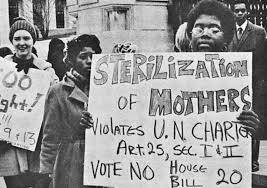
But there are also – and still – problems of women being sterilized in prison – not by force, but by neglect. Women who do not receive adequate gynecological care while incarcerated at a high risk for sterilization because, by the time illnesses such as cervical cancer are detected, they are too advanced to treat any other way. In other situations, women who have gynecological issues that could be treated otherwise are given hysterectomies. Given that many of these women are women of color and given this country’s discomforting history of sterilizing women of color, this should make us all queasy. Feministing has more.

Subjective Intent Isn’t the Issue

[ 0 ] April 15, 2008 | Scott Lemieux

One thing to say about this thread, which has won a coveted Belle Waring Award for Outstanding Achievement in the Field of Excellence in Trolldom, is that given the inevitable displays of racism we’re going to see as Obama runs for president we’re going to be seeing a lot more of one of the central arguments there. That is, the “you can’t say that anything is racist, including an experienced border state politician calling an adult African-American man “boy,” without unequivocal evidence of that person’s intent” argument. The beauty of this standard — which his trolls also used to defend George Allen — is that you can never prove racism because the knowledge in question is unknowable. How can you know to an absolute certainty what’s in David Duke’s mind? You can’t.

It’s essentially irrelevant anyway. It’s fair to use people’s statements to make inferences about intent in most cases, but more importantly the intent doesn’t matter; the comment is racist whatever was in Davis’s mind. Just as George Wallace’s ringing defenses of apartheid were racist even if they were in considerable measure just political posturing. When it comes to public rhetoric, it’s public meanings not private intent that matters.

Page 5 of 6« First...23456
  • Switch to our mobile site