
Erik Visits an American Grave, Part 1,920
 By
By This is the grave of Eleazar Wheelock.
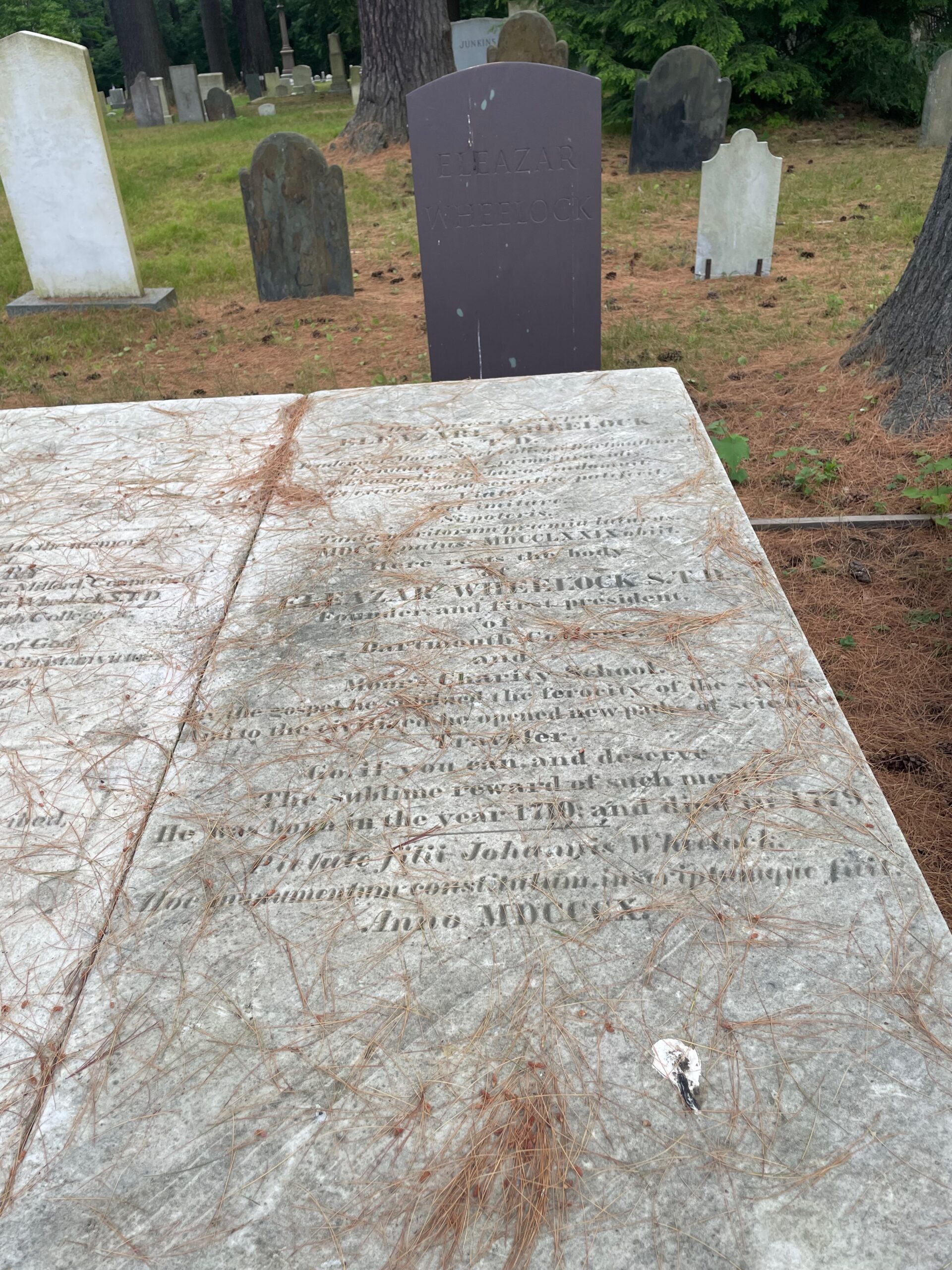
Born in Windham, Connecticut in 1711, Wheelock grew up in what passed for the elite of the early 18th century, which wasn’t really that wealthy. But his family had a pretty big farm and he got to go to Yale, where he graduated in 1733. He was ordained as a minister in 1734 and got a church in what is today Columbia, Connecticut, married shortly after, and started his own farm. His first wife died in 1746 and he soon remarried.
Wheelock became a big proponent of the Great Awakening, where the mid-18th century descendants of the Puritans became concerned about the lack of religiosity in the century since the founding of Massachusetts. This swept the colonies but thanks to people such as Jonathan Edwards and George Whitefield, was primarily centered in New England. Wheelock was one of its biggest leaders in Connecticut.
Wheelock was super into converting Native Americans to Christianity. Now, we have to understand two things here. First, Wheelock was, for his time, one of the most pro-Native American whites around. He was concerned about their exploitation and wanted to stop that, at least up to a certain point. He certainly didn’t want the genocide so popular among frontier whites. Second, that concern had absolutely no room in it for Native American culture. He still thought that the Indians should basically become white people. Even as you go forward into the 1820s and the fight against Andrew Jackson’s hideous genocidal removal of the Cherokee and other tribes to Oklahoma, the liberal whites who allied with the Tribes such as Jeremiah Evarts had the basic position that, sure, there was nothing worthy about Indian culture and it should be completely eradicated and destroyed forever and these people should be turned into whites. But they should be able to keep their land too.
So Wheelock had an Indian pet. His name was Samson Occom. Occom was a Mohegan who converted to Presbyterianism in 1743, when he studied at Wheelock’s school. Wheelock had established a school that taught anyone who wanted to attend. It was the kind of school that was standard at the time–instruction in Latin and Greek, as well as religion. Occom was a really good student and Wheelock was impressed. Occom would go on to be a missionary with the Pequot living on Long Island and eventually was ordained as a Presbyterian minister.
The Occom experiment went so well that Wheelock decided to establish a school just for Indian students. This was in Columbia, Connecticut. At first, it was a local school, but then he wanted a college and for that you needed a charter from the king. Wheelock sent Occom to London to raise money as the mascot to show the English how great a civilizer Wheelock was. King George III gave Wheelock a charter for this school in 1769, so it worked. By this time, the idea was that the school would be much larger. It became Dartmouth College, established on the frontier, in Hanover, New Hampshire. Wheelock became Dartmouth’s first president. This really was out there for the time. Heck, Hanover is pretty remote today. Despite what Wheelock wanted, it really was a school for white kids. Not surprisingly, Native Americans were not thrilled about sending their children for education in the white world. A few Native people did in fact graduate, but it almost immediately was dominated by whites.
But that’s the story of Dartmouth’s founding.
Wheelock died in 1779. He was 68 years old.
Eleazar Wheelock is buried in Dartmouth College Cemetery, Hanover, New Hampshire.
If you would like this series to visit other figures associated with the Great Awakening, you can donate to cover the required expenses here. Experience Mayhew (they had the best names back then) is in Chilmark, Massachusetts and Joseph Bellamy is in Bethlehem, Connecticut. Previous posts in this series are archived here and here.