
TN-7
 By
By 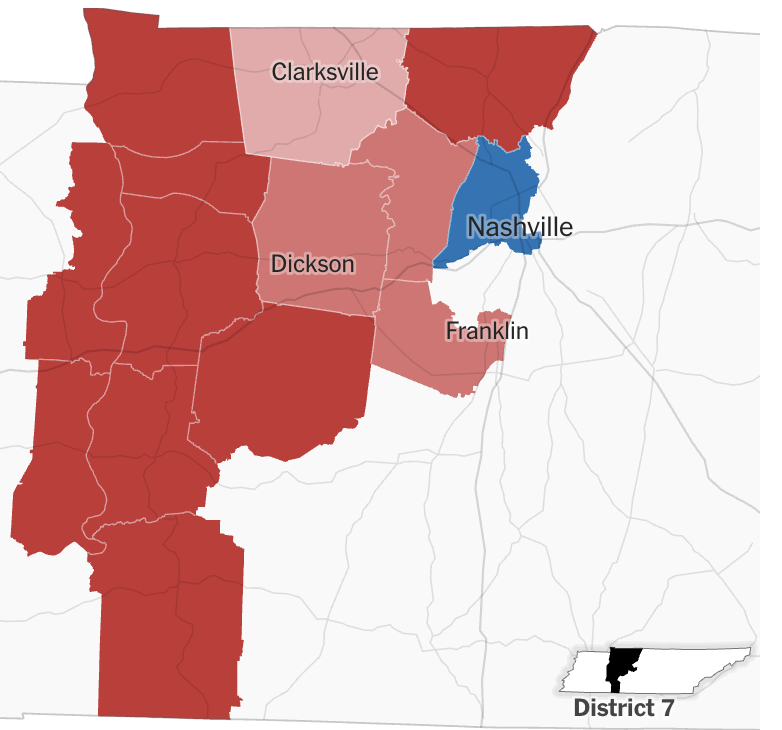
Republicans won the special eleciton in Tennessee tonight with margins that would portend a massive wave election in 2026:
Zooming out, the election on Tuesday confirms a broader trend in recent special elections to vacant congressional seats. Democratic candidates in special elections have been dramatically outperforming benchmarks based on the 2024 election. The result in TN-7 is 13 points less Republican than in 2024, in line with other congressional specials that have an average 17-point swing. And it is higher than other down-ballot special elections: Specials for state legislative seats have moved to the left at more like an 11-point clip in 2025.
For context, in the 2018 midterm cycle, Democrats beat their benchmarks in special elections by about 11 points. They ended up winning the U.S. House popular vote by about 7 points, accounting for distorted vote totals in uncontested seats. That was an 8-point swing left since 2016.
But handicappers should be careful not to apply the full special-election swing when forecasting next year’s congressional midterms. Turnout in special elections tends to be much lower than in midterms, with lower-education voters and the party in control of the White House disproportionately staying home. This produces a sort of two-electorate dynamic to elections, where the voters turning out in specials are (currently) much more Democratic than those who vote in presidential races. Swings in specials tend to exaggerate subsequent swings in midterms.
Midterm turnout sits somewhere between turnout in special and presidential elections. In 2022, for example, voters across the country cast about 70% of the ballots as they did in the 2020 presidential elections. Special elections can have much lower turnout — like, 20 to 30% of totals in presidential elections.
However… turnout in Tuesday’s special election in Tennessee’s Seventh was not low. A rough guess is that about 180,000 votes will be cast in TN-07 for this special election. In the 2022 midterms, voters in the same seat cast 181,000 votes. So we are at around 99% of the typical midterm.
This means the 13-point swing in TN-07 (compared to 2024) is less likely to be distorted by low turnout. My best guess is that the 13-point swing on Tuesday translates to something like a 7- or 8-point swing for the midterms (turnout is still way below 2024, at 314k). My math is based on two factors: First, special election swings recently have been overestimating swings in midterms by about 2x, benefiting Democrats each time. But I’m hesitant to discount the full 50%, since turnout in TN-07 was so high. I’m assuming about 40% of the result in TN-07 was due to differential turnout patterns, and 60% was due to crossover voting — real changes in which party individuals vote for.
A swing of D+8 would put the national vote at D+6 in nominal terms — just shy of the Democrats’ D+7 “blue wave” in 2018. (Disclaimer: This estimate comes with uncertainty.)
Also worth remembering that this is one of the districts into which disenfranchised Nashville voters have been cracked into:
TN07 is a story about gerrymandering: the GOP cracked Nashville into 3 districts when it redrew the 2022 map, destroying the Dem seat there. Fast-forward: a section of Nashville, which just 5 years ago had a Dem representative, is now voting Dem by huge margins but it's been designed to not matter.— Taniel (@taniel.bsky.social) Dec 2, 2025 at 6:14 PM