
Faster Labor Contracts Act
 By
By 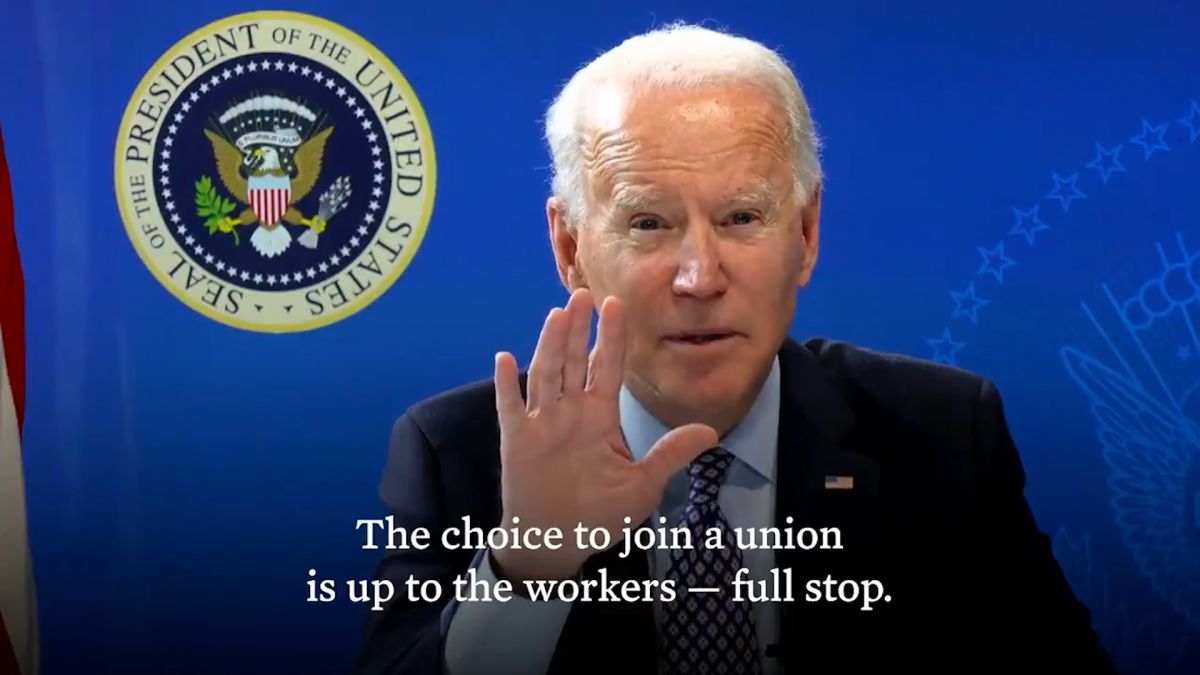
On this Labor Day, it’s worth noting that it’s now almost impossible to win a union contract. Corporate America so dominates the processes of the National Labor Relations Act that they can hold off recognition and a contract for years while they replace the work force. We do not rebuild the labor movement without something done about this. Joe Biden made it a priority with his PRO Act. Of course that never had a chance of passing the Senate (and I’m not sure it would have gotten 51 Democrats for that matter, since people like Mark Warner tend to feel about organized labor what Bill Clinton felt), but momentum has slowly built. Even Josh Hawley cosponsored the Faster Labor Contract Act in the Senate, though I am sure if it ever really mattered, he’d find a way to vote no faster than he ran from the January 6 coup rioters that he promoted beforehand. Still, this is the kind of bill we need:
When a fed-up bunch of baristas in Buffalo, New York, organized the first-ever Starbucks union in December of 2021, excitement rippled through the labor movement. Precarious fast-food workers around the country wondered if corporate goliaths like Starbucks and Chipotle, which employ hundreds of thousands of workers without a union contract, could be brought to the bargaining table.
Not so fast, they learned.
Although Starbucks Workers United’s numbers have grown to more than 12,000 workers at almost 700 locations across 45 states in the nearly five years since the 27 Starbucks workers at Buffalo’s Elmwood Avenue branch first unionized, not a single one of those shops has won a union contract.
Which, sad to say, is just normal American labor relations. Across the United States, employers with newly minted union shops currently stall for an average of 465 days to negotiate a first contract, according to a 2022 study of Bloomberg Law’s labor data. Data on time-to-contract is scarce, but labor historian Kate Bronfenbrenner’s 2009 study of roughly 1,000 NLRB elections between 1999 and 2003 revealed that 25 percent of organized units that had unionized had not won a contract more than three years after they’d voted to go union and the NLRB had certified their victory. Many more, we may assume, were never unionized at all.
This year, a bipartisan group of legislators introduced the Faster Labor Contracts Act in both houses of Congress. The legislation aims to give newly unionized workers the legal means to enforce contract negotiations with their bosses, setting legally enforceable time limits for bargaining after a union’s first written request to negotiate and essentially guaranteeing a contract within 130 days or less.
But as workers wait to find out if they might ever get to stop waiting, intransigent corporations benefit from stalling, hoping to demoralize their workers and reduce their interest in and support for their union. In early 2025, Starbucks briefly entertained mediation before walking away from the bargaining table. By the end of that year, Starbucks Workers United baristas walked out of work and staged a nationwide strike at the majority of unionized Starbucks locations. But Starbucks outlasted the striking workers by relying on other, non-unionized locations and hiring scabs to cover for striking workers. Dejected and defeated, the baristas called off the strike and returned to work after nearly three months off the job and on the line.