
Erik Visits an American Grave, Part 2,186
 By
By This is the grave of Miantonomo.
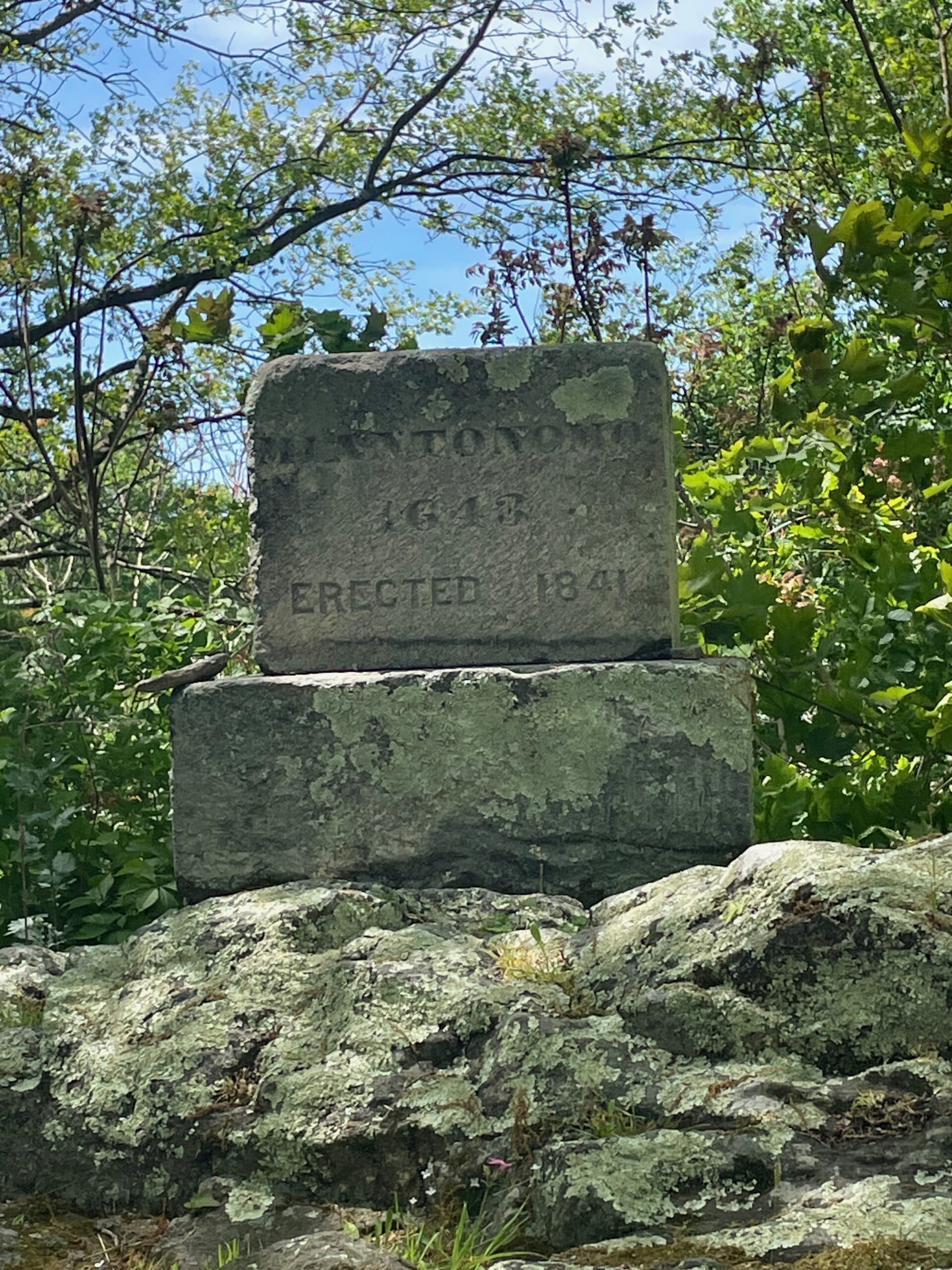
Born sometime around 1600, Miantonomo was one of many members of his family who were prominent leaders among the Narragansett people. By the time he was born, their lives were beginning to be blow apart by the arrival of the English. At first these were traders and were often welcomed, but they also brought diseases. While I don’t think we know specifically how early epidemics impacted the Narragansett per se, we do have accounts of English traders returning after visits some months later and seeing entire villages completely abandoned, as if everyone had just died overnight, which was more or less true.
Still, the tribes of New England were independent peoples with their own agendas and they responded to the arrival of the British in ways logical to them–they attempted to use the newcomers to gain advantages over their long term enemies. That got harder when the British began to live in New England, first in Plymouth and then Boston and then Rhode Island. The British were really violent. Their military experience, both on the continent and in Ireland, had taught them levels of mass killings that the indigenous peoples of New England didn’t know. And the British quickly proved their technological superiority.
Miantonomo had to prove himself to the English. As the lead Narragansett sachem in the 1630s, the British wanted to know that he was loyal to them. The colonists of course trusted no Indians, even those who had converted to Christianity were suspect anytime there were conflicts with non-converts. Miantonomo had placed the Narragansett in alliance with the colonists, along with the Mohegan. Their long-time enemies the Pequot were opposed to the English. The Pequot had been expanding its territory anyway in order to gain control over more furs for trading with Europeans and the Narragansetts had suffered from this. So it was a logical move for Miantonomo to make.
But the Pequot War was not like indigenous warfare. This is not to downplay the violence of indigenous warfare in New England, where torturing people to death was the norm and ideals of the ultimate manhood was to be able to stand up to these horrible tortures without grimacing. But the English wanted the Pequot eliminated entirely. So they surrounded the Pequot Fort, set it on fire, and killed or captured anyone who escaped. This brought the idea of genocide to North America. Very few Pequot remained after this, not after the mass killings and the selling of many survivors to the slavery death camps of the Caribbean. But Miantonomo took advantage. He demanded his share of the remaining Pequot and got about 80 of the 200 or so who remained as slaves. By this point, he was probably the most important and powerful sachem in southern New England.
But the thing was that even if Miantonomo was on the side of the English in the Pequot War, the Puritan demand for land was insatiable. So by the early 1640s, Miantonomo was trying to unite New England tribes against the English. But that wasn’t going to be so easy to do, as Tecumseh discovered 170 years later. These tribes all had their own histories and cultures and dislikes of one another. Why would they unite? He had some progress on the front, but not enough to battle the English effectively. And of course, despite past alliances, the English didn’t trust Miantonomo at all like they didn’t trust any Indian.
Plus tensions had grown between the Narragansett and the Mohegans, mostly over who would control the remnants of the Pequot. So in 1643, the two tribes went to war. This went very badly for Miantonomo and the Narragansett. Not only were they repelled, but Miantonomo had armor on that made him obvious and he was captured. Two of his own men actually betrayed him. He tried to convince the Mohegan leader Uncas that they should unite against the English. This was not some desperate attempt to save his own life, as that would have been counter to the ideas of the indigenous masculinity of that region discussed above. When he was surprised that Uncas didn’t have him immediately killed, he suggested that he be turned over to the Connecticut colonists.
Uncas took Miantonomo to Hartford in order to consult with the English in Connecticut Colony. They weren’t really sure what to do. The Narragansetts tried a ransom with Uncas, sending him a bunch of wampum. Since Miantonomo was an ally with the British, the colonists threatened Uncas with war if he wasn’t released, but they really admitted that he deserved whatever Uncas wanted to do with him. They were a little concerned that escalating the warfare could come back and lead to a lot of dead colonists, truly their only concern. There was war going on in New Netherland at that time and they feared it could head east, so they didn’t want to inflame the issue by ordering the death of a leading sachem. So they told Uncas, go ahead and do what you want with him but don’t involve us.
Uncas had his brother Wawequa tomahawked Miantonomo and killed him. Miantonomo was approximately 43 years old. The Narragansetts wanted revenge and lobbied with the use of wampum all the way west to the Mohawks to have it, but the word came down that if they attacked Uncas, the English would go to war with them.
Miantonomo is buried in Sachem’s Park, Norwich, Connecticut, near where he was killed. This has been a site of memory for white Connecticut since around 1800 or so and so who knows just how accurate any of it is. But that was around the moment when New England whites began to take their history seriously and the kind of places and people they chose to remember reflected them more than the past (which is of course just as true with what we choose to remember or emphasize today in our history). A few famous Native leaders have always been something whites could get behind in memory, even as they were fully committed to crushing and killing them when they were alive. So this stone was placed in this spot in 1841, as it says in the picture.
If you would like this series to visit other Native American leaders, you can donate to cover the required expenses here. Uncas is in Norwich, Connecticut as well, but a different graveyard. Sitting Bull is in Corson County, South Dakota. Previous posts in this series are archived here and here.