
Erik Visits a (Latin) American Grave, Part 2,178
 By
By This is the grave of Juan Manuel de Rosas.
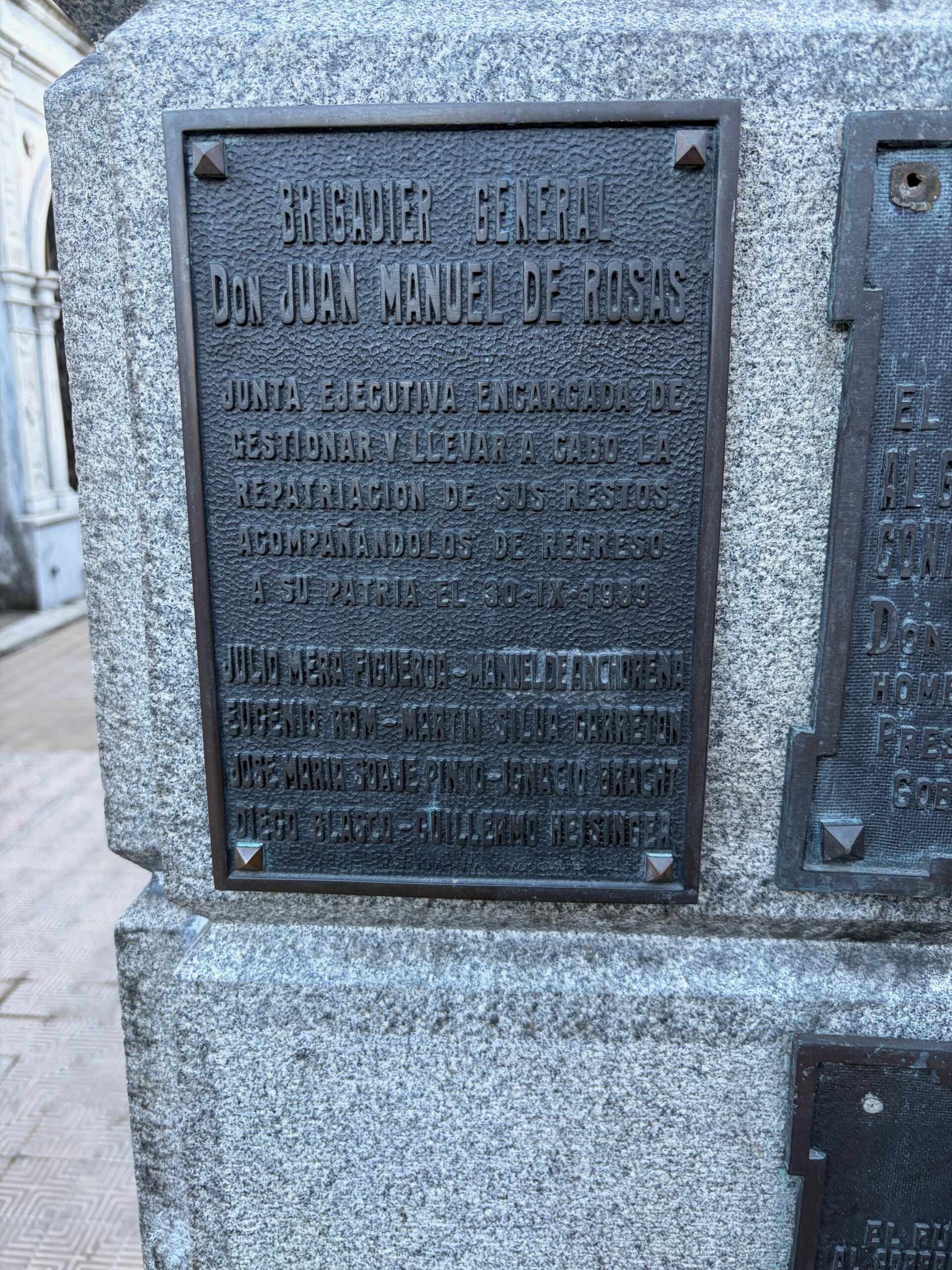
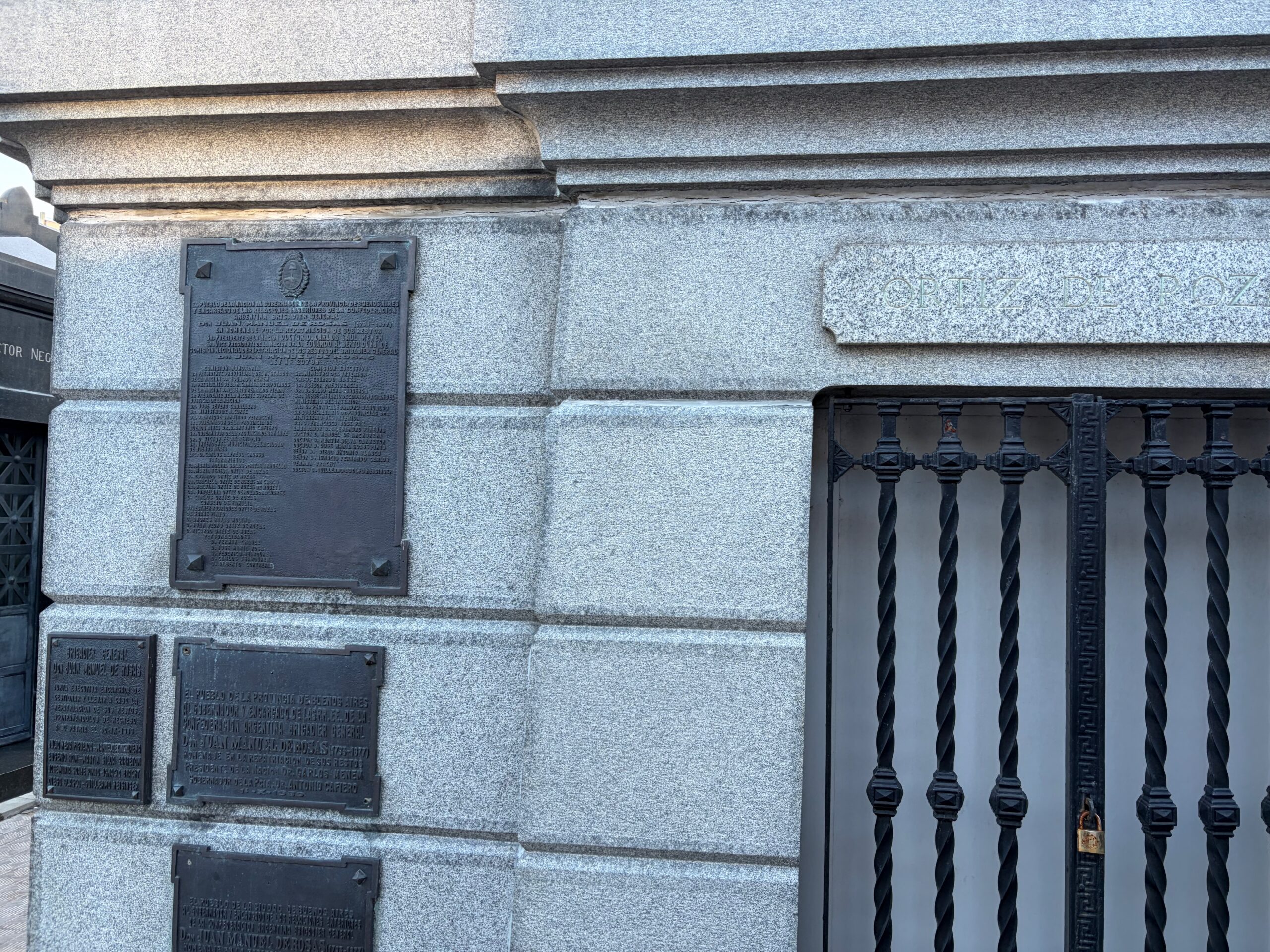
Born in 1793 in Buenos Aires, Rosas grew up extremely wealthy as part of the Spanish colonial elite. He would only get wealthier. The family had a place in BA but mostly lived on their ranches, where they control hundreds of workers. Rosas had early interest in military matters. In 1806, the British tried to invade Buenos Aires, though not that hard, and the young Rosas was part of the resistance, passing ammunition to the soldiers. But mostly he grew up and started running his family’s ranches. He bought a lot more land too.
Rosas was not really part of the early Argentine independence movement. He and his family were doing just fine under the Spanish. But in 1816, when it was clear Argentina would not be returning to Spanish control, Rosas was basically OK with it. But, as I discussed in the Manuel Dorrego post from the other day, the history of what would happen over the next few decades, which deeply revolved around Rosas, is almost opaque in its reasoning. One way to understand these early 19th century Latin American politics is to read Gabriel Garcia Marquez’s The General in His Labyrinth, which deals with the last days of Simon Bolivar and his deep sadness over his project to unite Latin America being destroyed, with obvious instability and civil war coming as soon as he was off the scene. In the case of Argentina, the big question was whether Buenos Aires would control the region or whether the rural forces could counter BA. Such civil wars between distant provinces and centralized control from the capital weren’t uncommon–early Mexican history was very much defined in the way and the Texas rebellion against Santa Anna was part of a larger series of problems Mexico had in controlling its outer provinces.
Rosas was a leader in the anti-Buenos Aires forces. But this was really all about him and this is the thing to know about Rosas–he basically introduced the concept of caudilloism into Argentina. Now, the caudillos already existed but he combined that with the idea that one man should hold power, that one man should be him, and he should create the structures to make that happen. As he became the leader of the federalist faction, it became increasingly clear that this wasn’t really something the man believed in. He believed he was the state and the state was him. Well, at least in Buenos Aires. He was a federalist in the sense that at least early on, he didn’t care that much about what happened far away. And in fact, he never was president of the nation. He was just the dictator of Buenos Aires. Also, the dictator of Buenos Aires would run foreign policy and financial policies and police forces. In fact, Argentina didn’t even have an official national leader in these years. It was just the head of Buenos Aires, which meant it was Rosas.
Rosas became governor of Buenos Aires in 1829 and created a strong state backed by official violence and state terrorism. He stated, “For me the ideal of good government would be paternal autocracy, intelligent, disinterested and indefatigable … I have always admired the autocratic dictators who have been the first servants of their people. That is my great title: I have always sought to serve the country.” If by “serve the country” you mean “gain total power for my own personal interests” then sure I guess.
Rosas held onto the idea of federalism still and in 1831, led the movement for a federal constitution that guaranteed provincial autonomy. At first, he even intended to leave power voluntarily. In fact, he did in 1832. Then he left office and did his other favorite thing–genocide. The Argentine history of genocide against indigenous people is equal to that of the United States. So as ranchers started moving into new territory, the tribes resisted. That meant they needed to be exterminated. So Rosas had a lot of fun engaging in mass slaughter during the Desert Campaign in 1833 and 1834.
But things got unstable in Buenos Aires. Rosas’ supporters launched a coup against the government. He returned and took power. He held it from 1835 to 1852. Here he developed the apparatus of state terrorism, with secret police, torture, castration, murder, and with Rosas making sure he had total control of the courts so nothing would happen to his men. Not everyone liked this–Argentine politics is full of intrigue after all–but he would kill those who didn’t. Meanwhile, he engaged in an aggressive foreign policy, with his internal enemies making alliance with Andres de Santa Cruz, the head of the Peru-Bolivian Confederation in the late 1830s. They attempted to overthrow Rosas, but failed. The French blockaded Buenos Aires for awhile when Juan Lavalle, another major power player. returned from exile with French support. That led many of the provincial leaders to revolt against Rosas too. But the British, who didn’t care about Argentina but did want to keep the French at bay, helped him out and the French had to back off. After that, Rosas went hog wild on the police state and effectively ruled all Argentina after 1845. Rosas wanted to conquer Uruguay, Paraguay, and most of Bolivia, the lost areas of the Viceroyalty of the Río de la Plata. He conquered most of Uruguay in 1843 and blockaded Montevideo to take that over too. The British didn’t like that, but whatever, they said in the end.
It was his aggressive foreign policy that finally did Rosas in. Increasingly isolated like many dictators get, paranoid about the outside world, he lost some touch with reality. In 1851, he declared war on Brazil after Emperor Dom Pedro II gave support to the holdout forces in Montevideo. Argentine forces were crushed in Uruguay and Brazil marched toward Buenos Aires. Finally, Rosas fled to England in 1852.
The English agreed to keep Rosas because he had always welcomed the British merchant class, which let’s face it, is all the limeys really cared about in a place like Latin America. But he lost everything. He didn’t really buy assets in Europe and the new Argentine leader confiscated all his holdings at home. He was tried in absentia and sentenced to death if he ever returned. His old allies were the other caudillos who got to rule their regions with an iron fist too, but they made their peace with the end of the era. So he really had no support left at home.
Rosas ended up being a farmer outside of Southington. He had a little bit of money, enough for a housekeeper, but he was doing much of the farming itself. There’s a long history of once big shot Latin American right wing thugs being able to move to their European or American supporters once they are finally kicked out but they don’t get to live in luxury. They actually have to work. Rosas claimed to enjoy it. Maybe he even did.
Rosas died in England in 1877, at the age of 83, having never seen Argentina again.
A century later, the far-right Argentine military took over the nation in a coup. Rosas was largely seen as a terrible figure by most Argentines. Not anymore. The dictatorship saw him as a hero, their model for governance. They most certainly took inspiration from his torture and murder and extrajudicial activities, that’s for damn sure. Then the dictatorship fell. But after years of propping Rosas up as a good guy, enough people bought into the idea of the strongman as a nationalist hero from a long ago that his legacy was seen by some as a uniting thing in this fractured country. So when the right-wing Peronist Carlos Menem came to power, one of the things he wanted to do was repatriate Rosas’ body to his family vault in Buenos Aires. That happened in 1989. It was one week after this repatriation that Menem decided to pardon most of the military dictatorship leaders. What an asshole that guy was.
Thus, Juan Manuel de Rosas is buried in Cementario de la Recoleta, Buenos Aires, Argentina
Thankfully, the U.S. has no equal to Rosas, or at least it didn’t before Donald Trump, who lives. So I can’t suggest sending to me visit anyone quite like this, at least not yet. But if you want this series to visit people who served as Secretary of State Rosas’ time and thus would have had some, though likely. marginal, concern with him, you can donate to cover the required expenses here. John Forsyth, who was in the position during the late Jackson and Van Buren administrations, is in Washington, D.C. John Clayton, Secretary of State for Taylor, is in Dover, Delaware, Previous posts in this series are archived here and here.