
Erik Visits a (Latin) American Grave, Part 2,175
 By
By This is the grave of Manuel Dorrego.
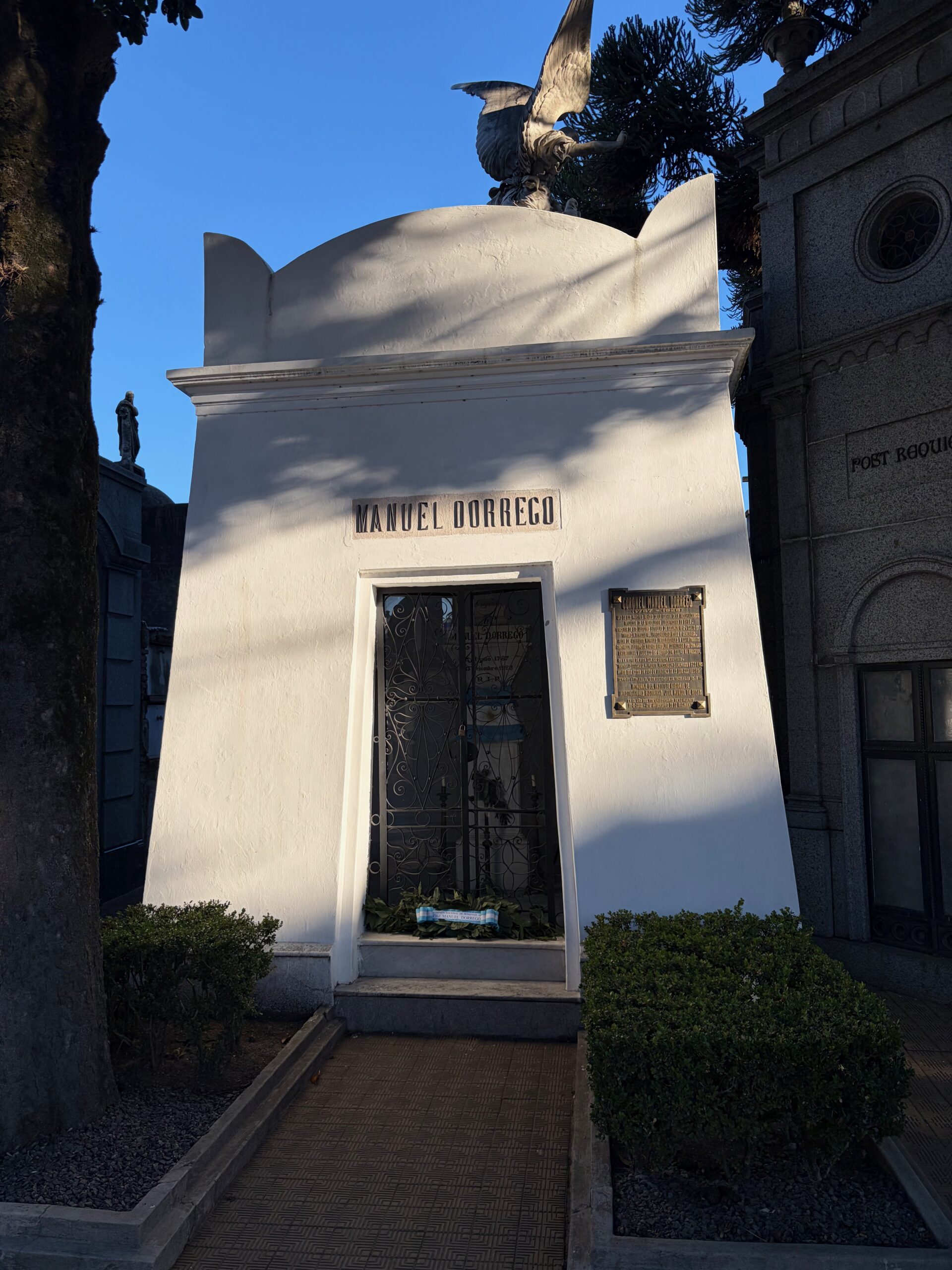
Born in 1787 in Buenos Aires, Argentina, Dorrego was the son of a Portuguese merchant and an Argentine woman. They had money and he grew up well. He went to the Colegio Nacional de Buenos Aires, which is the fancy high school there and still exists today. Then he go to go to college, even rarer at that time. That was at Real Universidad de San Felipe, which is in Santiago, in what is today Chile. He went there in 1810. That was the same year that many of the Spanish colonies in the Americas rose up to begin their revolution from the Spanish.
It can be a bit hard to look at the Latin American revolutions of this era today in the broader context of how we consider the global revolutionary past. Latin America of course plays a big role in that history, but it’s the 20th century revolutions that are remembered fondly by the left, whether successful movements such as in Cuba and Mexico or the many many defeats, such as of Augusto Sandino in Nicaragua, for example. The American Revolution is seen as a precursor to all of these revolutionary movements and it is, but its reputation has declined in this popular history in recent decades since it was mostly a bunch of rich slavers trying to protect their investments and ever liberal value had to be fought for. We are seeing this today with the complete indifference on the left and even among most everyday liberals to the 250th anniversary of the American Revolution, a very different world than 1976’s 200th anniversary. And that has very little to do with Trump, no one much cared even before he clown showed it on the National Mall.
Meanwhile, the Haitian Revolution has risen in our esteem because it was explicitly anti-slavery and because the Americans and French doomed post-revolutionary Haiti due to their racism and repression of any real freedom to protect their own racist interests. Part of the problem with the Latin American governments is that they were almost universally disastrous in the post-revolution period, divided by personality over ideology, with so many coups and executions and the causes, mostly around the liberal/conservative divide where neither fits in well with contemporary concerns, are so arcane.
Also since I am going with an Argentine for the 250th anniversary of the U.S., a bit of speculation is warranted.
Well, Dorrego was taken with the idea of independence of Spain. He left Chile and crossed back into what is today Argentina, going to the north and volunteering under Manuel Belgrano’s command in the Army of the North. Like a lot of the young officers involved in these independence movements, Dorrego was intensely protective of his pride and reputation. So after being in a couple of keep early battles against the Spanish at Tucúman and Salta, and in fact having wounds from both, he was involved in a duel and punished for that, though I think he was the second. Belgrano nearly kicked him out of the army for that. He thus was absent for some key battles and the independence army didn’t do so great in them.
Then Dorrego was opposed to the Argentine invasion of Uruguay and parts of Brazil between 1816 and 1820, which is basically where Uruguay is today. Juan Martín de Pueyrredón was named Supreme Leader of the United Provinces of the Rio de la Plata after the declaration of independence. José Gervasio Artigas was a big leader from Uruguay who threatened Argentine control. Pueyrredón wanted to make sure that Uruguay stayed in Argentina. Artigas wanted an independent nation. Dorrego thought this invasion was bad. So Pueyrredón had him exiled. Dorrego came to the U.S. for awhile and was in Baltimore, but got back to Argentina as soon as he could. That happened when Pueyrredón was evicted from office in 1819.
So Dorrego went back and under the new government and was briefly named governor of Buenos Aires. But BA was as divided as the rest of Argentina. He led armies against other factors in the city and was soon forced back into exile. This time it was what was then called Upper Peru, which is more or less Bolivia today. He met Simon Bolivar while visiting Quito and they agreed on the need to unite South America into one big empire. Quite a few people believed that, it’s just that they thought they should be the ones leading it and not these other people with similar beliefs who they hated and refused to submit to. You can see the problem.
Now, generally to the extent Dorrego had strong beliefs, they were on the more liberal side. He believed in a broader suffrage than some, though I think in part because he saw himself as something of a more popular leader than some of these other Argentine elites and felt it would help him if more could vote. So he came back to Buenos Aires by 1826 and won election to the assembly. He had already moved away from the Bolivarian belief in a unified strong central government, likely because he didn’t see it helping him personally at that time. So Argentina didn’t go in his direction. It created a constitution that had a stronger central government than the more federal system he wanted. It limited suffrage to a relatively few elites.
Bernardino Rivadavia became the nation’s first president. Not for very long–these South American presidents came and went like the wind because of the constant civil wars between the elites who, again, all hated each other. So he lasted about 18 months before being overthrown and replaced by Vincente Lopez, who himself lasted 6 weeks. Dorrego led the opposition to Rivadavia in action and in newspapers. So then for awhile Argentina had no president and Dorrego got himself back in as governor of Buenos Aires province.
Dorrego did have something of a populist mentality about him and he engaged in some actions that helped the poor. He also worked the end the war with Brazil that basically ensured Uruguay’s existence. But Dorrego also was pro-British. The British were not happy with what was going on in Latin America and were quite interested in recolonizing it. And don’t let North American nationalists feed you a bunch of hogwash–the U.S. had zero ability to enforce the Monroe Doctrine. In any case, because the British were involved in creating the treaty to end the war and Dorrego agreed to their conditions, the military was furious with him, thinking they could have won outright.
So the military took Dorrego out and shot him during the coup led by Juan Lavelle, who would then take over in Buenos Aires and last all of a few months, as per everyone else in this post. Dorrego was 41 years old.
You can see why one finds the history of Latin America in the 19th century a confusing miasma of people killing each other for reasons difficult to discern to the modern reader.
Manuel Dorrego is buried in Cementario de la Recoleta, Buenos Aires, Argentina.
Again, it’s July 4, so if you want this series to visit some of the founders of the United States, you can donate to cover the required expenses here. Say what you want about the U.S., but it held together a lot better than Argentina! Nathaniel Gorham is in Boston and Jared Ingersoll is in Philadelphia. Previous posts in this series are archived here and here.