
Erik Visits a (Non)-American Grave, Part 2,179
 By
By This is the grave of Stephen Hawking.
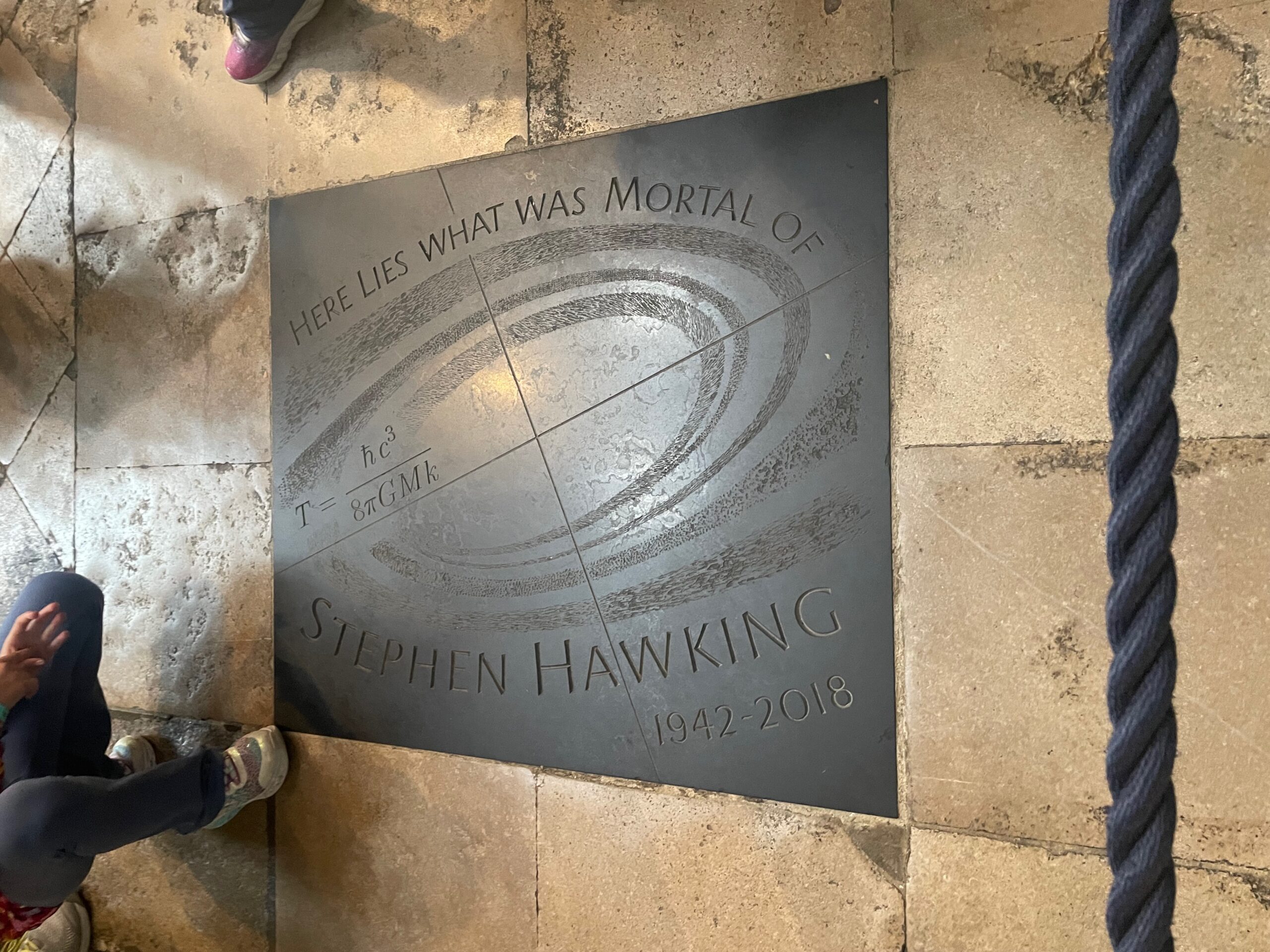
Born in 1942 in Oxford, England, Hawking grew up pretty well off. Most of the people in his family were doctors. His family were also seen as eccentrics. They had a lot of artistic friends, the house was usually a disaster in terms of cleanliness, they sent the kids to experimental schools, the kind of thing that wasn’t so common in the early Cold War. But his father was also an excellent scientist and that’s what Hawking wanted to be. He wasn’t very good at academics, largely because he was one of those kids who was too smart and everything was really easy. He wanted to be a mathematician, but his father wanted him to be a doctor. He ended up majoring in physics, graduating from University College, Oxford in 1962.
But in 1963, Hawking started having health problems. He was diagnosed with what is just about the worst disease on Earth–ALS. I lost a very good friend from ALS a couple of years ago and it was just horrible, really destroyed me and ALS is just common enough that a lot of people have run across 1 or 2 people in their lives that died from it. Usually ALS kills in a few years. But Hawking was the extremely rare exception to this norm. He seems to have taken it as a challenge and he embraced new technological ways to communicate. He did maintain control over one cheek muscle that allowed for communication to continue. It’s really an incredible story. He just didn’t die. Not for a very long time. In fact, he became one of the longest living people ever with ALS. He also didn’t let the horrors of what his life became get in the way of him living that life. He just plunged ahead with his science and his life. It’s really an inspiring story, though if I was to get ALS and I lived in the state with the option, I might very well choose assisted suicide once the disease progressed to a certain stage. I completely respect people’s opinions on this issue no matter what they choose.
Only if you are Stephen Hawking is the fact that you survived with ALS for more than a half-century not the most remarkable thing about your life. It takes being the most famous and one of the most important scientists since Albert Einstein. OK, now we face an issue–I do not really have the knowledge to describe Hawking’s contributions to science in a way that doesn’t make me look like a blundering uneducated fool. Which maybe I am. But since I am admitting this up front, I am just going to list a few things that he did and not worry about it too much and you all can expand on this in comments, correct me, make fun of me, it’s all good.
Hawking’s primary contribution to science is the development of what became known as Hawking radiation. In 1974, he developed a model that predicted that black holes would release radiation outside their event horizon. This countered previous ideas that electromagnetic radiation could not escape black holes. It’s pretty theoretical–current telescopes cannot actually pick this up, but most people believe it to be correct today. What this also predicts is that unless black holes can gain mass from somewhere else, this will eventually lead to enough mass loss that they will close and disappear and that they would lose more energy over time, eventually leading to a cataclysmic event. But no one has totally proven this yet because it’s never been picked up by humans and the available technology.
Hawking also worked with Roger Penrose on what became known as the Penrose–Hawking singularity theorems. This is way outside something I am likely to describe accurately, but it is evidently to do with something called gravitational singularity, a theoretical framework that would show a level of gravity so intense that spacetime itself breaks down and the entire ideas of what these things mean to human beings, at least at this point in our history, would be incomprehensible. Or maybe my discussion of this is incomprehensible, it’s all good. I just hope I’m not being quizzed on this. Penrose would receive the Nobel Prize in 2020 for this, but Hawking was already gone by then and somewhat to my surprise, never did win the Nobel.
Just generally, Hawking spent his life pushing forward the understanding of quantum mechanics around black holes. He brought forward the concept of the micro black hole. He pushed the “many-worlds interpretation” of quantum mechanics that claims universal wavefunction (whatever that is) is in fact real. OK then.
Other than just being one of the world’s leading physicists, Hawking also became a massive prophet of science education. Maybe I should take advantage of this and read some of his books. Though on the other hand, how much American history did he read? Knowledge goes in many ways. Anyway, his 1988 book A Brief History of Time was an enormous bestseller. He had the ability (perhaps with a lot of help from real writers, but whatever) to communicate the complexities of his scientific discoveries to a lay audience, including the theories of general relativity and quantum mechanics, as well as the attempts to find a unified theory to explain everything. The book sold tens of millions of copies and made Hawking a very rich man. Errol Morris made a documentary of it by the same name in 1991 and that I have no excuse not to watch.
Despite his health, Hawking was married most of his life. His first wife married him in 1965 and stayed with him for 30 years. It helped some that his ALS was very slow-acting and he was able to speak until the mid 70s, at least a little bit. Hawking was a strongly felt atheist, despite his condition. His wife did not feel the same way and was an avowed Christian who claimed that her faith helped her get through three decades of taking care of him. They did have arrangements where she had a lover on the side for some time. They also had three children using the glorious of contemporary technology. She finally had enough and divorced him in 1995. But then he remarried the same year and that lasted for over a decade until a subsequent divorce in 2006. There were some beliefs that his second wife physically abused him. Let’s hope that’s not true. He really hoped to be able to go to space and Richard Branson tried to make that happen for him. He got pretty close, but he didn’t quite make it to the era of commercial spaceflight, to the extent that it sort of exists today.
Hawking finally died in 2016. He was 76 years old.
Stephen Hawking is buried in Westminster Chapel, London, England.
If you would like this series to visit American physicists, you can donate to cover the required expenses here. Robert Millikan is in Glendale, California and Arthur Holly Compton is in Wooster, Ohio. Previous posts in this series are archived here and here.