
The Great Tolkien Reread: A Journey in the Dark, The Bridge of Khazad-Dûm
 By
By 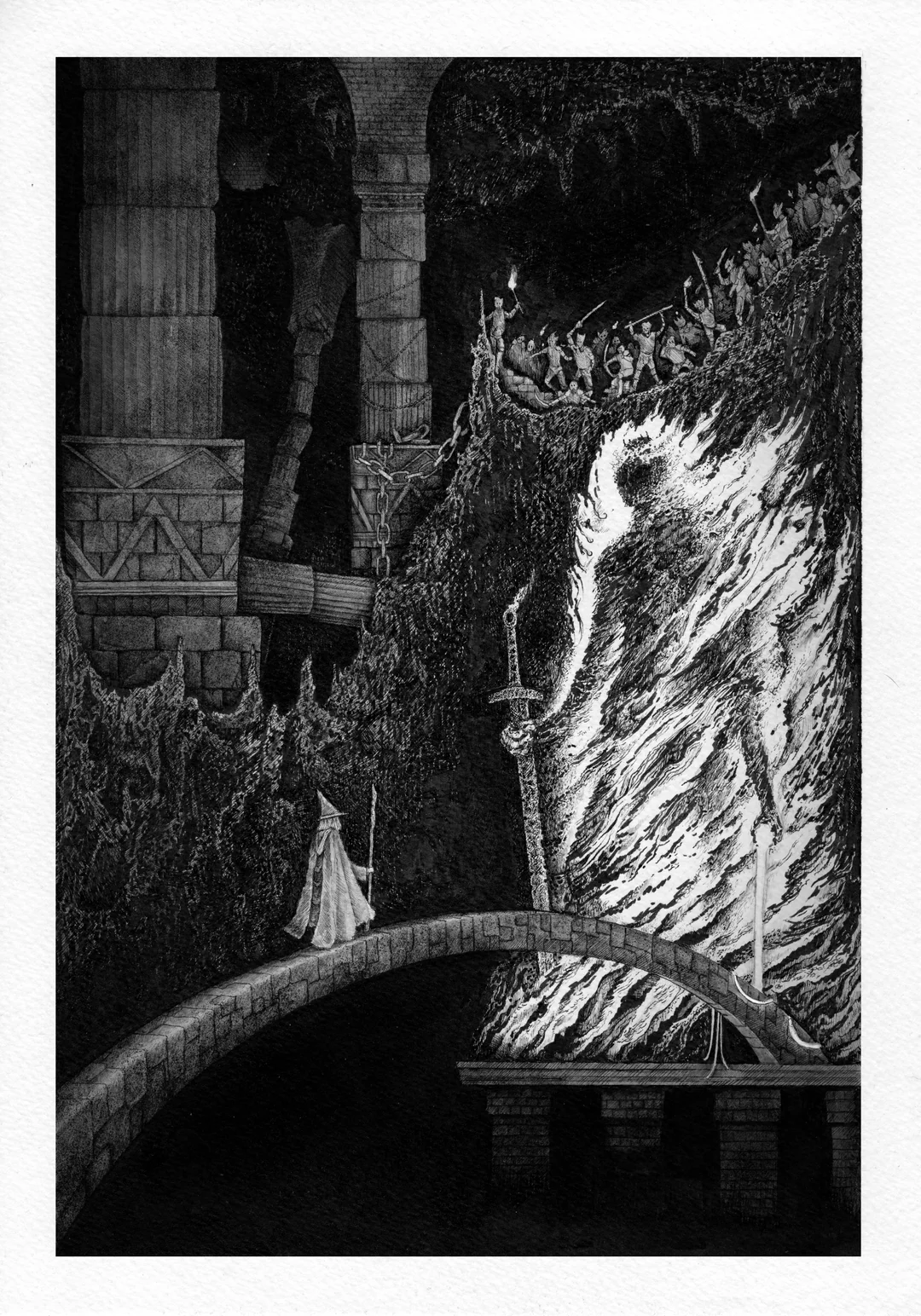
The last thing that Pippin saw, as sleep took him, was a dark glimpse of the old wizard huddled on the floor, shielding a glowing chip in his gnarled hands between his knees. The flicker for a moment showed his sharp nose, and the puff of smoke.
After failing to cross the mountains that separate them from Mordor, the fellowship of the Ring decide to go underground, through the lost dwarf city of Moria. Things do not go well. The discovery of the entrance to Moria, its dangerous traversal, the attack on the company by a large contingent of orcs and eventually a balrog, and the death (“death”? let’s say loss) of Gandalf are the climax of The Fellowship of the Ring, and one of the most exciting, memorable sequences in the whole novel. There’s much to talk about here, and as we’ve done in the past, we will divide our discussion into several topics.
***
There’s a commonplace about Tolkien that I first read on Teresa Nielsen Hayden’s Making Light, though I don’t know if it originated with her: Tolkien was a great worldbuilder, it goes, because he came up with a detailed history for his world going back thousands of years, comprising countless world-shattering events, and then only put about five percent of that backstory into his actual book. The implicit writing advice in this analysis is, I would say, pretty solid. As a young reader coming to the novel for the first time, many of the details in these chapters felt a bit on the opaque side to me. But because Middle Earth and its history were so well crafted in their author’s head, I was able to feel the lost grandeur of Moria, or the terror of the Balrog, without being buried in excessive detail about them.
Something happens, however, when you read this ancillary material (by which I mean mainly The Silmarillion) and then come back to The Lord of the Rings. It becomes clearer that this story is a post-apocalypse. That, perhaps no less than Jack Vance or Gene Wolfe, Tolkien has written a tale about moving through the ruined, sometimes corrupted remains of a lost civilization.
We have seen those ruins, and that corruption, already in Fellowship: the bare ring of stones that is all that remains of the North Kingdom watchtower of Amon Sûl; the wights who have infested the burial mounds of that kingdom’s dead kings. The journey in “A Journey in the Dark”, and the calamity at the end of “The Bridge of Khazad-Dûm”, are the fullest expression of this idea in the novel so far. Moria stands for everything that has been lost from Middle Earth in the millennia since the First Age. It is a reminder of a time when great cities like Gondolin and Eregion still stood, when the roads were safer and more frequently traveled, and when the nations of Middle Earth had regular, peaceful contact with one another. But it is also emblematic of the failures of those past ages. When the dwarfs delved “too greedily and too deep”, they called forth the evil that generations of elves and men before them had failed to defeat, and were consumed by it.
Middle Earth is a setting in which nostalgia is justified. Where the past truly was better, brighter, and more civilized than the present. What’s interesting about the sadness with which our heroes regard Moria’s glorious past, however, is how modest and homely the things they miss about it are. The Moria that we glimpse in “A Journey in the Dark” is grand, a gargantuan edifice and clearly a site of fantastic wealth (as the delightful reference to Bilbo owning, and then gifting Frodo, a mail shirt worth more than the whole of the Shire reveals). But what Gandalf and Gimli miss about it is that it represents a world where people could trust each other. Where you could write the password to the door of your underground city on the door itself, and trust that anyone calling themselves a friend really was one—”Quite simple. Too simple for a learned lore-master in these suspicious days. Those were happier times.”
“The world was young, the mountains green,” Gimli sings while trying to teach Sam about the lost glory of Moria during the reign of Durin I. “The world was fair in Durin’s day.” By the end of the song, however, the disappointing present creeps in—”The world is grey, the mountains old”. It is the hope of reclaiming that lost, fair world that fueled the dwarfs’ doomed effort to recolonize Moria, and which continues to underpin Gimli’s increasingly delusional belief that he will find in Moria a thriving colony of dwarfs under Balin’s leadership. Instead, what we find—in a thrillingly effective early example of environmental storytelling—is a narrative of failed hopes, of early success meeting an inevitable, crushing defeat.
‘It is grim reading,’ [Gandalf] said. ‘I fear their end was cruel. Listen! We cannot get out. We cannot get out. They have taken the Bridge and second hall. Frár and Lóni and Náli fell there. Then there are four lines smeared so that I can only read went 5 days ago. The last lines run the pool is up to the wall at Westgate. The Watcher in the Water took Óin. We cannot get out. The end comes, and then drums, drums in the deep. I wonder what that means. The last thing written is in a trailing scrawl of elf-letters: they are coming. There is nothing more.’
“I have looked on Moria, and it is very great, but it has become dark and dreadful”. This is the conclusion of Gimli’s hope for the redemption of his people’s lost city. By the end of The Lord of the Rings, we will see that this redemption is still possible. Gondor will be revitalized, and some of the peace and prosperity that existed in the days of Moria will return to Middle Earth. But in the journey through Moria, the horrors of the past, and the corrupted form of its leftovers in the present, remain inescapable.
***
Here’s a fun game to play if you happen to be reading along with this series. Make a note of every time Boromir speaks to express an opinion or offer advice about what the fellowship should do. Then observe how long it takes for one of the unambiguous heroes of this story—Elrond, Gandalf, Aragorn, or even Frodo—to tell him, with a greater or lesser degree of politeness, that he has no idea what he’s talking about and should shut his mouth.
Spoiler: it is almost always in the very next line. Especially in “A Journey in the Dark”, Boromir is wrong in every suggestion that he makes, and Gandalf and Aragorn are clearly increasingly frazzled by having to explain that no, going all the way around the Misty Mountains is not a feasible plan for multiple reasons. That he cannot force the company to avoid Moria simply by announcing that he will not go into it. That Gandalf is not a fool for bringing the fellowship to a door to which does not—yet!—know the password. Hell, they even take the time to disagree with him in rhyme.
‘Then let us start as soon as it is light tomorrow, if we can,’ said Boromir. ‘The wolf that one hears is worse than the orc that one fears.’
‘True!’ said Aragorn, loosening his sword in its sheath. ‘But where the warg howls, there also the orc prowls.’
This pattern will continue for the rest of Book Two, until it culminates with Boromir’s attempt to persuade Frodo to bring the Ring to Minas Tirith (an argument Frodo rejects because “it would seem like wisdom but for the warning in my heart”), and then his attempt to take it. It’s easy to forget this in light of the Jackson films’ more sympathetic take on the character, but Tolkien does not really want us to like Boromir. Even as he highlights the man’s strength, courage, and loyalty (like Aragorn, Boromir goes back for a probably-suicidal last stand with Gandalf against the balrog), he also takes care to constantly put him in the wrong.
There are a number of possible reasons for this choice. It might simply be that Tolkien, who knows writers who use subtext and thinks they’re all cowards, is preparing the reader for Boromir’s final wrong choice by having him suggest many other wrong ones before it. It may be setting up Faramir as the “good” brother, the one who, when faced with a course of action that seems like wisdom, instead heeds the warning of his heart and lets Frodo go on to Mordor. But I think the fact that so many of Boromir’s errors of judgment occur against the backdrop of the journey into and through Moria reveals the besetting flaw that Tolkien has given him, and which he particularly wants us to notice in these chapters. Alone among the members of the fellowship, Boromir does not care about the past.
Throughout the council of Elrond, Boromir listens with growing bewilderment, clearly not understanding what any of these old stories have to do with his, and his nation’s, present problems. His desire to use the Ring against Sauron is at least in part driven by a belief that his people are the exception to a rule that has held for thousands of years, and thus able to avoid being corrupted by it. On the journey south, he repeatedly flattens distinctions between very different things—”You speak of what you do not know, when you liken Moria to the stronghold of Sauron”, Gandalf says in “A Journey in the Dark”, and in future chapters Boromir will make similar errors when he refers to Galadriel as a witch, and to Lothlórien as a land of enchantment which travelers rarely escape.
The reason for this, it eventually becomes clear, is that Boromir does not see himself as part of the story of Middle Earth. The complex interactions of forces that came before him, the tangled histories that continue to ensnare people in the present day—such as Legolas and Gimli fixing to start a fight over which of their races caused the friendship between elves and dwarfs to fail—all of these feel immaterial to him. Unlike his brother and his father, he doesn’t care about lore and history, and doesn’t understand what relevance they have to the life of a warrior. There is a concrete problem to be solved, and as far as Boromir is concerned, the solution to that problem is to move forward and attack it, not look back.
In a pair of chapters in which, as we’ve already noted, the past has teeth, and a longing for it may prove fatal, the fact that Boromir’s refusal of the past is also treated negatively feels pointed. It’s Tolkien saying: this too is the wrong way to go about it. Some parts of the past may be irredeemable, but throwing the whole thing away will also lead to disaster. Just look at what happened to poor Boromir.
***
‘Do not be afraid!’ said Aragorn. There was a pause longer than usual, and Gandalf and Gimli were whispering together; the others were crowded behind, waiting anxiously. ‘Do not be afraid! I have been with him on many a journey, if never on one so dark; and there are tales of Rivendell of greater deeds of his than any that I have seen. He will not go astray—if there is any path to find. He has led us in here against our fears, but he will lead us out again, at whatever cost to himself. He is surer of finding the way home in a blind night than the cats of Queen Berúthiel.’
The final thing to be said about these two chapters is that they are—unsurprisingly—a Gandalf story from beginning to end. From deciding to travel through Moria, to finding and opening its gates, to discovering the path through it, to escaping the encounter with the balrog, Gandalf is essential to the fellowship’s survival and forward progress in these chapters. This naturally makes his death at the end of the “The Bridge of Khazad-Dûm” all the more shocking and destabilizing.
Even before they enter Moria, “A Journey in the Dark” gives us a sense of how much the company depends on Gandalf when they’re attacked by wargs after descending from Caradhras. Gandalf’s display of magic and force of will feels like a bookend to his squaring off against the balrog at the end of “The Bridge of Khazad-Dûm”. In both confrontations, he defeats the servants of the Enemy as much through the sheer force of his personality as through any act of magic.
Gandalf stood up and strode forward, holding his staff aloft. ‘Listen, Hound of Sauron!’ he cried. ‘Gandalf is here. Fly, if you value your foul skin! I will shrivel you from tail to snout, if you come within this ring!’
Part of the project of these chapters is to remind us (or, if we’re coming to The Lord of the Rings with nothing but The Hobbit in our background, to reveal to us) that Gandalf is a celestial being, whose corporeal form is a disguise obscuring his full majesty. At the same time, however, the final tale of Gandalf the Grey is also a story about Gandalf as a person, and a showcase for all his very human qualities. He is stubborn, insisting on going into Moria even after Aragorn foretells his death in its depths. He is irascible—”Fool of Took!” traces back to these chapters. And he is extremely, and a little unfairly, short with Boromir when the latter is dismayed to learn that he doesn’t actually know how to enter Moria.
‘Then what was the use of bringing us to this accursed spot?’ cried Boromir, glancing back with a shudder at the dark water. ‘You told us that you had once passed through the Mines. How could that be, if you did not know how to enter?’
‘The answer to your first question, Boromir,’ said the wizard, ‘is that I do not know the word—yet. But we shall see. And,’ he added, with a glint in his eyes under their bristling brows, ‘you may ask what is the use of my deeds when they are proved useless. As for your other question: do you doubt my tale? Or have you no wits left? I did not enter this way. I came from the East.’
On the other hand, these chapters also show us a kind Gandalf, who worries about Sam’s sorrow at having to leave Bill the pony behind in the wilderness, and who takes a moment to put a spell of protection on the animal before setting it loose. A Gandalf who can laugh at himself when he realizes that all his knowledge and words of command are not as much use as good hobbit sense and the ability to read a simple instruction. All these qualities come together in the fellowship’s final trial in Moria, when Gandalf reacts to the realization that he has led his friends into danger with profound arrogance, but also the iron-hard belief that it is only he who can save them.
‘They are coming!’ cried Legolas.
‘We cannot get out,’ said Gimli.
‘Trapped!’ cried Gandalf. ‘Why did I delay? Here we are, caught, just as they were before. But I was not here then. We will see what—’
The rest of the confrontation with the orcs and the balrog is, of course, the stuff of legend. But I think it’s important that before he shows us Gandalf the angel, in his final confrontation with a demon from hell, Tolkien reminds us that he is also Gandalf the man. That what the fellowship mourns and weeps for when they escape Moria isn’t just their leader, but their friend.
Next time: On July 14th, we will discuss “Lothlórien” and “The Mirror of Galadriel.” In which A Woman appears.