
Erik Visits an American Grave, Part 2,172
 By
By This is the grave of Oscar Handlin.
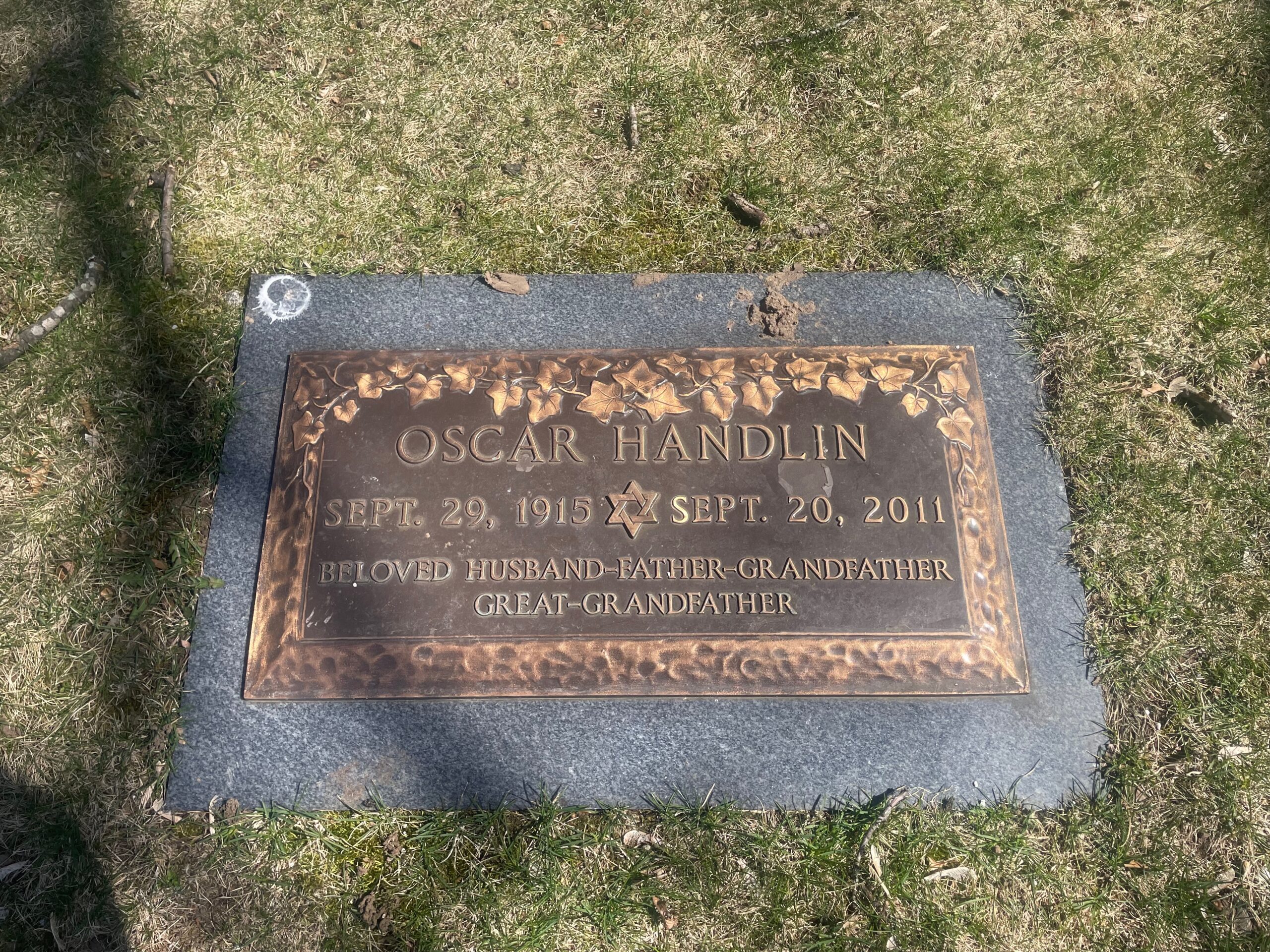
Born in 1915 in Brooklyn, Handlin grew up in a Jewish immigrant household. Both parents had come from Russia, but I think they met in the U.S. His mother was a garment worker and his father had been forced to fight in the Russo-Japanese War before leaving. They were intellectuals and they pushed that on their kids. If they weren’t communists, they were very close to it. Many of this generation of Jewish immigrants were determined to make a better world and they fought hard for it, in their union shops and in their communities and in the politics of their new nation. That’s how Handlin grew up.
Handlin was ridiculously smart and with a near-photographic memory. He started at Brooklyn College in 1930, only 15 years old. He finished in 1934 and then went to Harvard for a master’s degree in History. This was very early for places such as Harvard to accept Jews into its doctoral programs. There was still a ton of anti-Semitism in the universities. He went to Europe in the mid 30s, taught for a couple of years, and then returned to Harvard for his PhD. What made Handlin very different is that he wrote about immigrants. The U.S. had a long immigration history but this was not the kind of thing that historians of that generation wrote about. These elite WASPs generally didn’t much care for things such as immigration. It was more “proper” to write about diplomacy or how Reconstruction was a horror imposed upon the white race, you know, things that united whites at that time.
Handlin was different and not only because he was a New York Jew, but because he maintained that as the center of academic and personal belief system. So he wrote his dissertation, immediately turned into a book, titled Boston’s Immigrants, 1790-1865. This was a way to start writing about immigration that was perhaps less threatening to the powers that be. After all, he was mostly focusing on the Irish. But that didn’t mean he was really accepted at Harvard. Anti-Semitism was a favored form of discrimination among the American elite of that time and so they might begrudgingly accept Handlin as a colleague, but they weren’t going to treat him as an equal and so socially, he was pretty isolated and was denied access to leadership in clubs and the other things that rich Harvard people liked.
Handlin plugged away on his scholarship despite his colleagues’ treatment. He did a book with his wife Mary on the role of the government in the economy that was published in 1947, a more traditional type topic for the time. But in 1951, he put in immigration history on the map with The Uprooted; The Epic Story of the Great Migrations That Made the American People. Handlin made big claims here. He tried to reorient the field toward the understanding that what made the American history was not the frontier (Frederick Jackson Turner’s influence remained super strong at this time) but all the immigrants who came to the U.S. He’s right about that too. This book was very popular, it won the Pulitzer, and really it is one of the most impactful books in the entire study of American history, though I don’t think anyone really reads it today except as an artifact. But that’s how it is with all histories and that’s how it should be.
Handlin then wrote books such as Adventure in Freedom; 300 Years of Jewish Life in America, from 1954, Race and Nationality in American Life in 1957, and The Newcomers: Negroes and Puerto Ricans in a Changing Metropolis in 1959. Handlin worked hard. He published a lot–none of it as important as The Uprooted, but still. He also directed the Harvard Library from 1979-83. He was obsessed with the idea of America providing liberty, a concept with which I feel a lot of ambivalence.
But somewhere along the line, Handlin’s politics moved to the right. Like a number of Jewish intellectuals who had become anticommunist either before or after World War II, Handlin began to see communism as a greater threat to the world than American imperialism and interventionism. Now, you can certainly say that’s a fair argument. But the problem so often became that “communism” became “criticizing the US government from the left” and “not supporting blowing up Vietnam.” And so it was for Handlin. He hated HUAC and communism just about equally so he deserves some credit here for having principles and never becoming a hack. Also, very much to his credit, his testimony was key in the U.S. overturning its racist and exclusionary immigration laws extending back to 1924 and passing the 1965 Immigration Act that opened the nation up to Asians and Africans and Haitians and other groups long shut out.
Handlin was clearly moving right by the mid-60s. He was always more of a class over race guy when it came to slavery and so when he supported the civil rights movement, as any decent liberal did, he so strongly rejected the black nationalists and connecting the internal colonialism of the United States with what was going on in Algeria and South Africa that he sounded more sympathetic to establishment than to people fighting for their freedom. He went on to oppose affirmative action and busing. Again, “liberty” to him was an extremely individualistic thing and so group quotas meant its destruction.
Then when Vietnam came, he found the antiwar movement absolutely abhorrent. He thought the U.S. should have won and blamed the media and the left. He also came to loathe the new histories of the 70s, not so much in subject matter but in approach–women’s history, black history, social history, histories from below. It’s ironic because he started so much of it. But he thought it was faddish. And this is man who hated the new culture of the late 20th century. Seeing hippies really bugged him.
Now, Handlin really didn’t become a full-fledged neoconservative. This was written by one of our frequent commenters but I won’t say what his nym is, he can identify himself if he chooses. And I think this is fair–Handlin was a principled man and may not have ever actually identified as a conservative, as, say, Norman Podhoretz did. He did not really go into supporting American adventurism in the Middle East but remained pretty focused on what happened in Vietnam, which he could never get over. Kind of unfortunate that he could never see past this to understand what was really going on in Vietnam or why people weren’t wearing suits and ties to class anymore and taking birth control and stuff like that.
Handlin died in 2011. It was a heart attack. He was 95 years old.
Oscar Handlin is buried in Beth Israel Memorial Park, Waltham, Massachusetts. A note here: Often in the comments of grave posts, people say that this or that person is cremated or doesn’t have a grave or is buried here and there. Don’t take any of that too seriously. Both yesterday’s Joseph Berliner post and today’s post, from the same cemetery, are graves of people not listed online as being buried. And in fact, it was not to see either of these guys that I went to that cemetery. That was for someone not yet covered here.
If you would like this series to visit other American historians, you can donate to cover the required expenses here. Frederick Jackson Turner is in Madison, Wisconsin and David Potter is in Palo Alto, California. Previous posts in this series are archived here and here.