
Erik Visits an American Grave, Part 2,171
 By
By This is the grave of Joseph Berliner.
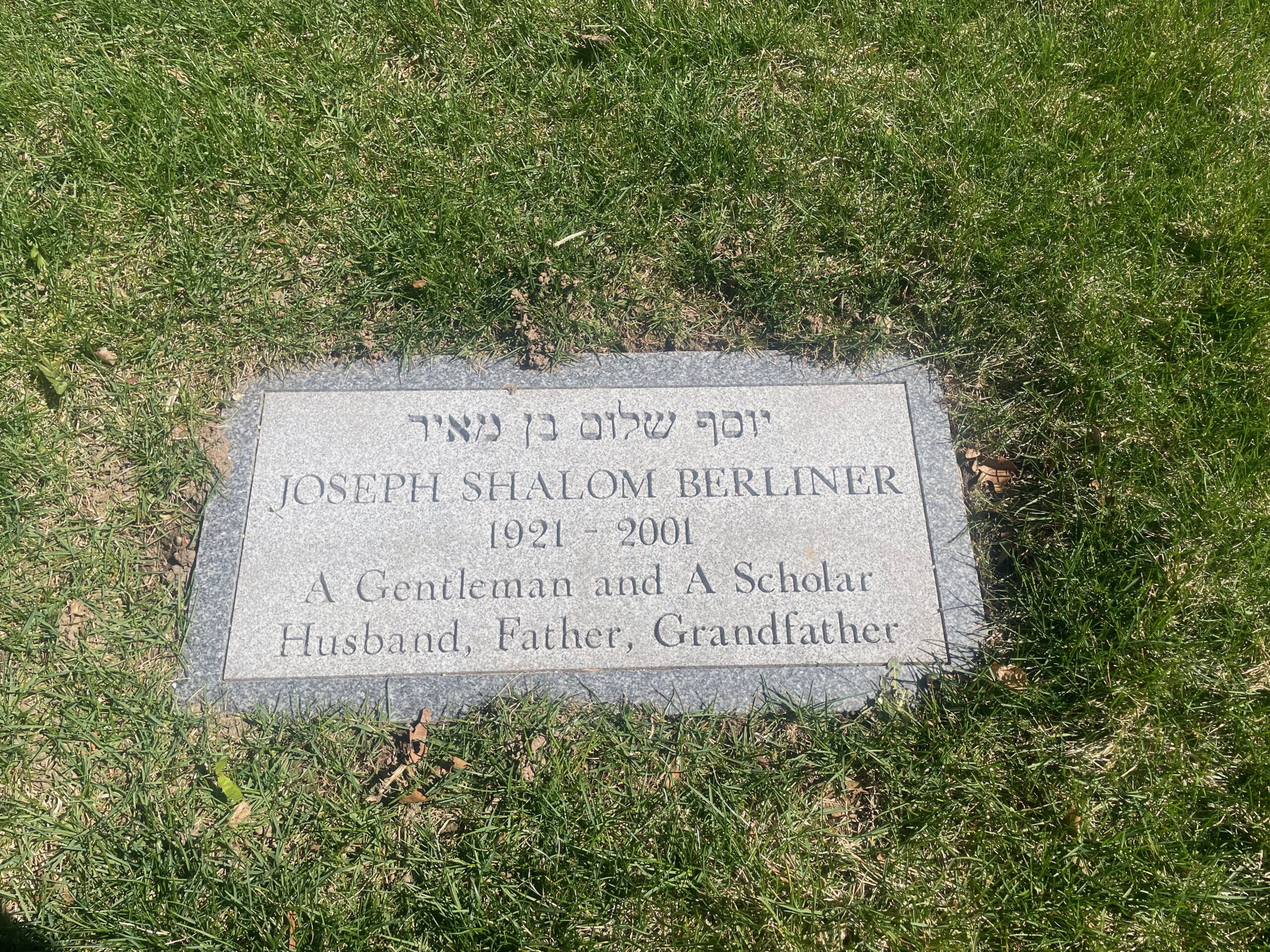
Born in 1921 in New York, Berliner grew up in Rockaway Beach, Queens. He was a very smart kid and got into Harvard, where he did a bachelor’s and then stayed on for the PhD. He became an economist, with a speciality in the Soviet Union. This was a period in which few Americans actually knew anything about the USSR. It took a long time for American scholars to get on board with actually learning about communist nations and then it took a lot longer for policymakers to care about what they had to say, which is how the U.S. ends up fighting in Korea and Vietnam despite having effectively zero knowledge about these places.
Berliner got early academic jobs at George Washington and then Syracuse. But he got to go back to Cambridge, where he continued to maintain a home or at least had places to crash since he was notably always there anyway when he could be. Not to Harvard, but to Brandeis, which I guess he could live with. He started teaching there in 1963. His 1957 book Factory and Manager in the U.S.S.R. was a very important addition to the limited literature on just how the Soviet economy worked. Notably, he wasn’t actually able to go to the USSR to do any research. So he went to West Germany for interviews with refugees. This was a kind of economic study that economists could use more of today–descriptive, with actual words and references to literature instead of just charts and graphs and equations that make their studies completely opaque. Other key books included 1976’s The Innovation Decision in Soviet Industry and 1988’s Soviet Industry from Stalin to Gorbachev.
But Berliner wasn’t just an academic. He was able to influence policy. In 1991, he was on a panel created by the House Permanent Select Committee on Intelligence to evaluate how the CIA understood the Soviet Union, to prepare for understanding Russia. Berliner was a leader of that committee, which found that the CIA wasn’t really terrible at understanding the Soviets, or at least not any worse than anyone else, but the agency’s unwillingness to engage with experts outside the agency hamstrung its ability to understand Soviet defense expenditures. These findings got the attention of policymakers and let to changes in how the CIA operated, which then led to more connections with academics and more serious work with international agencies who actually knew about these things, such as at the IMF and World Bank. So this was a not insignificant addition to American intelligence capabilities in the post-Cold War world.
I’d like to mention one thing about Berliner that I found when I was researching the guy. Actually, two things. First, he is almost totally unknown today. Although he had a New York Times obit and not that short of one, he doesn’t even have a Wikipedia page. Not that this matters all that much, but I found it notable given the kind of figures who do have them and how complete now that site can be even for some pretty obscure fields, much more than what Berliner worked in. But that’s not that interesting. More interesting is that when he died, remembrances of him include something so very rare in academia, especially among leading people in their fields–he was a really nice guy. There was something at Brandeis called the Berliner Effect. This was Joseph Berliner in a department meeting or college meeting that got contentious and him providing a calming presence in just a few words.
Berliner was president of the American Association for the Advancement of Slavic Studies in 1963 and then of the Association for Comparative Economic Studies in 1975. He was also deeply involved in a lot of the service work that a lot of these folks avoid–Fulbright committees, for example.
At the end of his life, Berliner was working at Harvard. He was at the Davis Center for Russian Studies there, as a research associate, which I think probably meant he was just affiliated with it and had an office and went to talks and things like that, the kind of thing that happens at elite schools. But he was still active. In 2001, he went in for some kind of surgery. There were complications and he didn’t make it. He was 79 years old.
Joseph Berliner is buried in Beth Israel Memorial Park, Waltham, Massachusetts.
If you would like this series to visit other scholars of the Cold War and Soviet Union, you can donate to cover the required expenses here. Thomas Bailey is in Palo Alto, California and Philip Edward Mosely is in Westfield, Massachusetts. Previous posts in this series are archived here and here.