
The Luddites: A True History
 By
By 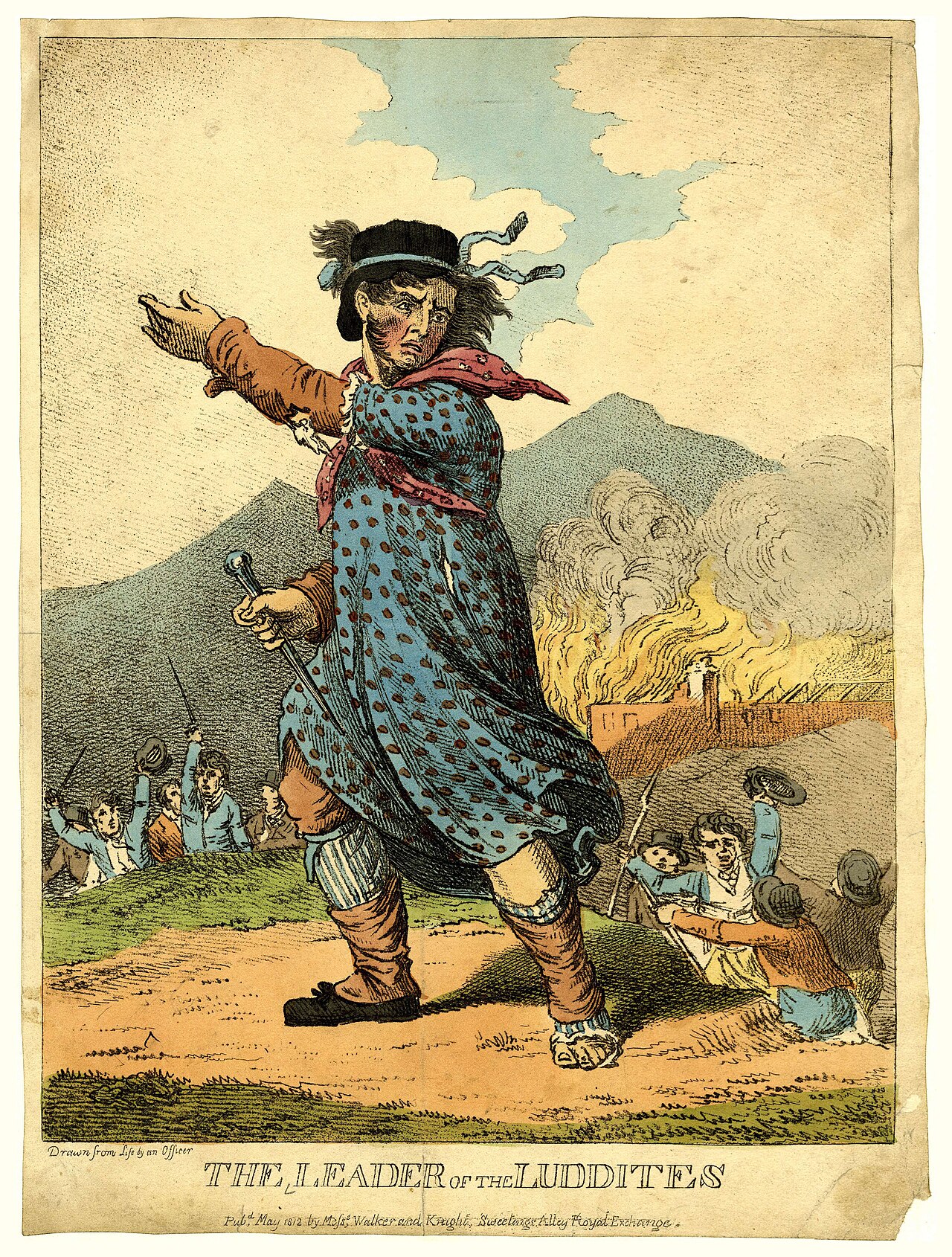
I get very angry when people use the term “Luddite” to describe anything that questions the technological futurism of our society, a futurism across the political spectrum. One big problem–the complete misunderstanding of the Luddites. Brian Merchant asks us to understand the Luddites, even more important now since anyone questioning the dominance of AI over our lives is a “Luddite” and wants to go live in a cave or something. An excerpt:
But the pundits and the chatbots all get it wrong: The real Luddites—the machine breakers who rose up at the dawn of the first Industrial Revolution to smash the looms and wide frames that factory owners were using to automate their labor—were not opposed to technology. They were opposed to the way technology was being used against them. That is, the Luddites objected to the industrialists who used machinery to depress wages, evade labor laws, and degrade the quality of products in order to profit at their expense.
It was, and remains, an eminently reasonable objection. The real Luddites were not know-nothing technophobes, despite their current reputation, and they certainly did not hate technology. In fact, many were technicians themselves, and understood better than most exactly how a technology would be used to exploit them. It was the rational and just thing to do, to object to the use of industrialist machinery to reshape their working lives and their communities.
Not only that, but their objections were informed, popular, and, for a time, effective. The Luddites organized a tactical rebellion that terrified elites and won the favor of the working class. People cheered them in the streets; hymns were sung about them in pubs. Lord Byron wrote poems about them. For a few years, they were more beloved than Robin Hood.
If we are to truly understand the impacts of mass automation technologies like AI, and why there’s a vociferous and fast-growing backlash to it, then it’s crucial that we rethink our dismissal of the Luddites. We must understand their actual history; why they turned to machine breaking and what they really fought for.
After all, we now sit on the precipice of a moment where backlash to a mass automation technology threatens to boil over again.
So who were the real Luddites? To understand them properly, we need a little background first.
After providing plenty of background, he follows by noting:
Ultimately, Luddism didn’t fizzle out because it was unpopular; it was crushed by the state. The Prince Regent’s government deployed thousands of troops to the industrial districts alight with Luddite activity. It was the biggest domestic occupation in British history. Parliament passed laws that made it a capital crime to break a machine, or to take secret oaths, essentially making being a Luddite a crime punishable by death. (Lord Byron made his first speech to the house of Lords in a thunderous defense of the Luddites, but was ignored by his peers, if not the public.)
As a result, scores of Luddites were hung by the state, and many others were killed in riots and raids as the factory owners grew emboldened to take up arms against them. Luddism died out by the end of the 1810s, but not before it helped to inspire Mary Shelley’s Frankenstein, a new generation of labor organizing, and paved the way for a raft of serious reforms like the overturning of the anti-union laws.
And yet, the Luddites today are still remembered as a punchline. As the cultural critic Theodore Rozak put it, “if the Luddites didn’t exist, their critics would have to invent them.” And to an extent, elites have done exactly this. By continually insisting that any criticism, objection, or resistance to commercial technologies are backwards looking, by linking objections to worker exploitation, antitrust violations, and surveillance to the Luddites, who dramatically lost their battle, they have turned a powerful working class movement with specific grievances about technological exploitation—and ideas about how to address it—into a caricature.
That caricature is the reason that Bernie Sanders’ ideas for regulating AI development, or pausing the breakneck data center expansion (an incredibly popular political proposition, by the way) gets him slapped with the term, derisively. Sanders himself felt compelled, as many do, to respond to the accusations in the defensive. He wrote, in an op-ed for Fox News, “Can AI and robotics help us in many ways? I am not a Luddite — I believe they can.” He argued that “we must make sure these new technologies benefit all of us, not just a handful of billionaires.”
But that’s exactly what the Luddites would have wanted. Sanders is a luddite, after all. Because the Luddites do not deserve derision; they deserve our empathy, even our admiration. They refused to “lay down and die” as the elites of the day might have hoped they would, and as the historian Frank Peel put it—and fought for workers’ rights despite everything.
What the Luddites fought for, after all, was ultimately pretty straightforward:
- Fair wages
- Checks on fraud and abuse
- A working life in which they maintained dignity and personal autonomy
- A seat at the table in deciding how technology would be used in their workplaces and communities
- To put down, not all machinery, but, as they put it in one of their most famous letter, “the machinery hurtful to commonality”
The Luddites were not against progress or anti-technology. They were against exploitation; they were anti-poverty.
Only when wages were pushed so low that workers could not feed their families, when the indignity of soulless factory work looked inevitable, when fraud and exploitation ran rampant, and they had exhausted every avenue to have their voices heard did the Luddites take up their hammer.
As for me, I’d say actually learning about these people instead of using them for bullshit narratives is a first good step. Plus they were mostly right.