
Erik Visits a (Non)-American Grave, Part 2,141
 By
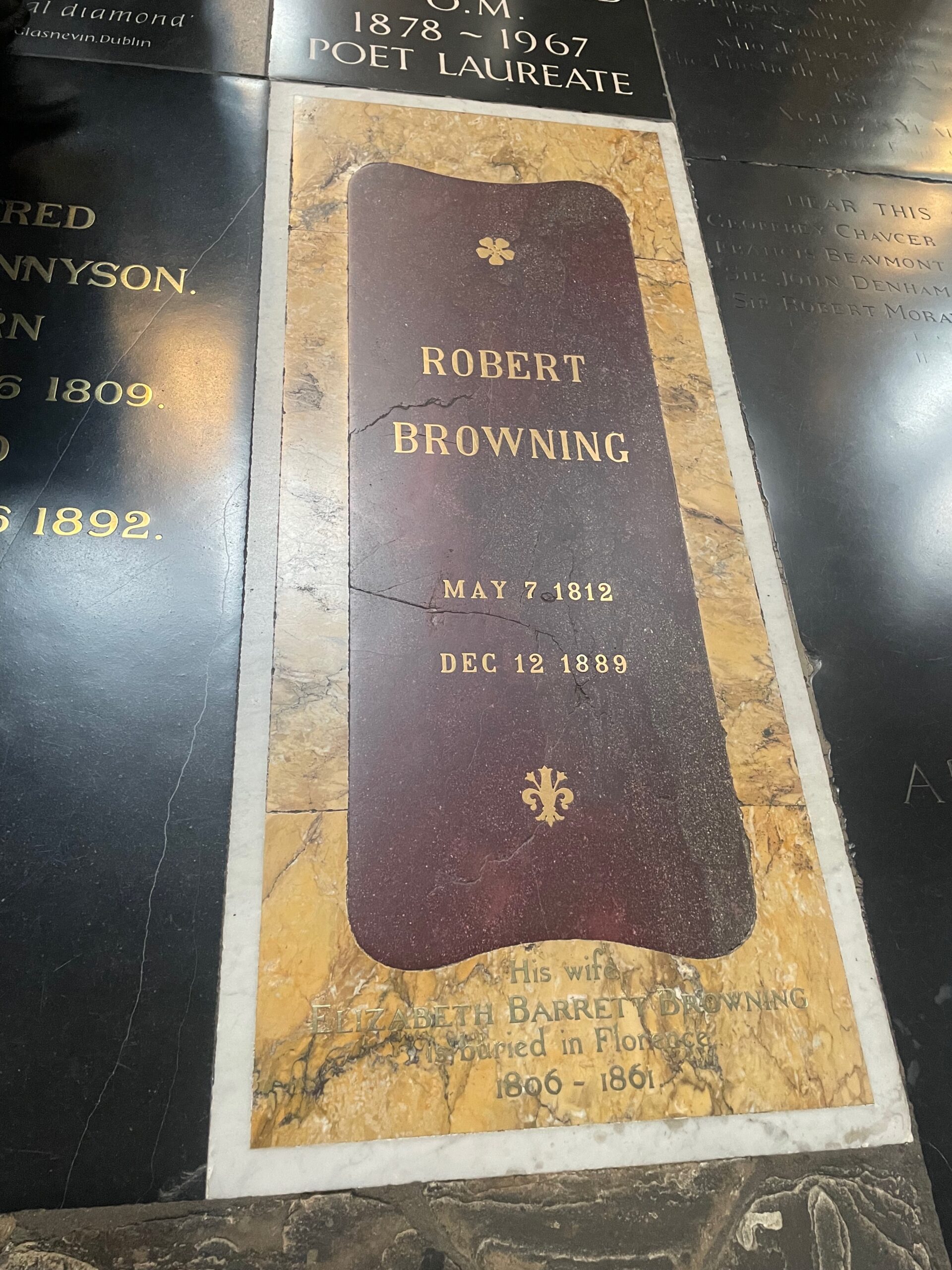
By This is the grave of Robert Browning.
Born in 1812 in Camberwell, Surrey, England, Robert Browning was one of the critical literary figures of 19th century England and one I think basically no one reads today. Let’s consider this a bit.
Browning came from good money; his father was a bank clerk but that is much more lucrative in that context than what you think it would be today when you visit Wells Fargo and his grandfather was a Caribbean landowner and slaver. The family had lots of books and art around and so it wasn’t surprising that young Browning started writing poetry. The 1820s was the decade when the romantic movement in art really started building as a rejection of the Enlightenment’s art and poetry would be a key part of this era. Because his parents were nonconformists, their children could not study at Oxford or Cambridge. Browning went to University College in London for a bit, but didn’t finish. He was pretty useless as supporting himself or having any kind of real job, so he lived at home until he was 34 years old, with his father paying to have his poems published.
Browning’s first major publication was in 1833, with “Pauline, a Fragment of a Confession.” He later disowned it and tried to bury it. In 1835, he published “Paracelsus,” a long five-part poem, after visiting St. Petersburg. This got him some attention. But not that much. Well into the 1840s, he was not a known figure. He published Sordello in 1840, filled with so many obscure references that even his fans more or less wrote him off.
What really changed Browning’s life was marrying the poet Elizabeth Barrett, who I have already covered in this series in a different country, definitely making this the first couple in the series who I have visited in different countries, in 1846. She was sickly already and would spend most of their marriage in Florence before dying in 1861. But she was a very big deal poet, one of the best in the country and one of the most beloved. She evidently taught him an awful lot, for after their marriage, the quality and the popularity of his work increased significantly. In 1853, he started writing Men and Women. Published in 1855, it wasn’t an immediate hit but it would soon be seen as one of the core poetry volumes of the era.
Like Barrett, Browning was a political liberal. He wrote widely against slavery, which given his family wealth was hardly inevitable. He supported women’s rights. He also supported animal rights. Perhaps most notably, he wrote strongly against anti-Semitism. He also, much to his credit, ranted against the rise of spiritualism, i.e., frauds and grifters claiming they could communicate with the dead, another big part of 19th century romanticism. Barrett probably influenced him on a lot of these politics as well, since she was well-known for her outspoken views.
After Barrett died in 1861, Browning moved back to London with their son. It was in the 1860s when Browning finally became one of the most popular English writers. The Ring and the Book was a ridiculously long poem published in 1868. Like 21,000 lines long. People loved it. It’s about a murder trial in Rome that includes the pope. Browning had spent so much time in Italy, so it was natural enough to write about it. It became one of the most read poems in the English language until the rise of modernism and after that almost no one has ever read it again. But at the time, it really was an enormous success that made Browning’s name and led to his being famous for the rest of his life.
Browning continued publishing after this, though perhaps nothing else was received with such overwhelming ardor as The Ring and the Book. Another his most popular works was 1873’s Red Cotton Night-Cap Country, another long poem about sexual intrigue and violence in France, through the critical reception was mixed, perhaps because it was a bit sordid for the Victorians.
In 1889, just before his death, Browning agreed to try a new technology. Rudolf Lehmann was a German-born author and painter who had access to one of the early Edison recording machines. So he asked Browning to record his voice into a wax cylinder. He agreed and read part of his 1845 poem, “How They Brought the Good News from Ghent to Aix.” This recording survives to the present. This is one of the first if not the very earliest recording of an author reading their own work.
Browning died in 1889 in Venice. He was 77 years old.
Let’s read a bit of Browning. This is part of “My Last Dutchess”:
ITALY AND FRANCE.
I.—ITALY.
That’s my last Duchess painted on the wall,
Looking as if she were alive; I call
That piece a wonder, now: Frà Pandolf’s hands
Worked busily a day, and there she stands.
Will’t please you sit and look at her? I said
“Frà Pandolf,” by design, for never read
Strangers like you that pictured countenance,
The depth and passion of its earnest glance,
But to myself they turned (since none puts by
The curtain I have drawn for you, but I)
And seemed as they would ask me, if they durst,
How such a glance came there; so not the first
Are you to turn and ask thus. Sir, ’twas not
Her husband’s presence only, called that spot
Of joy into the Duchess’ cheek: perhaps
Frà Pandolf chanced to say “Her mantle laps
“Over my Lady’s wrist too much,” or, “Paint
“Must never hope to reproduce the faint
“Half-flush that dies along her throat:” such stuff
Was courtesy, she thought, and cause enough
For calling up that spot of joy. She had
A heart . . how shall I say? . . too soon made glad,
Too easily impressed; she liked whate’er
She looked on, and her looks went everywhere.
Sir, ’twas all one! My favour at her breast,
The dropping of the daylight in the West,
The bough of cherries some officious fool
Broke in the orchard for her, the white mule
She rode with round the terrace—all and each
Would draw from her alike the approving speech,
Or blush, at least. She thanked men,—good; but thanked
Somehow . . I know not how . . as if she ranked
My gift of a nine hundred years old name
With anybody’s gift. Who’d stoop to blame
This sort of trifling? Even had you skill
In speech—(which I have not)—could make your will
Quite clear to such an one, and say, “Just this
“Or that in you disgusts me; here you miss,
“Or there exceed the mark”–and if she let
Herself be lessoned so, nor plainly set
Her wits to yours, forsooth, and made excuse,
—E’en that would be some stooping, and I chuse
Never to stoop. Oh, sir, she smiled, no doubt,
Whene’er I passed her; but who passed without
Much the same smile? This grew; I gave commands;
Then all smiles stopped together. There she stands
As if alive. Will’t please you rise? We’ll meet
The company below then. I repeat,
The Count your master’s known munificence
Is ample warrant that no just pretence
Of mine for dowry will be disallowed;
Though his fair daughter’s self, as I avowed
At starting, is my object. Nay, we’ll go
Together down, Sir! Notice Neptune, tho’,
Taming a sea-horse, thought a rarity,
Which Claus of Innsbruck cast in bronze for me.
I dunno, sure, whatever.
Robert Browning is buried in Westminster Abbey, London, England.
If you would like this series to visit 19th century American poets, you can donate to cover the required expenses here. Epes Sargent is buried in Boston and Daniel Decatur Emmett is in Mount Vernon, Ohio. Previous posts in this series are archived here and here.