
Erik Visits an American Grave, Part 2,095
 By
By This is the grave of Charles Bent.
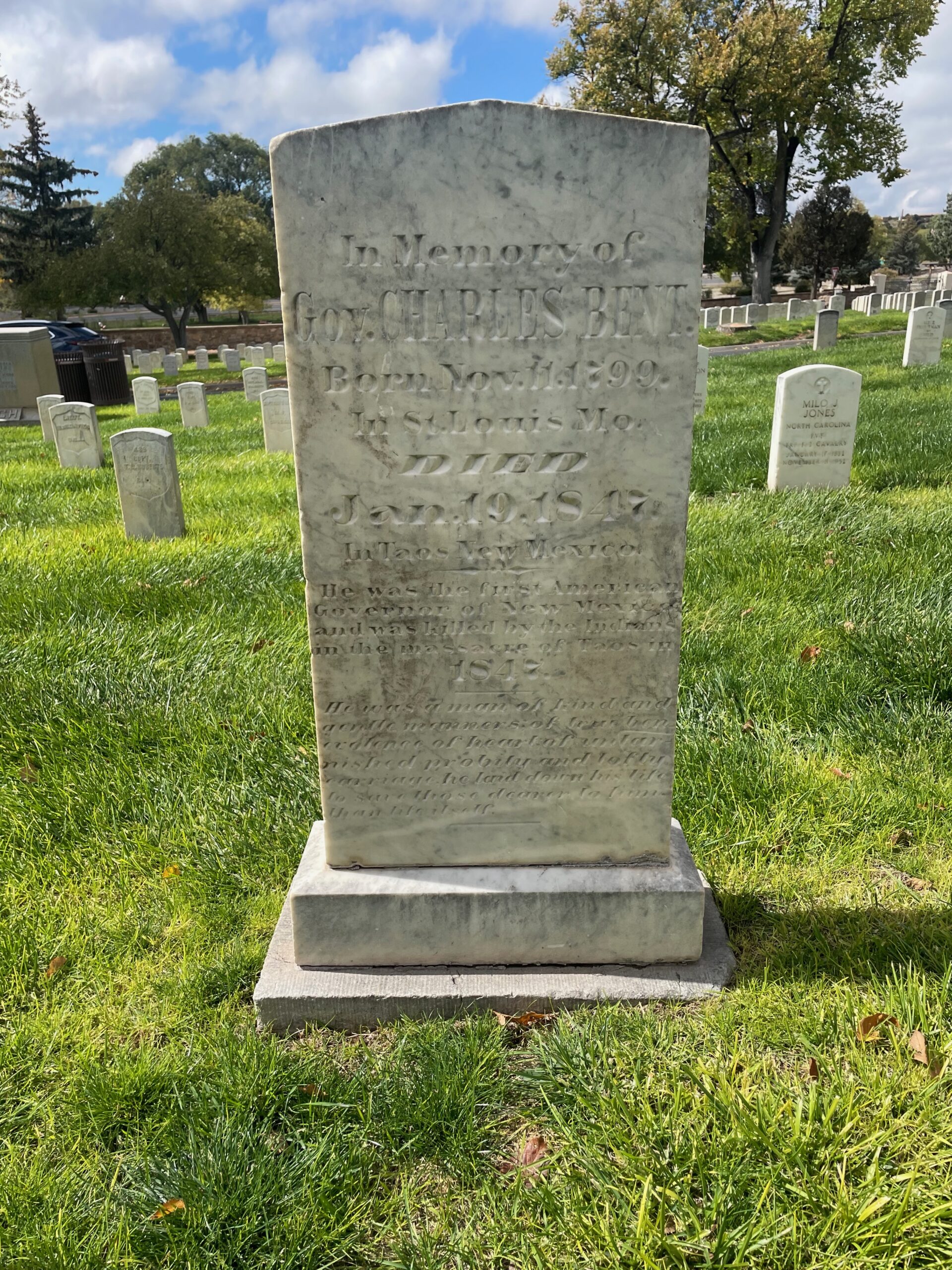
Born in 1799 in Charleston, now West Virginia, Bent was the son of a judge named Silas Bent. The family moved to Missouri after some time in Ohio. Basically, Bent Sr. was a frontier guy and constantly moving to new opportunities in the West. That became Missouri, which is where the frontier basically stalled out for a long time. Albert Gallatin had hired Bent to become surveyor-general of the Louisiana Purchase, to figure out just what the heck the U.S. had bought off the French. Silas became a state supreme court judge eventually.
So this was the milieu in which the Bent children grew up. Unsurprisingly, the romance of the frontier was taught to them. Both Charles and his brothers William felt it especially. In 1828, they decided to leave St. Louis to accompany a wagon train of traders to Santa Fe. Neither would ever spent too much time back in Missouri again. The Bent brothers became partners with Ceran St. Vrain, one of the French traders with the West based out of St. Louis. Bent became a king of fur trade. The new firm established forts across much of the American West. They had a big store in Taos, a center of trade due to its site on the border between the southern Rockies and the Great Plains. Bent’s Fort was a big adobe fort on the Arkansas River in what is today eastern Colorado. It’s a national park site now though you have to really want to get there since it’s between Pueblo and nowhere. Fort St. Vrain was built farther north, on the Platte River, not too far from modern Denver. Fort Adobe was another big fort the firm built, in the northern part of the contemporary Texas panhandle. From these forts, the Bents and St. Vrain would control the trade between the many tribes of the area, the growing number of Americans, the Mexicans, and whoever else showed up. These forts were cosmopolitan places, if not exactly sites of peace.
Bent was economically successful because he managed the massive trading zone of what is today the American West. The Plains tribes were providing bison robes. The Rockies tribes provided beaver and a few other furs. Now, this wasn’t long-term sustainable because the beaver especially was in rapid decline and the bison were starting to decline too. The idea that the tribes engaged in sustainable hunting is a complete myth, they were as open to overhunting the resource for short-term economic gain as any white, they just didn’t really have the capitalist system to do so. What Bent provided was a central location that people could go for trade and also a space of relative peace where rivalries were at least suspended while on site.
This all worked just fine under Mexican rule. In fact, the distance of Mexico City served basically everyone involved in this region just fine, white American, French, Mexican, Comanche, Pueblo, whoever. Bent was successful. The Santa Fe Trail became their lifeline, bringing goods to and from Missouri. Sometimes Bent would accompany these trains, but usually, he hired people to do this so he could stay on the ground in New Mexico. He also was a slaver, buying two black people to work at Bent’s Fort, a couple who were also married, at least as much as the laws allowed them to be. They were under Bent for his whole adult life and the Bents had forced to come into the wilderness with them. It’s worth noting that our westward expansion also included the forced labor of black Americans and one wonders how frightened you’d be to have no desire to go into the middle of nowhere (and I have no idea if the slaves felt this way, but presumably they very well might have) but you have no choice in the matter.
But then in 1846 James Polk decided to steal half of Mexico to expand slavery. Santa Fe was the most known place to Americans in northern Mexico. So the troops quickly marched in. The Mexicans had no ability to all to stop them, even if they sloweed the Americans down significantly when they marched on Mexico City. But the arrival of the Americans made a lot of people in New Mexico angry. It was obvious the Americans intended to rule much more harshly than the Mexicans did. This was a place where the languages of the day were Spanish and the different languages the various tribes used to communicate. English was secondary. This felt like a foreign occupation, which of course it was.
All this meant that a lot of people in Taos who had a long life of experience with Bent began not to trust him. Meanwhile, Bent was named governor-general of New Mexico by Stephen Kearny, who was leading the American forces in that part of northern Mexico, since he was their top agent on the ground. So Bent became the symbol of the occupation. It didn’t help that while Bent got along with the tribes just fine, he basically hated Mexicans, though he had married a wealthy Mexican widow named Maria Jaramillo. The Mexicans didn’t like him either. They believed that he was plying the Indians with liquor to take advantage of them and to incentivize their stealing of farm animals that they could sell to him. That was probably true, he didn’t care where the animals came from. So they started plotting to get rid of him. You had to resist somehow. What did Americans expect the Mexicans to do? The answer is that they didn’t respect the Mexicans enough to even consider the question. There was an initial conspiracy to attack Bent and Sterling Price, the lead military officer based in Taos. It was found out. Several leaders were arrested.
But not everyone involved with this plot was discovered. They quickly reorganized since there was so much hostility to the American occupation. So in January 1847, a combination of Hispano and Pueblo people rose up in what became known as the Taos Revolt. This started when Bent traveled from Santa Fe to Taos without a military escort. He was captured upon his arrival in Taos. Some of the Puelobans scalped and killed him. Evidently, he was scalped while still alive. Bent was 47 years old.
In the aftermath, Bent’s male slave joined the military effort to put down the Taos Revolt, which succeeded in July. For that, the slaves was freed. He and his wife got out of New Mexico very quickly and went back to Missouri, where they died a few years later.
Charles Bent is buried in Santa Fe National Cemetery, Santa Fe, New Mexico.
If you would like this series to visit other Americans involved in the white conquest of the West, you can donate to cover the required expenses here. John Bidwell is in Chico, California and Benjamin Louis Bonneville is in St. Louis. Previous posts in this series are archived here and here.