
A Possible Design for Burevestnik
 By
By
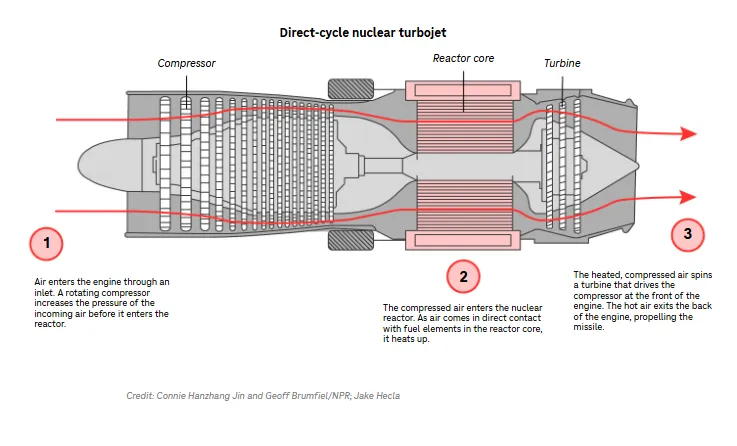
Ever since Vladimir Putin announced a nuclear-powered cruise missile, some of us have been trying to figure out how that might work. I drew on my experience* with people working on the Rover reactor for exoatmospheric rocket propulsion to suggest that a direct drive, in which gas flows through the reactor to be heated for propulsion was more likely than something weighed down with a heat exchanger. The model for that had been Project Pluto, which envisioned a ramjet driven by the Tory reactor. It didn’t work.
Additionally, the direct drive exposed the fuel elements to air, which would spread radioactive contaminants as it flew. This was exaggerated into “Flying Chernobyl.” The fuel elements for the Tory reactor were ceramic and were eroded. The thing would leak radionuclides, but not to the extent suggested by that name. More about this later.
Now Jake Hecla and Scott Kemp at MIT have done a detailed study to figure out how such a nuclear-powered cruise missile might be built. Geoff Brumfiel has summarized it nicely in a Bluesky thread and NPR article.
This design avoids the problems of a ramjet by using a turbine and is subsonic. It was developed from open literature about Russian tests and is a plausible representation of what the Burevestnik design might be, not that design itself.
The reactor design has similarities to Tory, Rover, and other earlier reactors. The power required, the space constraints, and heating a gas for propulsion severely limit possible options. Hecla and Kemp have gone so far as to suggest the makeup of the fuel elements. Control is not be neutron-absorbing rods internal to the reactor, but by rotating neutron reflectors around the perimeter.. The article contains many useful diagrams, including one of the reactor with reflectors.
Hecla and Kemp also estimate the radioactive trail that such a missile would leave and conclude that through three sources – activated air, activated structural material released by erosion, and fission products escaping from the fuel. The activated air and gaseous fission products would be produced under all circumstances.
Overall, these results suggest that atmospheric air activation alone would provide a substantial and persistent signature for a Burevestnik-like nuclear propulsion system.
They conclude that this is a “prestige weapons system,” something for the Russians to show off and perhaps cause fear in their adversaries. The subsonic speed makes it relatively easy to shoot down, and the capability touted by Putin to fly for many hours is of questionable value. Whether or not Burevestnik has flown, I’ll continue my suggestion that it’s a boondoggle sold to Putin in the same way Star Wars was sold to Ronald Reagan by Edward Teller.
The Russians have claimed to have built and tested the concept but have provided little confirmatory information. In the most recent test last fall, Putin claimed that the missile flew for 14 hours but offered no details. The Norwegian intelligence services confirmed to RFE/RL that something had flown, but no details were given. US “sniffer” planes were deployed for the test, but no radionuclides were reported to have been detected. Nor did universities or other monitors report radionuclides. With such slender public evidence, it’s hard to say much about the test.
The one unambiguous test of something that could have been Burevestnik ended in tragedy in 2019, when the reactor came down in a lake. During recovery, the reactor went critical and killed seven people on the project. That criticality was probably from the reflector controls sliding into position.
Hecla and Kemp have done a thorough job of developing a possible design and evaluating its plausibility. It looks like there is a path to Putin’s Burevestnik. The utility of such a weapon, however, is unlikely to match its cost.
It seems to me that much of the discussion assumes far too much success on far too little evidence. I have seen the MIT paper referred to as “the Burevestnik design,” and much discussion assumes that last fall’s test was definitive. I am pleased to see that the turbine design gives plausibility that the ramjet did not, but I’d like to see some photos and much more about the tests before I decide it’s a done deal.
*There are many more articles at Nuclear Diner, if you search there for “Burevestnik.” Most of this was before I came to Lawyers, Guns & Money.
Cross-posted to Nuclear Diner