Rare Notable Exceptions
 By
By 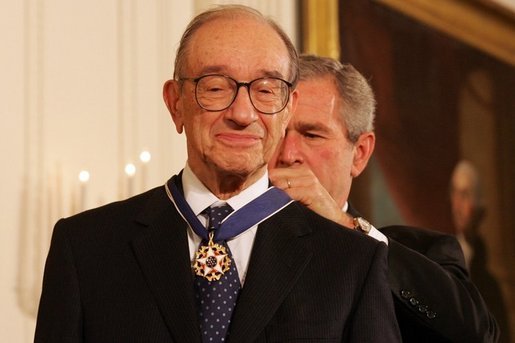
President George W. Bush presents the Presidential Medal of Freedom to Federal Reserve Chairman Alan Greenspan, one of 14 recipients of the 2005 Presidential Medal of Freedom, awarded Wednesday, Nov. 9, 2005 in the East Room of the Whiite House. White House photo by Shealah Craighead
Alan Greenspan, iconic economist of the New Gilded Age and capitalist extremist who made the world worse for his ideological running of the economy, is dead at the age of 100. With rare notable exceptions, Alan Greenspan was a horrible economist who made the nation and world worse through his obsession with Randian quackery.
Born in 1926 in New York, Greenspan grew up in a well-off Jewish household. His parents divorced, but both were decently wealthy. His father was a stockbroker on Wall Street. Young Alan was a talented musician who actually played clarinet and saxophone with Stan Getz and went to Juilliard for a year. He was also in a band with Leonard Garment, who would later become famous as Richard Nixon’s lead attorney in Watergate. Quite a band there. Unfortunately, he did not continue in career of jazz, where he might have actually added something to the human story. Instead, he went into the financial world where he became a monster. In 1945, he started at New York University, majoring in Economics. He graduated in 1948 and then got a master’s degree from the same institution in 1950. He initially started a Ph.D. program at Columbia in 1950, but dropped out because he was already rising in the financial industry.
While at NYU, Greenspan became close with Eugene Banks, who was a leader at Brown Brothers Harriman, one of the big New York banking firms. Banks brought him on board in the research department while he was still an undergraduate. In 1948, while still working on his master’s degree, Greenspan became an analyst at the National Industrial Conference Board, the big research agency for Wall Street.
It was during the early 1950s that Alan Greenspan fell for the worst author to ever write in the English language: Ayn Rand. He was very briefly married to a woman named Joan Mitchell, who despite getting an annulment within a year, introduced Greenspan to Rand’s writings. Worst. Marriage. Ever. He became a fervent Randist, quite literally worshipping at her feet. He was such an insider that he was one of the group that got to read drafts of Atlas Shrugged while they were being written. That he and the others didn’t read this drivel and immediately flee in horror from the morally bankrupt cheap philosophy, the clunky prose, and the absurd attempts at character development demonstrates both the poor taste and the power of pure selfishness reified into religion by people such as Greenspan.
Soon one of the leading Objectivists, Greenspan contributed essays to Rand’s books, including one supporting the gold standard, which should have permanently barred him from Washington circles, but of course did not. Greenspan became one of the leading prophets of Rand’s ideology, including offering a public ten-lecture course called “The Economics of a Free Society,” in the mid 1960s. All of this talked about the horrors of government intervention in the economy, how social programs destroyed freedom, and how any kind of collective economic response to crises simply made it worse. That one could have lived through the Great Depression and how the New Deal responded to it and think this is completely mindblowing to me. But then I guess I just don’t get the great thinker Rand.
The other thing to note about Rand is that she ran what was effectively a sex cult. Now, I don’t particularly care who has sex with who. It’s unclear whether Greenspan and Rand ever had sex. In this, it’s certainly no different than any other number of cults in American history, from those Second Great Awakening to NXIVM. What makes this sex cult different is that its other cultish beliefs—its economic system—only managed to do tremendous damage around the world. It so appealed to the brain of people who think like they did when they were 6 years old—MINE MINE MINE!!!—that it soon reached the highest echelons of American and thus global financial power. And no member of Rand’s cult would become more powerful in these circles than Alan Greenspan. Greenspan didn’t marry again for many years, preferring the life of the bachelor. But the FBI, when Nixon named him to his Council of Economic Advisers, couldn’t understand this so in their background investigation, they interviewed his former wife, now remarried to another Randian insider, to make sure he wasn’t a homosexual.
Because he was now not only a leading economist, but also a right-wing ideologue, he became perfect for the Republican Party. Richard Nixon brought him to Washington. He was a Nixon loyalist, helping to crunch polling data with computers, which of course was a new thing in 1968. Greenspan played a key role in ending the peacetime draft, claiming that it was a violation of individual liberty. Whether that’s really true or not or whether the all-volunteer army has been a generally positive thing is up for debate, but certainly it helped move the nation beyond the Vietnam War so that’s something in his favor. Nixon promoted him to the Council of Economic Advisors in 1974. After Watergate, Greenspan went back to Wall Street, but not for long. During these years, Greenspan was still working closely with Rand. In her book of essays, Capitalism: The Unknown Ideal (eyeroll), Greenspan got three chapters for himself, In one, he wrote,
“It is precisely the “greed” of the businessman or, more appropriately, his profit-seeking, which is the unexcelled protector of the consumer.… Reputation, in an unregulated economy, is thus a major competitive tool. Builders who have acquired a reputation for top quality construction take the market away from their less scrupulous or less conscientious competitors. The most reputable securities dealers get the bulk of the commission business.”
This of course was part of the Randian cult. It wasn’t just a system of capitalism. It was that the greedier the capitalist, the more moral the capitalist, so long as they worked in some nonexistent world where this wasn’t based on corruption, where you want to college, who you knew, and all the corners you cut. This wasn’t any different though than the ridiculousness of Andrew Carnegie and John D. Rockefeller who talked in similar ways in the initial Gospel of Wealth era, but then in fact built their empires through the worst corruption imaginable. He never changed his opinion of his hero either, telling Christopher Hitchens about his relationship with Rand, “And I wouldn’t change anything. I still think she was right, and I have learned a great deal from her.” That right there is disqualifying. Or should have been. And when he told a union leader at a 1974 White House economic summit that the real people who suffered from inflation were the rich because they lost more “percentage-wise,” well, he was just showing the results of his cult of the one true religion.
Gerald Ford named Greenspan his chief economic adviser. To be fair, I guess, Greenspan wasn’t the craziest economist gaining power during the Ford years. For instance, he, as did most economists including even Milton Friedman, completely dismissed Arthur Laffer’s ridiculous supply side economics as idiotic, saying “I don’t know anyone who seriously believes his argument.” But let’s not overstate Greenspan here. He was a major architect of applying shock doctrine economics to the United States by completely giving up on any sort of full employment economy in order to reduce inflation. Bubbling about the possibility of the possibility of increased unemployment through bringing about a recession, Greenspan stated “if adhered to, it would be the most important change in monetary policy in a generation.”
In 1980, Greenspan was part of the coterie of Ford advisors trying to get the ex-president on the ticket with Reagan, but as the VP. The idea was that Kissinger would return as Secretary of State and Greenspan would become Secretary of the Treasury. Well, that didn’t happen and Greenspan did not become Reagan’s choice at Treasury. But Greenspan did become a close advisor to Reagan during the election, writing many of his economic speeches. Moreover, Greenspan was moving even farther right on economics, increasingly embracing the supply side economics of Laffer that he had rejected just a few years ago, because Reagan believed in them and Greenspan wanted to be at the center of power in the Republican Party.
Greenspan himself was hardly above a bit of corruption himself. In 1985, he was Charles Keating’s frontman in Washington and Sacramento. He testified before the California legislature about the soundness of Keating’s enterprises. For this, he got tens of thousands in payment. Whoops!
So then it was hardly surprising then when the monster named Ronald Reagan named the monster named Alan Greenspan to replace Paul Volcker as chairman of the Federal Reserve. Now, we had a hardcore Randian in charge of our economy. As Fed Chair, he responded to the 1987 stock market crisis and the economic shakiness that followed through his actions later known as the “Greenspan Put.” This was a series of moves intended to bolster the market by establishing the principle that when the grifters and cheaters on Wall Street blew up the market, the Fed would use its monetary tools to back them up. This included the Fed purchasing Treasury bonds in order to give Wall Street profits and free up capital on their balance sheets, lowering the Fed Funds rate, even into negative territory, to make borrowing cheap; and providing investment firms repurchase agreements to buy distressed assets.
While possibly this made sense at the time (though George H.W. Bush did partly blame Greenspan’s slowness to act for his loss in 1992), it also established the principle that the bankers would not face any consequences for their reckless and often criminal actions because Daddy Alan would bail them out. This led to concrete changes in how the banks operated and directly to the irresponsible and criminal behavior of the banks leading up to the 2008 financial collapse because they all believed that in the end, the Fed would bail them out and so why worry. The moral hazard of these actions was something Greenspan never seem to calculate because, well, why would a Randian believe in morals? This has created a scenario where the Fed keeps bailing banks out for bad behavior but then never makes any meaningful changes to prevent them from taking such actions in the future because Wall Street lobbies so effectively and because there’s a revolving door between the Fed and Wall Street.
So yes, Greenspan is a huge reason why the 2008 financial collapse happened. And yet he remained a Serious Person in the Beltway until the end of his life. Of course, some of this is that he was the consummate Washington insider, having married another consummate Washington insider, Andrea Mitchell, in 1997. The media was never going to go after St. Greenspan with that kind of insider love. But it was not like 2008 was the first time that liberals pointed out that Greenspan was a worthless hack. In 2001, his laughable approval of the Bush tax cuts by claiming the nation would pay down the national debt too quickly was a great height in all-time hackdom. Nothing like changing your position around tax cuts to promote your preferred political candidate. But what was Greenspan but a total hack? And we cannot overestimate the power he had. As Christopher Hitchens’ Vanity Fair profile from 2000 accurately put it:
“And therefore, since most of foreign policy is now driven by economics, and most wars are fought largely by economic means, he disposes of more power than any 12 heads of government of any remotely comparable countries. He can’t on his own initiative reach for the thermonuclear button, but then, outside the realm of Hollywood, neither can the president. He doesn’t have to waste any time at ceremonial events. He is obliged to report to Congress only twice a year, at formal occasions where he is received with the deference that was once accorded the Emperor of Japan. Fantasies about the mystical capacities of Greenspan are legion: one of the many whole-cloth journalistic inventions by The New Republic’s Stephen Glass (before he was caught) concerned a Wall Street investment house which kept an empty office as a Greenspan “shrine,” complete with fetishes and relics and memorabilia. Putative brokers were quoted, saying that they actually prayed to Greenspan and used a software program known as “The Talmud of the Federal Reserve.” The article escaped exposure because, after all, it might have been true. And Greenspan has achieved name recognition of a kind. No less a person than the used-and-scorned Gennifer Flowers once told Larry King, “I think truly that credit should go to Alan Greenspan . . . this was already in place before Bill—the upswing of the economy.”
This is all totally nuts. But this was the power this Randian cultist had in our society and thus over the entire world. During the debates in 2000, George W. Bush and Al Gore competed to brag who was more of a Greenspan acolyte. Economic policy in the early 2000s was so dominated by Greenspan and other Randians and neoliberals that there simply were no good alternatives for a voter anywhere in the mainstream Democratic Party. Maybe a Tom Harkin and a Bernie Sanders were screaming about this, but they weren’t Serious People.
And then 2008 happened and the entire mainstream economics/media/elite world just shrugged their shoulders and wondered how such a perfect system could fail. After all, it’s not as if they were underwater in their now worthless houses. Of course, Greenspan held a ton of responsibility for what was to come. It was his obsession with keeping the federal funds rate so low that gave the mortgage industry the raw material for the housing bubble. His associates at the Federal Reserve warned him about the bubble. He did nothing. Instead, in 2004, Greenspan stated, “Many homeowners might have saved tens of thousands of dollars had they held adjustable-rate mortgages rather than fixed- rate mortgages.” Oh great. By the time he finally got around to raising the federal funds rates, it was too late, as Wall Street was now all in as the guarantor of the shaky loans.
People raised the alarm about Greenspan well before the economy exploded. By 2001, Greenspan had completely switched gears and became a big supporter of Bush’s tax cuts, even though they would expand the deficit. He later went on to say that he thought the tax cuts for the wealthiest people should become permanent. A 2003 Paul Krugman column noted that the stern disciplinarian of the Clinton years and become a totally indulgent hack (yes, Krugman used the word “hack”) for whatever George W. Bush and his rich friends wanted to do. Harry Reid called him a “political hack” as well and refused to ever apologize for it, later saying he said it “because he was.” None of this should be surprising. Greenspan was never anything but a hopeless hack. It’s just that because he was a Serious Person, he could be that hack for decades and never be called out for it. And by the time he was called out on it, he was so entrenched as a Beltway elite that people could tsk-tsk that politician Reid or apostate Serious Person Krugman as losers who just didn’t understand the need for the wealthy to buy another ivory backscratcher. Finally, Greenspan left his role as Federal Reserve Chairman in 2006, replaced by Ben Bernake. Good timing too, as the entire house of cards was just about to fall.
Despite his obvious hackery, when Greenspan resigned, it was nothing but a lovefest. It was all about him being a guru. Everyone gave him credit for making sure inflation stayed low, reliving the 1970s every day, even though there were plenty of other reasons why inflation remained low for forty years. The global financial elite saw him as the man who made them all the money in the world, who created the New Gilded Age that brought them power, who stayed out of their way when they were making bank, who made sure Democrats focused on deficits and budget reduction while cheerleading for Republican tax cuts and military spending. He was their guru because he brought their ideology of pure, unhinged selfishness in modern economic life, not in an attention grabbing way like Oliver Stone created in Wall Street, but in the most boring, drab, banker way possible, keeping attention away from the big money and toward being a Serious Person.
Testifying before the House in 2008, Greenspan said he “made a mistake in presuming that the self- interest of organizations, specifically banks and others, were [sic] such that they were best capable of protecting their own shareholders and their equity in the firms.” Gee, you think? You mean that the doctrine of selfishness is completely bogus and wrong and your belief in it helped tank the entire global economy? Wow, maybe we shouldn’t put ideologues influenced by cults in charge of the entire economy!
The best part of Greenspan’s entire career was in 2011, when he was back to being a free market fundamentalist but had to explain away 2008. He notoriously said, “Today’s competitive markets, whether we seek to recognise it or not, are driven by an international version of Adam Smith’s “invisible hand” that is unredeemably opaque. With notably rare exceptions (2008, for example), the global “invisible hand” has created relatively stable exchange rates, interest rates, prices, and wage rates.” Rare notable exceptions! Sure my Randian fundamentalism works perfectly except when it creates the greatest global economic crisis since the Great Depression!
The internet had a field day with this, which Brad DeLong collected usefully (though his site from that era has disappeared from the internet). Examples included, “With notably rare exceptions, the levees protecting New Orleans have held fast in the face of major hurricanes” and “With notably rare exceptions, Newt Gingrich is a loyal and faithful husband.” Good stuff. But it also served to refocus on just how awful Greenspan’s management of the economy had been over the years. Dean Baker wrote, we have 25 million people who are unemployed, under-employed or have given up looking for work altogether because Alan Greenspan did not understand financial markets and the economy.” And Floyd Norris angrily stated, “Alan Greenspan is back, lecturing the regulators that they can’t possibly hope to do the jobs the Dodd-Frank law assigned to them … In other words, the fact that he completely failed to do his job–and in the process brought on a financial crisis whose effects are still felt–is ample evidence that it is futile to try to do the job at all.”
Probably the most truthful thing that Greenspan ever said that was that the Bush administration’s immoral and unjust invasion of Iraq was not about democracy or terrorism, but about oil. He stated in 2007, “I am saddened that it is politically inconvenient to acknowledge what everyone knows: the Iraq war is largely about oil.” Probably what actually made Greenspan sad is that it wasn’t about instituting ideological free market capitalism, even though it absolutely was that too as we saw 25 year old Heritage Foundation hacks being put in charge of big pieces of the Iraqi economy.
Congrats Alan. You were right one time in your life. And only one. Good riddance.