
The Breakup Song
 By
By 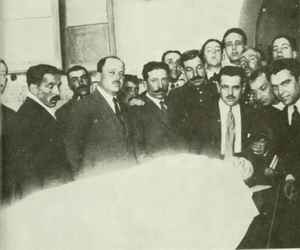
Body of Manuel Granero, bullfighter killed in the Madrid ring, May 1922. Hemingway’s caption to this photo in Death in the Afternoon reads: “Only two in the crowd are thinking about Granero. The others are all intent on how they will look in the photograph.”
I’ve been ruminating on the Jason Arday business a bit, which I referenced yesterday. It annoys the hell out of me that one idiot commenter thought I was somehow defending Arday, although there’s not a word in the post that even suggests he isn’t guilty of the same sort of egregious confabulations that I discovered when I investigated Alice Goffman’s massively successful academic fraud. The whole point of my post was that Jesse Singal was every bit as credulous in prominent print about Goffman as the people he’s now criticizing have been about Arday, but he hasn’t ever noticed or acknowledged this, at least as far as I’m aware.
I just checked and Goffman’s pseudo-ethnography On the Run has been cited nearly 2,000 times, while its predecessor article in the top journal in the field has been cited nearly 700 times, even though both are examples of straight up academic fraud. They are academic publications based on fabricated data of various kinds, including among many other things a quantitative “study” that’s the basis of the ASR article, which it couldn’t be more obvious Goffman never conducted. Neither the book nor the article have ever been retracted, however, and probably won’t be, because doing so would be embarrassing to various powerful and important people, so there aren’t going to be any Jesse Singal-type stories in the NYT about oh my god how did academia get this so terribly wrong it must be all the woke. (I note that as of right now Simon & Schuster is still planning to publish Arday’s heartbreaking work of staggering genius, aka his memoir, which appears to have been composed by a co-author who specializes in that sort of thing.)
All this has gotten me thinking about whether moral standards are just totally collapsing in our increasingly decadent society. I hesitate to conclude this because this is what old men have always thought about the present since at least Plato and probably in the caves where the aurochs were nowhere near as good as those of a generation or two ago; just watch any YouTube video of a song from twenty or thirty or forty or fifty years ago and discover in the comments that that was real music, not the crap they’re making today.
Here’s part of a long very funny passage from Hemingway’s Death in the Afternoon, which is about bullfighting:
To read any history of the great fighters of the past it would seem impossible that they ever had bad days or that the public was ever dissatisfied with them. It may be that they never were dissatisfied with them before 1873 because I have not had time to read the contemporary account any farther back than that, but since that time bullfighting has always been considered by contemporary chroniclers to be in a period of decadence. During what you now hear referred to as the golden age of all golden ages, that of Lagartijo and Frascuelo, which really was a golden age, there was a generally expressed opinion that things were in a bad way; the bulls were much smaller and younger, or else they were big and they were cowardly. Lagartijo was no killer; Frascuelo, yes, but he was mean as dirt to his cuadrilla and impossible to get along with; Lagartijo was chased from the ring by the crowd on his final performance in Madrid. When in the accounts we come to Guerrita, another golden-age hero, who corresponds to the period just before, during and after the Spanish-American war you read that the bulls are small and young again; gone are the giant animals of phenomenal bravery of the days of Lagartijo and Frascuelo. Guerrita is no Lagartijo we read, it is sacrilege to compare the two and this florid monkey business makes those who remember the serious honesty (no longer ugly meanness) of Frascuelo turn in their graves; El Espartero is no good and proves it by getting killed; finally Guerrita retires and every one is relieved; they have had enough of him, although once the great Guerrita is gone bullfighting is in a profound depression. The bulls, oddly enough, have gotten smaller and younger, or if they are big they are cowardly; Mazzantini is no good, he kills still, yes, but not recibiendo, and he cannot get out of his own way with a cape and is a loss with the muleta. Fortunately he retires, and once the great Don Luis Mazzantini is gone the bulls get smaller and younger although there are a few huge cowardly ones more fit to draw carts than for the ring, and with that colossus of the sword disappeared, gone alas with Guerrita, the master of masters, such newcomers as Ricardo Bombita, Machaquito and Rafael El Gallo, none of them anything but a fake, dominate the bull business. Bombita masters bulls with the muleta and has a pleasant smile, but he cannot kill as Mazzantini killed; Gallo is ridiculous, an insane gypsy, Machaquito is brave but ignorant, only his luck saves him and the fact that the bulls are so much younger and smaller than those giant, always brave animals of the time of Lagartijo and Salvador Sanchez, Frascuelo, now always called the Negro affectionately rather than as an insult and beloved for his kindness to all. Vicente Pastor is honorable and brave in the ring, but he gives a little jump when killing and is frightened sick before he goes in to fight. Antonio Fuentes is still elegant, a beautiful performer with the sticks and with a nice style killing, and that lets him out since who wouldn’t be elegant working with the bulls that are nowadays so much younger and smaller than in the time of those faultless colossi Lagartijo, Frascuelo, the heroic Espartero, the ruler of masters Guerrita, and that pinnacle of swordsmanship Don Luis Mazzantini. In this epoch incidentally, when Don Indalecio Mosquera promoted the Madrid Ring and cared nothing about bullfights but only about the size of the bulls, statistics show the bulls were consistently the biggest that were ever fought in Madrid.
You can find exactly the same pattern in pretty much any history of any subject under the sun, because things were always much better in one’s youth (it rarely occurs to people that this is only because they were young, and also human memory is selective, fortunately).
Nevertheless, despite all the well warranted caveats, it is true looking backwards that cultures do decline into decadence in various ways, and that certainly appears to me at least to be happening at the moment (again: old man talking here). It seems to me that Donald Trump’s utter shamelessness, or perhaps the larger forces that made the age of Trump possible in the first place, is or are making things like the most egregious open lying, grifting, confabulating, and whoring (in the broadest sense of the word) far more acceptable than they were in the more repressed and hypocritical society of the not so long ago (repression and hypocrisy here being the tributes that vice pays to virtue, and therefore preferable to the alternative, which is precisely our depraved circumstances).
There’s an untranslatable Spanish word: pundonor. Here’s an example of the essence of that quality, as displayed by a German American Jew, Louis Brandeis. After he became the most famous lawyer of his generation, Brandeis would often represent clients in worthy social causes who couldn’t afford to pay him. This is something that traditionally lawyers have come to be expected to do, it is called pro bono work, meaning for the good of the public, but what Brandeis would do went beyond that, because he would keep a tally of how much work he had nominally billed the client, and then he himself would pay that sum into his law firm’s accounts. He did this on the theory that not doing so would be forcing his law partners to indirectly subsidize his charities. That is pundonor, and we seem at the moment to have enormous amounts of the exact opposite, which is also captured nicely by another Spanish word, sinverguenza, which is a proper noun meaning utterly without shame, but with an emotional resonance that that phrase doesn’t have in English (I gather that shanda in Yiddish would be something of a rough equivalent).
Anyway they don’t make them like that any more.