
Erik Visits an American Grave, Part 2,167
 By
By This is the grave of Robert Peary.
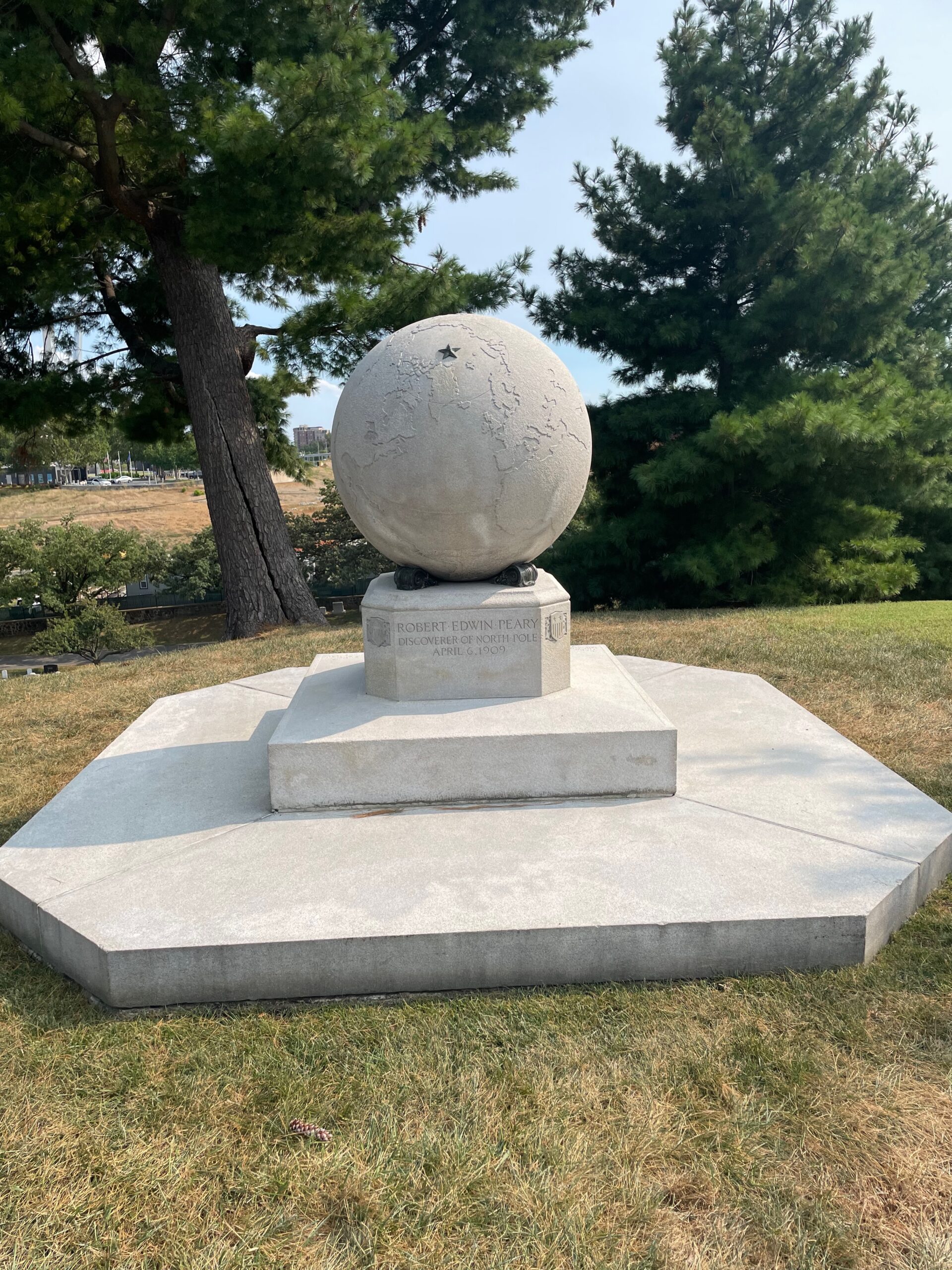
Born in 1856 in Cresson, Pennsylvania, Peary would not stay in that tiny town for the rest of her life. Maybe it was being born in that place that pushed to get out–anywhere other than small town western PA! In all seriousness, his father died when he was young and so his mother moved the family back to her relatives in Portland, Maine, so that’s where Peary grew up. The family had some level of money and he was able to go to Bowdoin after graduation. He majored in civil engineering.
After college, Peary got a job working with the U.S. Coast and Geodetic Survey and then joined the Navy in 1881, as a lieutenant in the civil engineering corps. From this moment, he wanted to be an explorer. He already wanted to be the first person to visit the North Pole (undoubtedly of course some indigenous people had done this, but they didn’t count for people such as Peary). In fact, he published a paper for the National Academy of Sciences in 1886 on possible ways to reach the Pole.
The military was certainly interested in letting Peary try to reach the North Pole. If he died, well, whatever, but if he succeeded, the U.S. could really benefit. This was a bit like how the Spanish crown thought about another crazy person–Christopher Columbus. In 1886, the Navy gave him leave for six months to explore the Arctic, with only one other person, a Danish official who had to convince Peary it was suicide to do this alone.
The idea of traipsing across the Arctic alone is so bizarre to me. I get the exploration thing I guess, but to actually do it. All the danger, all the loneliness. I assume there is a form of megalomania here. The single-mindedness is impressive in one way, if you don’t think about what it actually means in the reality. Anyway, they only made it 100 miles across Greenland before running short on food. It was a worthy first expedition though. First, Peary didn’t die and second, he knew much more about what travel in the Arctic was really like.
After this, Peary was sent to Nicaragua to survey a potential canal, which was never built because the Panama Canal was built instead after Theodore Roosevelt convinced Panama to leave Colombia in exchange for the Canal Zone. While there, Peary became friends with a black man named Matthew Henson from Washington who had gotten a job as a sales clerk from a company down there. It seems they were genuine friends, Peary told Henson about his dream, and Henson said he wanted to go. Henson would accompany Peary on ever single expedition after this.
In 1891. Peary and Hanson started another expedition. In fact, there would be expedition after expedition in the next 18 years before they finally succeeded in reaching the North Pole. Peary had big time funders now, including the American Geographic Society. And there was no solo expedition this time, he had a team. Peary was almost immediately disabled on this expedition as the ice breaker had an issue and whacked him in the leg, breaking both his lower leg bones on one leg. So he was stove up for months. But he spent time learning Inuit survival techniques and other useful things he would need. In 1894, he stumbled across the Cape York meteorite. Well, let’s be clear, his Inuit guides brought him there. Now, the Inuits used it for tools. They had access to no other stone of that quality. Peary then stole it for “science.” A big chunk of it sits in the Smithsonian today. Exploration and imperialism always goes hand in hand and that very much includes the ridiculousness of contemporary uber rich people exploring space. Oh and he then brought a bunch of Inuit people back with him to Washington with the promise that they would get a lot of tools and then get to to back north. He was a racist liar and they mostly died of disease.
On the very long expedition that went from 1898 to 1902, Peary got even farther north, reaching the top of Greenland at Cape Morris Jessup. He had a camera with him to chronicle this. On his 8th expedition, from 1908-09, Peary and his men claimed to have reached the North Pole. It’s hard to say. If anyone actually did, it was probably Henson, which upset Peary as he wanted it to be him. Does it matter though? It does not. Who cares about who precisely is the first person to be on this or that spot on the earth? Not to mention the actual site of the pole is very difficult to ascertain. It goes back to this mania whites have about being the first to do things as part of their desire to dominate the world. I can already see the comments for this post because this stuff, like space exploration is “cool.” Well, have you considered the horrors of what the stuff you think is cool means?
When Peary returned, he was promoted to captain in the Navy (surprised he wasn’t higher than this) and then immediately went to lobbying Congress to recognize that he in fact had been to the North Pole. Congress did not precisely agree here–there really was a lot of doubt–but in 1911, he was thanked by our congresscritters for “reaching” the pole. From there, he retired. He split his time between Maine and DC. He also was a big proponent of U.S. intervention in World War I and lobbied hard for the use of aircraft to defend the eastern coast from the Hun’s likely attacks. After the war, still loving the idea of air power, he used his fame to propose the use of the technology to speed up communications and this helped lead to the creation of airmail.
Peary developed a form of anemia that killed him in 1920. He was 63 years old.
Robert Peary is buried on the confiscated grounds of the traitor Lee, Arlington National Cemetery, Arlington, Virginia. A note about the grave. The globe at the top is a carving of Peary’s first survey, finished in 1879, of everything you could see from Jockey Cap Rock in Fryeburg, Maine. It was not on the original grave, but added by the family in 1936. Turns out Henson was later reburied near hin, but I hadn’t heard of him when I made this visit. So I guess I will have to go back.
If you would like this series to visit other American explorers, you can donate to cover the required expenses here. Roy Chapman Andrews, who did a lot of explorations into the Gobi Desert, is in Beloit, Wisconsin. Hiram Bingham, who “discovered” Machu Picchu, is also in Arlington. Previous posts in this series are archived here and here.