
Erik Visits an American Grave, Part 2,173
 By
By This is the grave of Lloyd Waner.
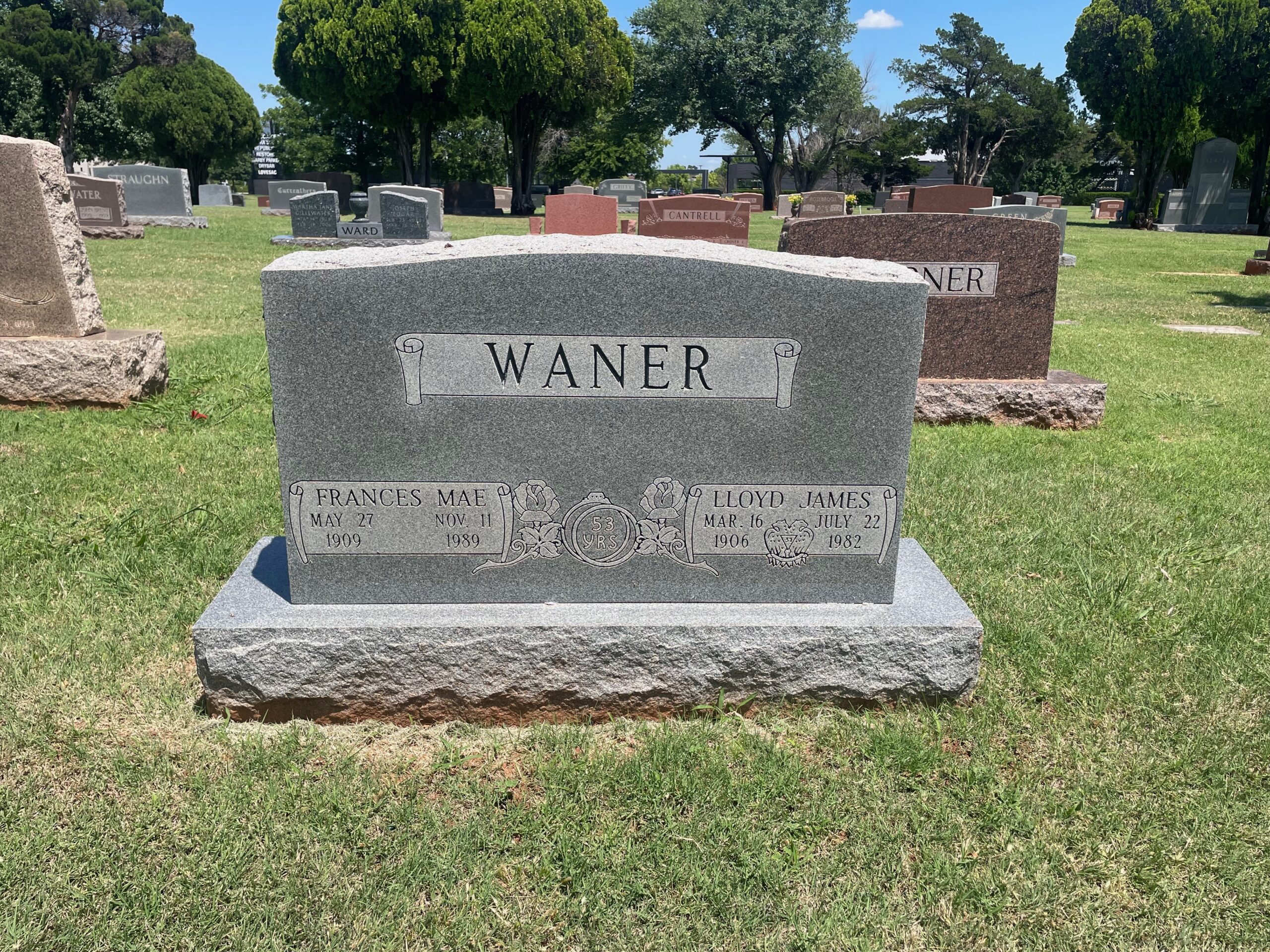
Born in 1906 in Harrah, Oklahoma, Waner grew up on a farm. It was hard work and the kids–Lloyd and Paul–didn’t really have leisure time. What they had was playing a little baseball at sunset. Their father had played some semipro ball and so taught the game to his kids. That worked out well given that they are the second greatest set of brothers to ever play the game, behind the DiMaggios.
The kids also got some education and so Waner went to what is today East Central University in Ada, Oklahoma for over a year. But baseball called. He played very briefly for the minor league San Francisco Seals in 1925, but was terrible. In 1926, the Pittsburgh Pirates tried him out. Paul was already in the minors for the Pirates and rising rapidly and told the team they needed to sign his brother. So they did.
It took Waner almost no time to get to the majors. He was a tiny guy, even by the standards of the era, but he was one of these slap hitting fast guys that are fun to watch. In fact, many of my all time favorite players to watch–Ichiro, Ozzie Smith, Brett Butler–fit into this category. Not too many of them around today in the extremely boring Three True Outcomes era. Waner made the major league club in 1927 and was an immediate sensation. He hit .355/396/410 with 223 hits and a league leading 133 runs. He did struggle in one category though. He struck out 23 times in 629 at bats. Yep, you read it right. And that’s the most he would ever strike out in his career. He also helped lead the Pirates to the World Series, where the Yankees swept them. But still, being a striking young leadoff man and getting your team to the Series in your first year, well, let’s say Pirates fans were pretty happy.
Now in truth, Waner’s style had some limitations. He was the player he was and he never really advanced from that. So by modern calculations, which is of course what has led to the Three True Outcomes era, he doesn’t rate that high. Even that great rookie season only gets him to a 3.0 WAR according to Baseball Reference. And this was the player he was every single year for the rest of his long career. That’s actually kind of fascinating–he sprung fully formed like Athena and Athena he would remain, if Athena was a really good slaphitter instead of a goddess. His next few years look exactly the same as his first. Then he started dealing with a few injury issues, missing most of 1930 due to appendicitis and usually playing 115 or 120 games after that. He never developed any power and didn’t steal a lot of bases either, which was normal in this era. He didn’t even have much doubles power, topping at 28. By Baseball Reference’s count, his best year was 1932, when he was worth 4.3 WAR after hitting .333/367/430.
But boy did Waner make a big splash when he first hit the league. He had 678 hits over his first three seasons. That remains the all-time record. Not even Ichiro could break it. But really, he wasn’t that great. He was a solid player with a solid career and a better older brother. Things started to slip in 1939 and then in 1940, he was worth -0.4 WAR, making him below replacement level. The Pirates moved him to the Braves in early 1941 and a month later, they then traded him to the Reds. He played for the Phillies in 42, was out in 43, signed with Brooklyn in 44, who released him in June. He came back to the Pirates in a backup role for the rest of that season, stayed in 1945, and retired at the age of 39. He ended with 2,459 hits, the only stat in which he was really accomplished, though 1,201 runs is nothing to cry about either.
After his career, Waner worked as a scout for the Pirates for a couple of years, He then took a job for the city of Oklahoma City for most of his working life. He also became a raging alcoholic, which was a family problem. He finally stopped drinking in the mid 70s. He was inducted into the Baseball Hall of Fame by the Veterans Committee in 1967. This is just ridiculous. He’s a nice player, no question. But with Paul Waner already in there and his former teammate Pie Traynor pushing for him as well, the VC allowed him in, one of many very questionable choices of that era. Though given that the current iteration is allowing in Jack Morris and Harold Baines, it’s not like it’s improved that much. Fred McGriff was much more defensible though. But really, Morris and Baines are clear HOF quality compared to Waner. Bill James used to use Waner as one of his examples of the least deserving HOF players.
Waner also smoked a lot of cigarettes. It was emphysema that killed him, in 1982. He was 76 years old.
Lloyd Waner is buried in Rose Hill Burial Park, Oklahoma City, Oklahoma.
According to Baseball Reference’s JAWS stat, Waner is the 99th best center fielder of all time, which really reiterates how far below the standard HOF line he is. If you would like this series to visit other center fielders, you can donate to cover the required expenses here. Cesar Tovar, who was so solid with the Twins in the 60s and early 70s, is 98th and is in Caracas and I hear a trip to Venezuela would be really fun about now, so maybe you want to send me there. Other readers might want to send me to Venezuela hoping I don’t come back, but hey, you could win either way! Dave Henderson is 97th but Hendu does not seem to have a known grave, too bad since he was a fun player of my childhood. Vernon Wells lives and is 96th. Josh Hamilton surprisingly lives since he tried to destroy his body most of his life and he’s 95th. Jim Pearsall, who was a near star with the Red Sox in the 50s, is 94th and he is in Wheaton, Illinois. Going the other way, Tony Gonzalez, a good player for the Phillies in the 60s, is 100th and does not seem to have a known grave. Bill North, center fielder for the As in on those good 70s teams, is 101th and lives. George Hendrick, solid forever for the Indians and Cardinals, is 102nd and also lives. So does Lloyd Moseby from the Blue Jays, in 103rd and of course Denard Span, the Twin who is 104th. Cool Papa Bell is 105th, though we all know he was a much, much better player than that but Negro League stats, even when counted, are so inconsistent or nonexistent, that this is where he falls. He is in St, Louis. This has also been an episode of Let’s Remember Some Guys! Previous posts in this series are archived here and here.