Erik Visits an American Grave, Part 2,138
 By
By This is the grave of Arthur Foote.
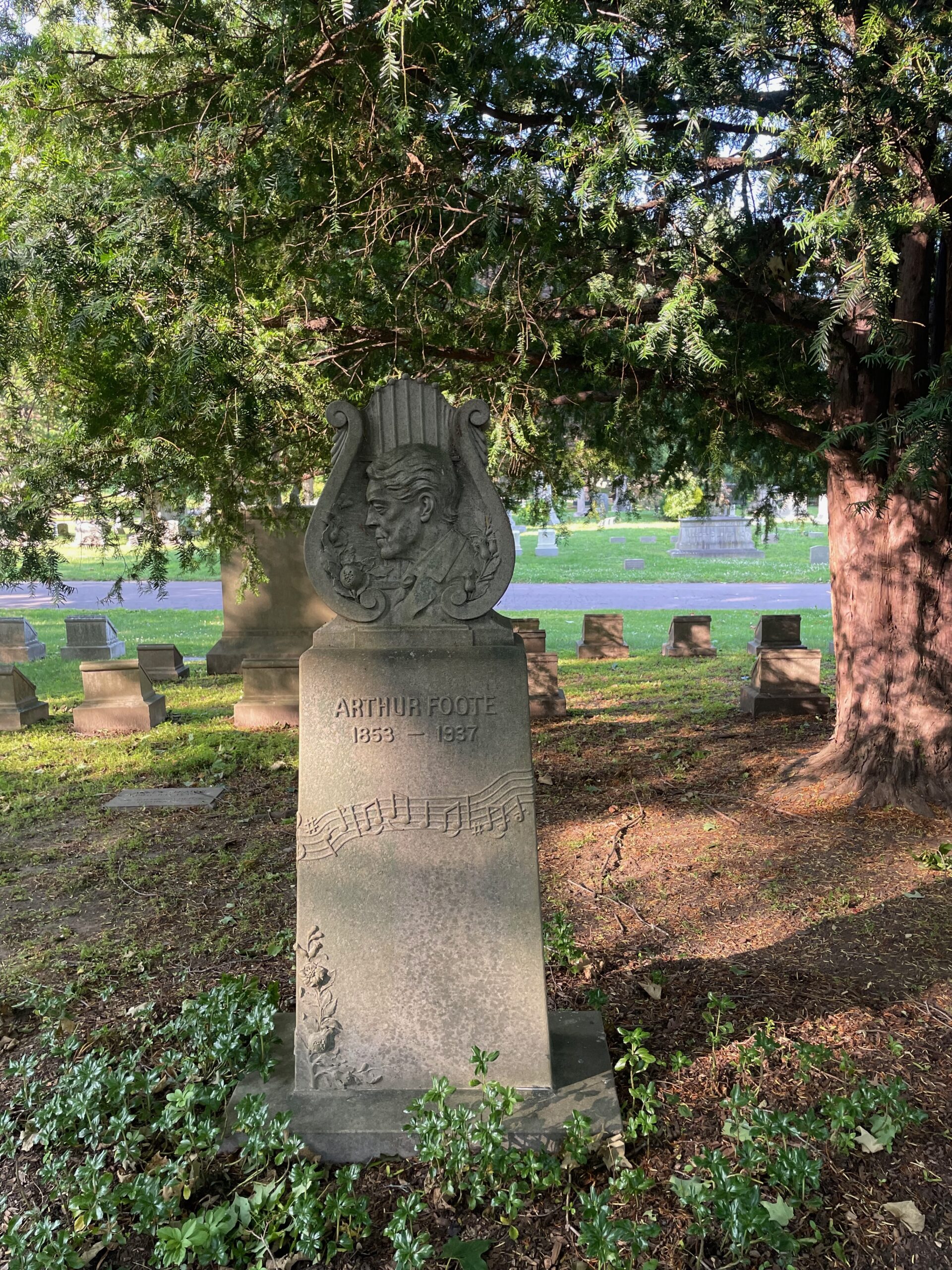
Born in 1853 in Salem, Massachusetts, Foote went to Harvard and eventually moved to Boston. The family was ancient New England, Revolutionary War legacy, all that stuff. His father owned one of the big papers in Salem and was a Whig and then Republican. Harvard gave him the first ever master’s in music awarded in the United States, in 1875. A Unitarian, he became the organist at the First Unitarian Church in Boston, a position he would hold from 1878 to 1910.
Now, who cares, that’s probably what you are asking. And fair enough. But…at this time, being a high church organist meant you were on the front lines of American composition. A lot of the early American “serious” music came out of the high churches like this. And Foote was one of the leaders of this movement. He started working in composition shortly after he got his organist job, which supported him and gave him lots of patrons, which makes sense if you consider the class background of Unitarians, both then and now.
Foote’s first major piece was Three Pieces for Cello & Piano, Op. 1 in 1881. And he kept composing well into the 1920s. He became one of the Boston Six, the group of composers based in that city that tried to make American composition something real on the European scene, as well as in the United States. Others in this group include John Knowles Paine, Amy Beach, George Chadwick, Edward MacDowell, and Horatio Parker. In fact, Paine was Foote’s teacher at Harvard. Now, no one really knows any of these names today unless you are really committed to the origins of American classical music. And this is not an area I know well, I fully admit. But….they have their defenders. I believe it. One thing about the canon–a concept that I despise on principle–is that it focuses on a few great artists and sidelines so many others who were also making some pretty great pieces at the same time. So historians know Foote’s name, but few ever listen to his music. It’s rarely performed or recorded.
Foote was also a big time educator and writer. He was important in promoting people such as Wagner and Brahms in the United States and helped introduce Americans to their music. He wrote important early 20th century music education books such as 1905’s Modern Harmony in Its Theory and Practice, 1909’s Some Practical Things in Piano-Playing, and 1919’s Modulation and Related Harmonic Questions.
Foote lived in Dedham and was involved in a group called The Society in Dedham for Apprehending Horse Thieves. It did exactly what it says it did. I was unaware that horse thieves were a major issue in suburban Boston in the early 20th century. In fact, it was started in 1810, when such things made more sense, and I think was really more of a social society around social order by the early 20th century. I imagine, you could easily replace “horse thieves” with “unionists stealing our God-given right to endless profit” and achieve the same basic result. To say the least, most of these people were Republicans by Foote’s era. Though later, Louis Brandeis and Michael Dukakis were members, so I guess it changed over time, as well as all the Kennedys, Richard Nixon, Elvis Presley, and Pope John Paul II. So, uh, huh, OK then.
Foote did get a good bit of attention at the time. In 1914, for example, church organists around the country used Thanksgiving to honor Foote by holding concerts to play his chamber pieces on their instruments. In 1920, he retired from his organist job and moved to a farm he bought in New Hampshire. His most performed work was one of the last pieces he composed. He originally wrote “A Night Piece” for a much larger Nocturne and Scherzo for flute and string quartet in 1914. But he reworked it in 1923 and it debuted with the Boston Symphony Orchestra. He also wrote an autobiography in his later years. His daughter wanted him to. Evidently, it’s mostly just a nostalgic thing about how great growing up in Salem was, which does fit his style of composing.
It’s also worth noting that Foote was influential on the next generation of American composers, who really did take American orchestral music and make Europe take it seriously. That includes Aaron Copland, William Schuman, Roy Harris, people whose music is known and played today and, especially in the case of Copland, beloved. But except for occasional scholars and classical music writers making the case for Foote, his music remains basically forgotten today. Foote loathed what had happened to music at the end of his life. He thought the works of Igor Stravinsky and the entire modernist movement to be horrible. He was most certainly not alone. He complained of these composers “who grew up with the sounds of grinding automobile brakes, the blasts of steel mills, and the hum of airplane motors in their ears” that influenced their music. Now, if you are me, that makes the music interesting, since it’s also the sounds that created modern jazz. Classical music is almost not boring this way. Wasn’t none of that in good ol’ mid-19th century Salem though. There was just merchants running capitalism across the globe to strip Asia and Africa and Latin America of its resources for American profit, the true bucolic paradise.
Foote died in 1937 in Boston. He was 84 years old. When he died, the composer Frederic Jacobi wrote of him creating a New England music:
He was refined without being precious; he had wit and charm and his originality was expressed by the turn of a phrase, by the aggregate of his being, rather than by a striking or arresting exterior. He was tender and his warmth showed itself through an admirable web of New England tradition: a tradition which was the base of his cult of the restrained in art. Overpowering passions were neither felt nor desired, it was an abstract, though friendly, beauty he sought.
Let’s listen to a bit of Foote:
Arthur Foote is buried in Mount Auburn Cemetery, Cambridge, Massachusetts.
If you would like this series to visit other American composers, you can donate to cover the required expenses here. Arthur Pryor is in West Long Branch, New Jersey and Conrad Susa is in Dorseyville, Pennsylvania. Previous posts in this series are archived here and here.