
The Great Tolkien Reread: The Departure of Boromir
 By
By 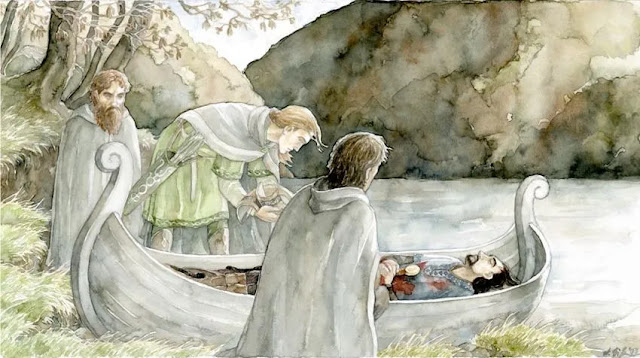
Aragorn hesitated. He desired to go to the high seat himself, hoping to see there something that would guide him in his perplexities; but time was pressing. Suddenly he leaped forward, and ran to the summit, across the great flag-stones, and up the steps. Then sitting on the high seat he looked out. But the sun seemed darkened, and the world dim and remote. He turned from North back again to North, and saw nothing save the distant hills, unless it were that far away he could see again a great bird like an eagle high in the air, descending slowly in wide circles down towards the earth.
At the beginning of the third book of The Lord of the Rings, and the first of The Two Towers, J.R.R. Tolkien does two things that remind us, yet again, that he was writing before many of the “rules” of fantasy fiction (and perhaps of popular fiction in general) were codified. First, he switches his point of view to Aragorn. The Lord of the Rings does not, like a lot of modern fantasy novels, feel the need to explicitly delineate its character perspectives, and much of its narrative is told in a third person voice that treats the travelers—the four hobbits, the fellowship, and, going forward, the subgroups into which it is about to be divided—as its protagonist. Occasionally, the novel shifts into a close third person that gives us insight into the thoughts of a particular character, but so far these have mostly been the heroes with whom we started the story: Frodo and occasionally Sam (and, on one memorable occasion, a fox). Aragorn, like the other members of the fellowship, or the majestic figures they’ve encountered on their journey, or any of the Big People who exist outside the boundaries of the Shire, has been glimpsed from afar. His thoughts, and even his story, have been doled out sparingly.
Now the point of view switches to Aragorn entirely—albeit briefly; this is the first and last time we will inhabit his thoughts. The man we discover is no longer the shaggy, self-deprecating Ranger of “Strider”, but neither is he yet Aragorn the king. He is riddled with self-doubt—”An ill fate is on me this day, and all that I do goes amiss,” he cries when he hears the horn of Boromir calling for aid; he will repeat this sentiment several times over the course of the chapter. His faith in his ability to lead the company after Gandalf’s death remains shaky, and he continues to be torn between his desire to turn towards Minas Tirith, and his sense of duty toward Frodo and his mission.
The second thing Tolkien does in “The Departure of Boromir” that violates the “rules” of fantasy fiction is perhaps the most shocking choice he makes in the whole novel. Off-page, in the gap between the previous chapter and this one, momentous events have occurred. Orcs attacked the most vulnerable members of the party. Boromir sped to their defense, making a glorious last stand but eventually being overrun. Merry and Pippin have been carried off. Boromir, when Aragorn finds him, is mortally wounded. The focus in their last exchange is not on the redemptive violence of his death, but on his limited ability to pass on vital information to Aragorn (though he does confess his attempt to take the Ring from Frodo). His actual death is heartbreakingly low-key.
‘Farewell, Aragorn! Go to Minas Tirith and save my people! I have failed.’
‘No!’ said Aragorn, taking his hand and kissing his brow. ‘You have conquered. Few have gained such a victory. Be at peace! Minas Tirith shall not fall!’
Boromir smiled.
‘Which way did they go? Was Frodo there?’ said Aragorn.
But Boromir did not speak again.
The rest of the chapter, after Legolas and Gimli return and are, like their leader, stricken by shock and grief, is divided between Boromir’s funeral rites, and the decision of our remaining three heroes about the course they will now take. What’s interesting is how many these actions and decisions are couched in logistics. Which is more important: seeing to Boromir’s body, or following the orcs? Is Frodo among the hobbits taken by the orcs, and if not, does the fellowship’s duty still lie with him? Even the question of how to quickly and effectively attend to Boromir’s body comes down to practicalities. Legolas suggests a cairn: “We have not the time or the tools to bury our comrade fitly”. Gimli demurs: “there are no stones that we could use nearer than the water-side.”
For the next few pages, we will continue to delve into the nitty-gritty of doing the necessary for Boromir and the missing hobbits. Legolas collects arrows from among the dead orcs. Gimli cuts down branches with which to make a bier to carry Boromir’s body. “These they lashed together with bowstrings, and spread their cloaks upon the frame.”
Did we need to know the bit about the bowstrings? Perhaps this is simply Tolkien showing off his outdoorsy knowledge, or the thought he’s put into this scene and his world as a whole. But there is something to the way these painstaking, mundane efforts lead into Boromir’s farewell, in which Aragorn and Legolas extemporize a poetic lament for him as his body is carried in a boat over the falls of Rauros. I’ve always found that lament a bit much—it feels very much like what you’d say at the funeral of a colleague who was generally decent but also a bit of a pain, when you’re feeling guilty for all the times you got annoyed at him. The way the narrative pauses, in the midst of Aragorn et al.’s furious efforts and general haste, to bid Boromir a proper (albeit overblown) farewell, feels almost as if it is Tolkien who is feeling a bit shamed, not just his characters.
Throughout their efforts, both practical and poetic, the trio have found hints of what has occurred at the camp during their absence. Some of these are things the readers already know, while others are obscure to us. One effect of locking into Aragorn’s point of view is that to him all of these hints are equally opaque. He, Legolas, and Gimli observe differences in the dead orcs’ armor and weapons, footprints in the wet earth by the river, and missing boats and packs. Again and again, they ask each other: “how do you read this riddle?”
There is a practical storytelling purpose here, to organically reveal past events to characters and readers alike without cumbersome infodumps. But the idea of the landscape, and the artifacts and impressions that people have left on it, as a riddle that must be read has occurred several times in the story already (and it will occur again in the next chapter). It is by untangling this riddle, and correctly surmising that Frodo has chosen to continue on his journey alone, that Aragorn finds the courage to make a decisive choice about his future actions.
‘Let me think!’ said Aragorn. ‘And now may I make a right choice, and change the evil fate of this unhappy day!’ He stood silent for a moment. ‘I will follow the Orcs,’ he said at last. ‘I would have guided Frodo to Mordor and gone with him to the end; but if I seek him now in the wilderness, I must abandon the captives to torment and death. My heart speaks clearly at last: the fate of the Bearer is in my hands no longer.’
This is, of course, the correct choice, the one to which Aragorn is fated both by his author, and by the force of providence that is guiding his and Frodo’s stories. We have spoken previously about how characters in this book are gifted with foresight; how, when they talk about the forebodings or urgings of their heart, what they’re feeling is often divine guidance. But Aragorn’s foresight has been clouded since Gandalf’s death, and the purpose of this chapter—the only one in the book that is told from his point of view—is to give him clarity. A clarity which is found in tending to practicalities: doing right by a dead comrade in arms, or collecting information about the fate of missing companions. It’s an interesting twist on Tolkien’s ideas about providence and foresight. By focusing on the mundane, Aragorn is able to arrive at the right choice with a clear heart and conscience.
Next time: Horsies! On September 22nd, we encounter “The Riders of Rohan”