
Erik Visits an American Grave, Part 2,231
 By
By This is the grave of Medgar Evers.
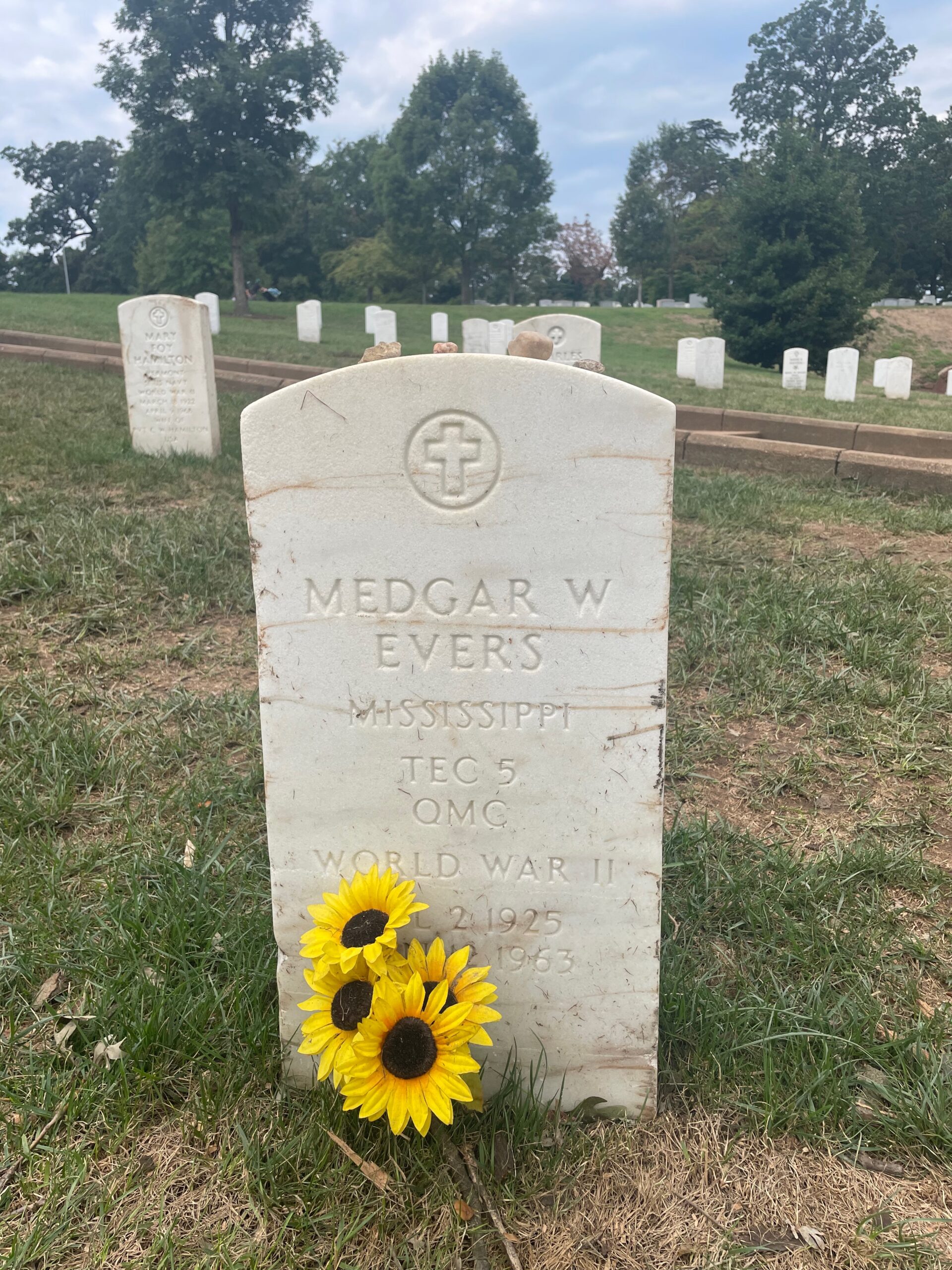
Born in Decatur, Mississippi in 1925, Evers grew up without much but with a little more than a lot of rural black families in his part of the world. His parents owned a little farm. That wasn’t much, but it was something. They were determined their kids would get an education. The only county school for black kids was 6 miles away. The kids walked there every morning and back every afternoon. Thanks to that determination, he got educated, after his brother Charles, who would be hugely important to his career and a major civil rights leader himself.
After high school, Evers went to war. It was 1943 and he was in the Army, a segregated unit of course since they were all that way. His unit brought supplies to front line troops. He later claimed that his time in France radicalized him, partly because it was the Army and partly because it was Mississippi. His time there mirrored what a lot of black soldiers felt during and after World War I too–life there was simply better for black people than in the South. He dated white women, for example. He also spent part of his time in France as a military policeman. You couldn’t do that as a black man in Mississippi. That was a good job with authority, two things whites would never accept.
Evers returned to the U.S. in 1946 and enrolled at what is today Alcorn State University. in 1948. He graduated in 1952 and married his classmate Myrlie Beasley in 1951. Myrlie still lives and became famous on her own, though for the sad reason of remembering her martyred husband and demanding justice for his murder. Evers got a middle class job–selling life insurance in the black community. Because of segregation, there was a mirror to the services white provided their own community, many of which would not in fact survive desegregation. Life insurance was a good example. But even at this early date, Evers was active in civil rights. He got involved in the Regional Council of Negro Leadership, which was an organization founded in Mississippi in 1951 to promote local struggles in that so very difficult and racist state. It didn’t take Evers long to become president of that organization, where he led boycotts of gas stations that wouldn’t let blacks use their restrooms.
As soon as Brown v. Board of Education happened, Evers applied to law school at the University of Mississippi, wanting to desegregate it, not to mention get a law degree. Of course that didn’t happen–he was rejected. But this was all part of getting the NAACP to run a test case.
The NAACP was often criticized at the national level. Roy Wilkins and friends really did shy away from a lot of local struggles, especially anything that might be seen as threatening to white society, say the Scottsboro Boys in the 1930s, when young black boys were jailed and nearly lynched for kissing white girls and the NAACP wouldn’t touch it and the Communist Party took it over instead. But at the local level, especially in the South, leading the NAACP was a major thing, something that directly challenged southern white supremacy. There was often a lot of tension between these local chapters and the national, as one can most famously see with Robert Williams in Monroe, North Carolina. So when Evers became NAACP field representative in Mississippi in 1954, he was taking in a major step and of course risking his life.
One of the major things Evers did was help James Meredith, who then became a huge supporter of Richard Nixon and every Republican since, desegregate the University of Mississippi, which famously happened in 1962, over enormous protests and riots by white supremacists and which required the calling up of 31,000 troops to manage the situation. Evers was a real stalwart of organizing in the most violently anti-black state in the nation, though Alabama had a claim to that “title” as well. He took on the lynching of Emmett Till and did a lot to publicize it and fight for justice within Mississippi at a time when it was almost suicidal to be this brave. When Clyde Kennard exposed the racism of Mississippi segregated education, he was imprisoned on completely false charges and sentenced to seven years in prison for the actual crime of talking publicly about Mississippi racism. This case, nearly forgotten in the civil rights historical pantheon today, placed Evers in the spotlight again for his public advocacy of Kennard. By the way, in 2005, Haley Barbour, then governor of the state, refused a pardon for the long-deceased Kennard.
Another way that Evers pushed ahead the struggle was his work with another mostly forgotten activist by the name of Gilbert Mason to desegregate the swimming pools of Biloxi through “wade-ins,” which are exactly what they sound like. Like the sit-ins on the buses in 1961, respectable black church going people walked into the segregated swimming pools in that city beginning in 1959, leading to a massive white freakout. Something about swimming pools drove whites even crazier than schools and buses.
For all of this, Evers was targeted with several assassination attempts. Someone nearly ran him over with their car. His home was firebombed.
Sadly, what Evers is most famous for is the end of his life, when he was murdered by the white supremacist scumbag Byron de la Beckwith. Evers was an important person in the movement, but probably he would have been remembered as one of a hundred amazing activists if it wasn’t for his murder, which made him into one of the iconic martyrs of the civil rights era. Evers was all of 37 years old when he was killed outside his home in Jackson. Beckwith was not convicted of his crime until 1994, after two juries could not come to a conclusion because they did not want to convict a white man of killing a black person, something that it had been pretty much the right of any Mississippi white to do since it was founded.
There’s always been conspiracy theories about Evers’ death. The FBI usually followed him home, against the will of the massive racist scumbag J. Edgar Hoover, who famous tried to blackmail Martin Luther King to kill himself. Given that, it’s really not impossible that the fact that the FBI cars that didn’t follow him that fatal day was intentional. Maybe one day we will know. The assassination happened just after John F. Kennedy gave a speech on civil rights that suggested his administration might finally get off their indifferent asses and do something about the issue. Evers had been meeting with other NAACP leaders. He got home and Beckwith shot him.
Evers wasn’t really that nationally known in 1963. In fact, if Beckwith didn’t kill him, he might not be that well known today. Certainly he wouldn’t be as known as he is today. It’s not like anyone can just name off the NAACP leaders in Alabama and Louisiana at this time and there were hundreds if not thousands of committed activists who did amazing work and are largely forgotten today. I’m mentioned a couple in this post, for example. But the racists made Evers a martyr. Moreover, that was an immediate action. He got a full military honor burial with national news coverage.
Medgar Evers is buried on the confiscated lands of the traitor Lee, Arlington National Cemetery, Arlington, Virginia. It’s even better that he is on the grounds of that slaveholding parasite.
If you would like this series to visit other civil rights leaders, you can donate to cover the required expenses here. Dorothy Height is in Brentwood, Maryland and Fred Shuttlesworth is in Birmingham, Alabama. Previous posts in this series are archived here and here.