
Erik Visits an American Grave, Part 2,230
 By
By This is the grave of Nana.
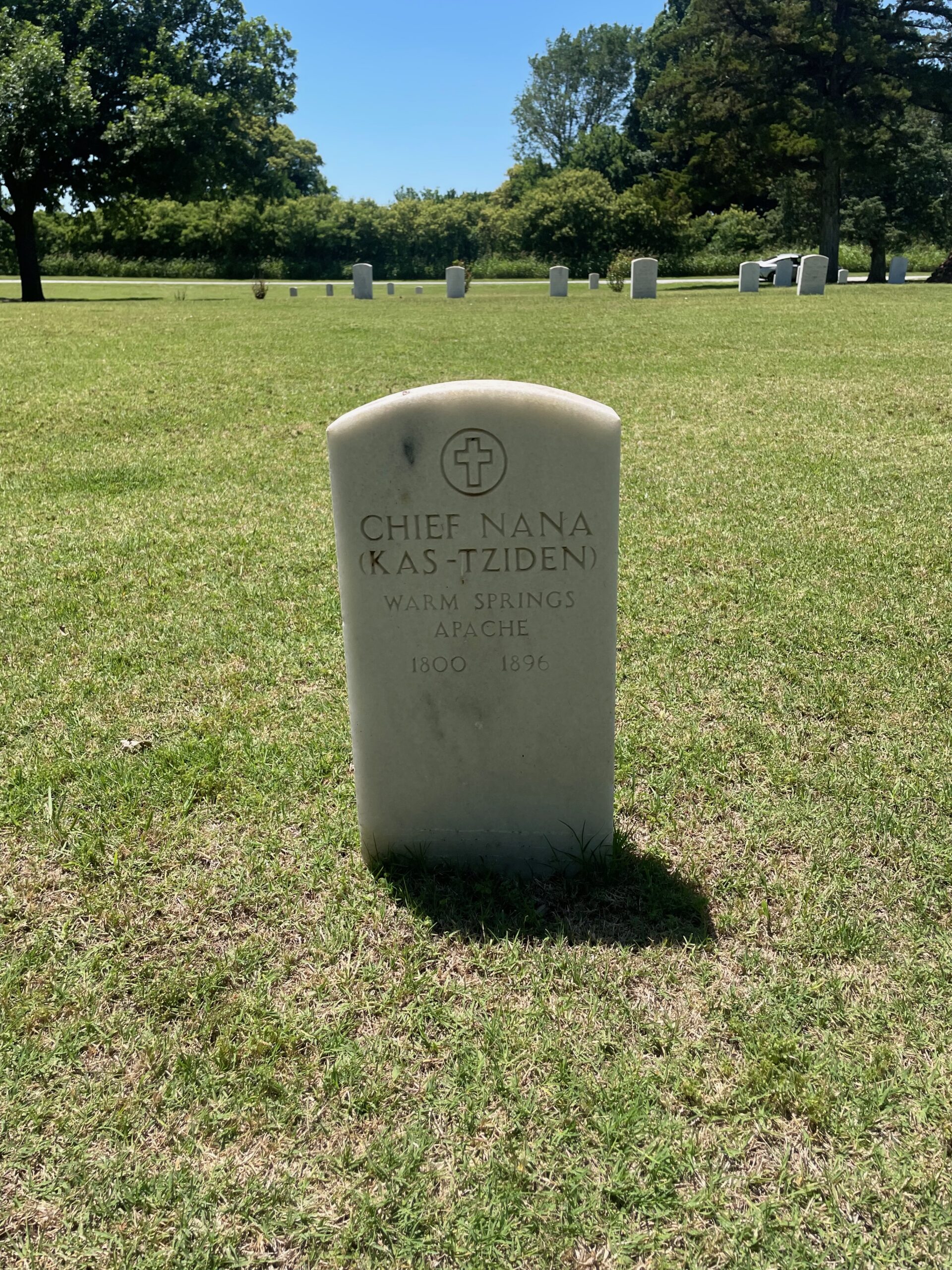
Born sometime around 1810, Nana, which was the Spanish name to given to an Apache man who was also named Kas-tziden and Haškɛnadɨltla, was one of the top Chiricahua Apache leaders in the days in which they were desperately trying to maintain their freedom against the Mexicans on one end and the Americans on the other. Caught in the border region, they managed to hold onto some level of independence longer than just about any other tribe in the United States due to their warrior ethos and the remoteness of the territory. But they had no real chance in the end. Nana is a part of this story.
We don’t know very much about Nana’s early life, unsurprisingly. There aren’t written sources. He really comes into the record as a close friend and confidante of Mangas Coloradas. They were raiding down in Mexico a lot in these days and the Mexicans were unhappy. While we can’t really take Geronimo’s memoir totally seriously here–he was writing for a white American audience with white American audience desires–he did state that he hated Mexicans far more than he hated Americans and that’s entirely possible. In 1862, Mangas Coloradas met with the American military under a truce. The military then executed him, which was complete treachery and bullshit. It’s be like if the Trump administration agreed to a meeting with the Iranian leadership, walked in, and murdered them all. As you can imagine, the Apache were not happy.
Nana was not there for that. After this, Nana rose in Chiricahua society and became a leading chief. Seeing the future, he tried to lead people to life on a reservation. But no one respected reservation boundaries and the idea of a reservation was pretty anathema to the way the various Apache people lived after gaining access to horses in the late 17th century. So it didn’t work out and Nana went back to war.
Working with another chief named Victorio and a Mescalero chief named Caballero (these are all Spanish names of course), they raided significantly both north and south of the U.S.-Mexico border. This became known as Victorio’s War in 1879 and continued for the next couple of years. This was really the last major Apache raiding war. It started with attacks on Americans near Silver City, New Mexico after life on the San Carlos Reservation proved untenable. Nana was pretty old here but was considered a top lieutenant of Victorio. It’s also hard to trust exactly what that means since the American context of understanding tribal leadership was to place them in a hierarchy that looked like Euro-American hierarchies and that didn’t often track effectively. But then whites also didn’t really want to understand Native societies.
The fighting was pretty consistent through the end of 1879 and the first half of 1880, battles every couple of weeks, crossing the border repeatedly, stealing livestock, attacking both civilians and the military. Victorio was killed in October 1880, but Nana continued the raiding into 1881. Nana then went into the Sierra Madre with what was left of his bands. He was still having success leading raids, even given his now pretty advanced age, though how much he was actually riding and raiding, I do not know. It is said that he had pretty bad arthritis and had lost an eye but was still effective in the field.
It’s also important not to understate the violence. Men like Nana both received and gave out tremendous levels of violence. This was the end of two hundred years of extreme violence in the Southwest, started by the Spanish, increased by the distribution of horses and the adoption of horse cultures by tribes after the Pueblo Revolt of 1680, manifested in its most extreme form by Comanche raiding into New Mexico and well into modern day Mexico, and the enormous slave trade throughout the Southwest that included Indians of all tribes, Spanish, and eventually English speaking people, particularly children. The Spanish and American hated Native Americans and the feeling was mighty mutual, not to mention tensions and histories between the various tribes. So Nana wasn’t exactly not seeking blood when he revolted and left San Carlos. He and his men left a violent trail of blood in his wake, killing any Spanish or American they found in southern New Mexico, stealing sheep and food, and eventually skirmishing with the Ninth Cavalry as they moved to more familiar land near the border in southwestern New Mexico.
Nana finally surrendered in 1886. He was very old. It’s amazing he was able to hold out this long. It was in these years that Geronimo became the leading chief among the Apache and famous within white American life. But the constant death that was squeezing the Apache simply could not be sustained. Nana surrendered around the same time as Geronimo. The Apache leadership was sent to Florida that year. Many of them did not survive. Nana was quite old, but he managed to hang on. It’s hard to overstate the trauma of those Florida prisons for the Apache. Even outside of losing the war and losing their land, these were 19th century American prisons in the swamps of Florida and thus incredibly hot and unhealthful. It’s almost as if they were built to manufacture tuberculosis.
Nana comes up here and there elsewhere. There are stories told later of him telling traders that there was gold everywhere in some area of Apache land while not understanding the value of said gold. This feels exceptionally unlikely to me because this kind of story assumes the Apache or other Native people were some kind of neophytes in a world of Europeans and just couldn’t understand it. Meanwhile, the Spanish had been in the Southwest since 1540 looking for gold. It’s far more likely that if this story has any truth behind it, it’s Nana fucking with the whites. These sorts of stories exist for Europeans and Euro-Americans to feel superior to those dumb Indians, like jokes about Indians in Manhattan selling the island for beads, which is very much not what happened. The Apache were well enmeshed in a sort of market economy by this time, they understood the value of gold.
In 1894, the surviving Apache leadership was allowed to leave Florida for Oklahoma. At least it was better than Florida, if not Arizona or New Mexico. They were placed at Fort Sill, near the American military. Nana died there in 1896. He was around 86 years old. Kind of amazing he survived this long–all that war, the years in the Florida prisons.
Nana is buried in Beef Creek Apache Cemetery, Fort Sill, Oklahoma.
If you would like this series to visit other Native leaders, you can donate to cover the required expenses here. Dennis Banks is in Federal Dam, Minnesota and Plenty Coups is in Pryor, Montana. Previous posts in this series are archived here and here.