
Erik Visits an American Grave, Part 2,132
 By
By This is the grave of Tom Glazer.
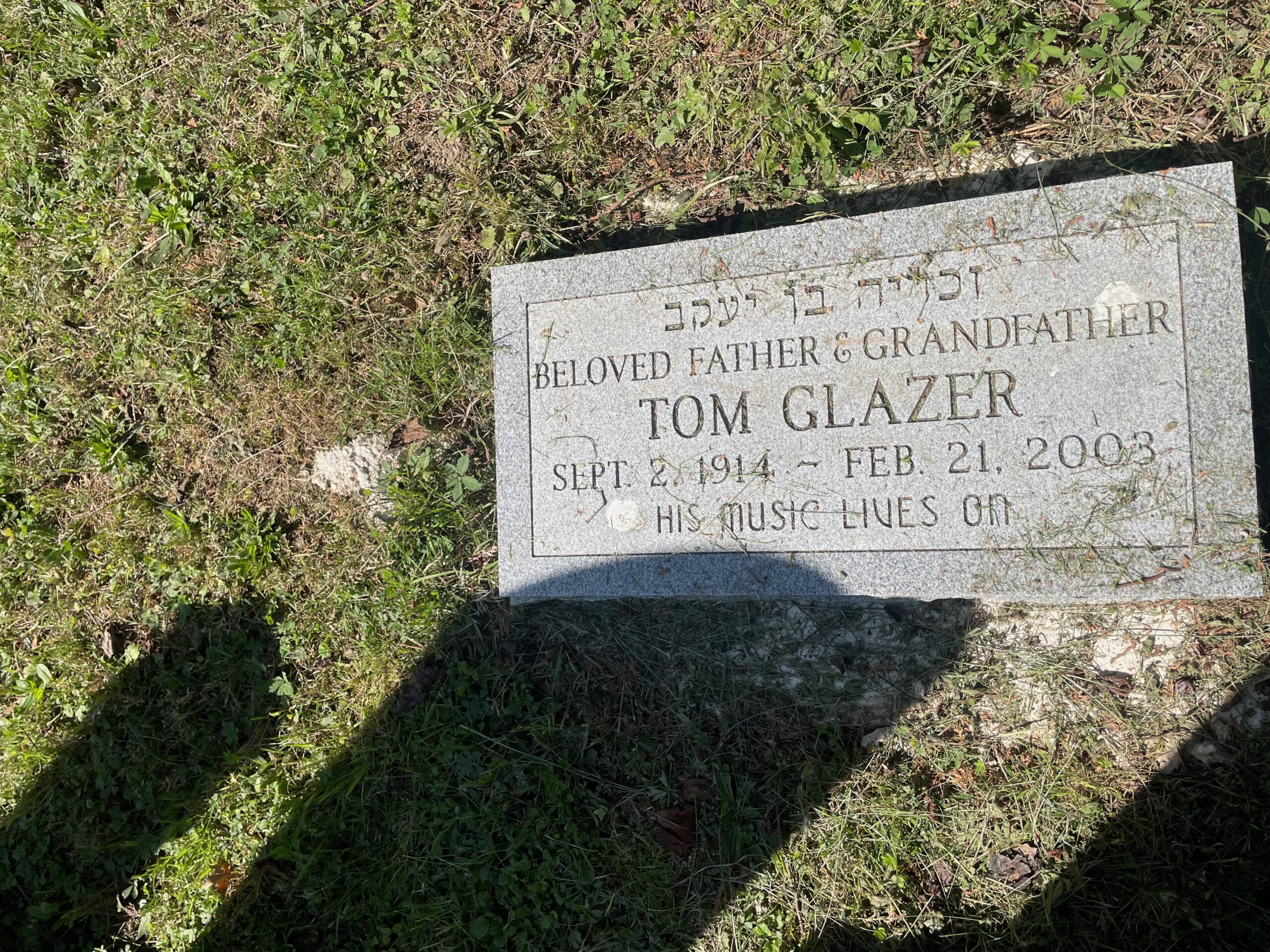
Born in 1914 in Philadelphia, Glazer grew up in a Russian Jewish household. At least at first. But in fact, he had it really tough. His father died in the flu pandemic in 1918. His mother couldn’t raise him. He was with his grandparents for awhile but ended up in an orphans home. Now, it was far from unknown at this point for kids to be placed in orphan homes for awhile as their guardians tried to get their own lives figured out. So I’m not sure how permanent that situation was. What we can say is that Glazer and his brothers were highly artistically inclined. Glazer learned to play several instruments. His brother Sidney, who went by Glazier in his professional world, became a close associate of Mel Brooks and produced The Producers. So these kids definitely overcame a hard early life.
As a teen, Glazer decided to go New York, stayed there for a few years while he went to City College, then got a job in Washington with the Library of Congress. While there, he got to know Alan Lomax, son of the early folklorist John Lomax. Alan would surpass his father and was just at the beginning of his long and important folklore recording career. Glazer got interested in this too. He started writing his own folk-style songs and had some local success. Eleanor Roosevelt even attended a concert where he played to honor soldiers. He moved back to New York during World War II and became part of the early folk scene there with people such as Pete Seeger, Woody Guthrie, and Burl Ives, not to mention black artists such as Leadbelly and Josh White. He started writing politically charged lefty songs as such as “”A Dollar Ain’t a Dollar Anymore” and “Talking Inflation Blues.”
Now, that was a legit scene in the 40s. But with the anticommunist craze of the late 40s and 50s, it was harder for a lefty folk singer to make things work. He had connections and he made a living. He did the score for Elia Kazan’s A Face in the Crowd, which I imagine paid pretty well. But where he made his real impact–and where anyone my age at the very least or younger I assume is going to know him–is that he started making children’s records. This makes a ton of sense for a folkie–simple singalongs are really at the heart of much folk music anyway and it’s a great way to get kids involved in music and singing. You just have to be a little silly about it. Woody Guthrie did quite a bit of this. “Car Song” is one of many examples of Woody writing and performing children’s music. He didn’t separate it out from his regular songs either–several examples of these are sprinkled through the Asch Recordings albums in between his political songs and songs about Okies and songs about electricity and the like. Well, Glazer was even more committed to this kind of thing than Guthrie.
Also, in the late 40s, Glazer’s politics began to turn to the right, which did not help his popularity with the people who listened to this stuff. It’s one thing that he moved away from supporting Henry Wallace and the Progressive Party in 1948 because of communist influence on Wallace, which was overstated, but also, lots of people did this. But he started writing songs about how great Douglas MacArthur was, in a song called “Old Soldiers Never Die,” in 1951. That’s not going to go over well.
So in the late 50s and early 60s, Glazer did a series of albums with another singer named Dottie Evans that intended to promote science education among children. Here he was just the singer. This was part of a larger project that included a variety of singers. Hy Zaret wrote all these songs. But one that Glazer sang–“Why Does the Sun Shine”–was later recorded by They Might Be Giants. That’s a perfect combination of song and weird band, no doubt about it.
But then, in 1963, Glazer became famous. He took “On Top of Old Smoky,” a folk standard that The Weavers had a big hit with back in 1951, and rewrote it as “On Top of Spaghetti.” It’s so silly and yet so perfect for kids. The first verse:
On top of spaghetti
All covered with cheese,
I lost my poor meatball
When somebody sneezed.
Who doesn’t love this? It is literally the perfect song for children, very silly, easy to sing, great topic. It was something of a crossover pop hit as a novelty song at the time as well. It hit #7 on Canadian charts. A Dutch folk singer almost immediately did a cover that did well in the Netherlands. It became a standard of children’s songs. Little Richard later did a version of it when he made a children’s answer, for example.
Well, there was someone who didn’t really care for it and that was Tom Glazer. He found it embarrassing. I don’t think he minded the money, whatever he made off it. And I don’t think he minded that he made children’s music. But Glazer took himself a bit seriously as a songwriter. He wanted to remember for his real songs. He found it a little demeaning that all anyone would remember him for was “On Top of Spaghetti.” He later stated, “I’m standing in line before the Pearly Gates in the musicians’ line, in which I stand last. When I’m asked what have I done in music and I say I wrote ‘On Top of Spaghetti’, I’m told, “Sorry, buster, you can’t enter.”
I don’t know, it seems like a significant entry in the American canon to me. A silly one for kids, yes, but that’s a lot more than most musicians ever accomplish.
Glazer didn’t really have a big career boost with the folk revival of the 60s. In fact, I don’t know what he did in later decades. He did release a record in 1961 called A New Treasury of Folk Songs, which some people speak highly of, but I have not heard it. His obituaries didn’t really get into that. Glazer died in 2003. He was 88 years old. It was complications from a stroke. Not sure if he had that stroke earlier, but I think this was the end of a lot of health problems.
Tom Glazer is buried in Mount Lebanon Cemetery, Collingdale, Pennsylvania.
If you would like this series to visit other members of the postwar folk scene, you can donate to cover the required expenses here. Burl Ives is in Hunt City, Illinois and Leadbelly is in Mooringsport, Louisiana. Previous posts in this series are archived here and here.