
Cannibalism and the common law
 By
By 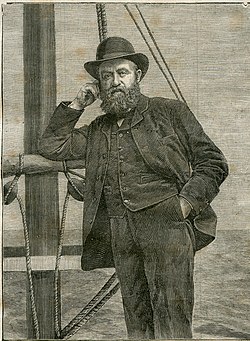
Continuing on this theme for a bit, as a law student at Michigan in the late 1980s I had the great good luck to take a class in English legal history from Brian Simpson, who had just been hired by the school after an extensive academic career in the UK and its imperial holdings, followed by a brief stop at the University of Chicago, where he picked up a salubrious distaste for the law and economics model that had become dominant there.
Simpson was a fantastic lecturer, and I still have the dozens of pages of handwritten notes I took in that technologically primitive age, long ago and far away, and so much better than it is today. He spent only a little time discussing R. v. Dudley and Stephens, the infamous lifeboat case that he had just written a whole book about, entitled Cannibalism and the Common Law. The book is characteristic of Simpson’s method as a legal historian, which was to dive into the most granular details of famous common law cases, which inevitably turn out to be far more complicated and interesting than the versions of the “facts” presented in the legal reports.
This is certainly true of the lifeboat case, of which I’ll only give a very short summary, that skips all the social and legal twists and turns the case actually took on its way to the casebooks (at least formerly most first year American law students read the case in their Criminal Law classes, although I don’t know if that’s still the case these days, when cannibalism is no longer as popular as it was formerly).
Four English sailors were contracted to transport some rich Australian’s (probably an ancestor of Rupert Murdoch) yacht from England, where he had bought it, to Sydney. The yacht sank in the south Atlantic after being hit by a rogue wave, and the crew had only a few minutes to escape in a flimsy lifeboat. After three weeks at sea with almost no food or water, two of the sailors, Dudley and Stephens, began discussing whether the crew should draw lots, the loser to be killed and eaten — also his blood would be drunk for hydration, which was even more critical for survival in such circumstances. This procedure, as Simpson illustrates with various examples, appears to have been something of a custom of the sea, since such dire circumstances were not that rare in the pre-Netflix era. ETA: Commenters remind me that the cabin boy ended up being eaten quite a bit more often than one would predict from a strictly statistical perspective.
The captain, Dudley, refused to participate in this scheme (Very interestingly, there appears to have been no real disagreement about what transpired among the survivors, despite the classic prisoner’s dilemma that the circumstances eventually produced). In any event the scheme was never adopted, because after a couple of more days it appears that the 17-year-old cabin boy, Richard Parker, was on the verge of death and slipping into a coma, and rather than draw lots Dudley and Stephens agreed to kill him, since, according to them, he was about to die anyway, and they were family men with wives and children. They did so, and Dudley and the captain Brooks subsequently consumed most of the unfortunate Parker, with Stephens eating very little per all three survivors (I hope you’re enjoying breakfast).
The three survivors were rescued a few days later by a German vessel, that dropped them off in Southhampton a couple of weeks after that. English maritime law required them to give statements about what had transpired, which they all did in a remarkably candid and non-contradictory way. It’s quite clear that none of the men thought they had done anything wrong, or at least criminally prosecutable, as they relied on their understanding of what apparently was a kind of custom of the sea.
Naturally the vast majority of such cases must have gone unreported to the world, because often there must have been no survivors to tell any tale — and when there were they may well have maintained a discreet silence — and also because, as Simpson’s account illustrates, it would have been commonplace for the local authorities to bring no charges, as indeed almost happened here.
What followed was a convoluted tale of tangled legal proceedings, again totally unanticipated by the survivors, in which the late Victorian English legal system tried to formalize some sort of rule about a necessity defense in these circumstances. The trial judge in particular engaged in a bunch of dubious shenanigans in an ultimately successful attempt to turn the whole thing into a test case before the High Court judges, who subsequently found Dudley and Stephens guilty of murder, which meant that they were statutorily subject to an automatic death penalty. The judges did recommend clemency, which could be granted by Queen Victoria, upon a recommendation from the Home Office. Public opinion was very much on the defendants’ side, although this shifted somewhat after they were formally found guilty of murder by the courts (their defense was paid for by a public subscription campaign).
In any event clemency was duly granted, and the two guilty men did six months in prison before being released. Legally speaking the case stands for the proposition that necessity isn’t a defense to murder simply because a homicide is necessary to preseve the life of the killer. A quote from the high court’s verdict:
To preserve one’s life is generally speaking a duty, but it may be the plainest and the highest duty to sacrifice it. War is full of instances in which it is a man’s duty not to live, but to die. The duty, in case of shipwreck, of a captain to his crew, of the crew to the passengers, of soldiers to women and children, as in the noble case of the Birkenhead; these duties impose on men the moral necessity, not of the preservation, but of the sacrifice of their lives for others, from which in no country, least of all, it is to be hoped, in England, will men ever shrink, as indeed, they have not shrunk. … It would be a very easy and cheap display of commonplace learning to quote from Greek and Latin authors, from Horace, from Juvenal, from Cicero, from Euripides, passage after passage, in which the duty of dying for others has been laid down in glowing and emphatic language as resulting from the principles of heathen ethics; it is enough in a Christian country to remind ourselves of the Great Example [Jesus Christ] whom we profess to follow.
Harrumph.
Anyway, it’s a truly fantastic book which is very much worth tracking down, as I can’t even hint at how complex and interesting the various precedents, legal and social, that Simpson uncovers and discusses are.
When I read Dudley and Stephens in law school — this was as a first year student before I took Simpson’s class, which along with William Ian Miller’s class on the Icelandic blood feud were the two best classes of those three years, at a time when Michigan was hiring all sorts of brilliant weirdos, as opposed to the standard issue super boring SCOTUS clerk types — I had a vague memory of a similar scene in Edgar Allan Poe’s The Narrative of Arthur Gordon Pym, which is a bizarre book even by Poe’s standards, which is saying something.
I looked up the relevant passage:
At length delay was no longer possible, and, with a heart almost bursting from my bosom, I advanced to the region of the forecastle, where my companions were awaiting me. I held out my hand with the splinters, and Peters immediately drew. He was free—his, at least, was not the shortest; and there was now another chance against my escape. I summoned up all my strength, and passed the lots to Augustus. He also drew immediately, and he also was free; and now, whether I should live or die, the chances were no more than precisely even. At this moment all the fierceness of the tiger possessed my bosom, and I felt towards my poor fellow-creature, Parker, the most intense, the most diabolical hatred. But the feeling did not last; and, at length, with a convulsive shudder and closed eyes, I held out the two remaining splinters towards him. It was full five minutes before he could summon resolution to draw, during which period of heartrending suspense I never once opened my eyes. Presently one of the two lots was quickly drawn from my hand. The decision was then over, yet I knew not whether it was for me or against me. No one spoke, and still I dared not satisfy myself by looking at the splinter I held. Peters at length took me by the hand, and I forced myself to look up, when I immediately saw by the countenance of Parker that I was safe, and that he it was who had been doomed to suffer. Gasping for breath, I fell senseless to the deck.
I recovered from my swoon in time to behold the consummation of the tragedy in the death of him who had been chiefly instrumental in bringing it about. He made no resistance whatever, and was stabbed in the back by Peters, when he fell instantly dead. I must not dwell upon the fearful repast which immediately ensued. Such things may be imagined, but words have no power to impress the mind with the exquisite horror of their reality. Let it suffice to say that, having in some measure appeased the raging thirst which consumed us by the blood of the victim, and having by common consent taken off the hands, feet, and head, throwing them, together with the entrails, into the sea, we devoured the rest of the body, piecemeal, during the four ever memorable days of the seventeenth, eighteenth, nineteenth, and twentieth of the month.
Yes, my memory was correct: the sailor who is killed and eaten after the drawing of lots is named . . . Richard Parker. I naturally assumed Poe had gotten both the idea for the episode and specific name of the victim from the English case, which was much publicized at the time, but then a little bell went off in my head and I remembered that Poe died [Twilight Zone theme music] several decades before the case itself.