
Debs and July 4
 By
By 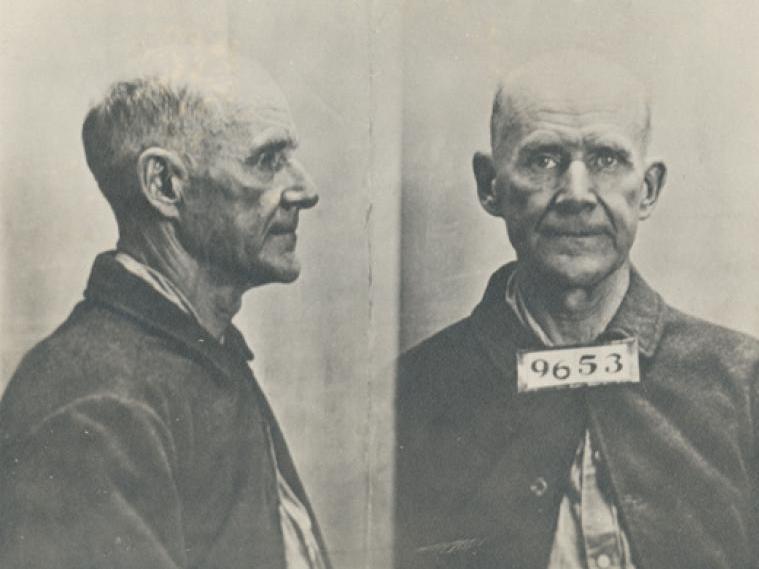
While Farley continues to pretend that the U.S. has values worth defending through his cultural choices (my July 4 viewing choices if I wasn’t in Chile would be The Birth of a Nation, The Searchers, and There Will Be Blood for the trifecta of white supremacy, settler colonialism, and rapacious capitalism, the three foundational ideologies of our horrific nation, plus they are all great movies artistically), I’d like to quote Eugene Debs and point you all to this Dissent piece on Debs.
It has been regarded as a patriotic duty for Americans, on the 4th of July, to apostrophize Liberty and to select from the vocabularies of all languages eulogistic words to describe its value and its glory, and when words failed to express those essential attributes of liberty which made life itself an inferior blessing, bonfires have blazed, cannons have belched their thunder, banners have waved, drums have throbbed, and bugle blasts have called the people to assemble and rejoice together over God’s inscrutable decree in bestowing upon Americans blessings denied to all other peoples, kindreds, and tongues since time began. Nor do I doubt that on this anniversary such exhibitions will be repeated, but it will be a hollow mockery. The stage will be gorgeous with scenery for the play of liberty, but liberty will be absent—only its ghost will appear, only its “canonized bones” will be present.
—Eugene V. Debs, “Liberty’s Anniversary,” July 4, 1895
If there is anything about this nation worth defending–a dubious proposition for me after living it in for 52 years and studying and writing about it for 30 of those–it’s the Debs tradition.
At the same time, Debs remained unbowed in his strenuous advocacy of both democratic civil liberties and a genuinely democratic socialism. And through his efforts, he helped lay the foundation for a socialist tradition that eventually gave rise to this very magazine in 1954, and that more recently has experienced a resurgence in the electoral successes of Bernie Sanders, Alexandria Ocasio-Cortez, Zohran Mamdani, Katie Wilson, and the hundreds of socialists, most members of the Democratic Socialists of America, who hold state and local office across the country.
This history is complicated, and it is not my purpose here to assess the many ways that Debs has figured and still figures in debates about left political strategy. My only point is that at a time when a triumphalist history of the United States is being promoted with a vengeance, we can clearly see how Debs’s greatness resided in his courageous activism in the face of real repression, vindicating the very ideals that the ideologues of the MAGA movement regularly trample.
Debs appreciated the rhetorical power of flag-waving, but he adamantly resisted the use of patriotic symbols to police dissent and repress the labor movement, and he suffered for his refusal to bend the knee to the rhetoric of “America, right or wrong.” At the same time, while Debs refused to pledge allegiance to the flag upon demand, he did not reject “the republic for which it stands,” or at least for which it has sometimes stood and might yet stand. He said as much in the opening line of his “Liberty” speech: in spite of the hypocrisy and the repression, “manifestly the ‘spirit of ’76’ still survives” wherever and whenever “lovers of liberty” and “despisers of despotism” act collectively to advance the cause of freedom.
Debs actually walked the walk of liberty in a way that few others in American history have done. And by refusing to cede the spirit of the Declaration to the economic and political elites of his day, he played a crucial role in advancing workers’ rights, the right to dissent and protest even in time of war, and the possibility of ongoing contestation that is at the heart of any meaningful form of democracy. Debs, in short, was one of the great democratizers of twentieth-century America.
To insist on this is not to sugarcoat Debs or to present him as someone easily incorporated into a reassuring liberal narrative of steady progress. Debs was a labor radical. He was a rabble-rouser who challenged the economic and political prerogatives of capital and disrupted the conventional politics of his day in the way he combined direct action, mass protest, and electoral politics. And what he stood for—socialism—was outside the American mainstream then, and remains so now, despite the impressive victories noted above. And yet what he stood for is an essential part of the ongoing history of the United States. His agitation, his repression, and the partial incorporation of his demands are all central to the contentious story of American democracy.
This July 4, Trump and his supporters will seek to conscript “the spirit of ’76” in the name of their bitter, authoritarian, gold-plated vision. And yet Debs reminds us that the tradition of radical dissent in the United States has always been contested. Those who have done the most to honor its legacy are those who have refused to keep silent in the face of injustice, and who have insisted that redeeming the promise of the Declaration of Independence’s noble words is an ongoing struggle.