
Erik Visits a (Latin) American Grave, Part 2,176
 By
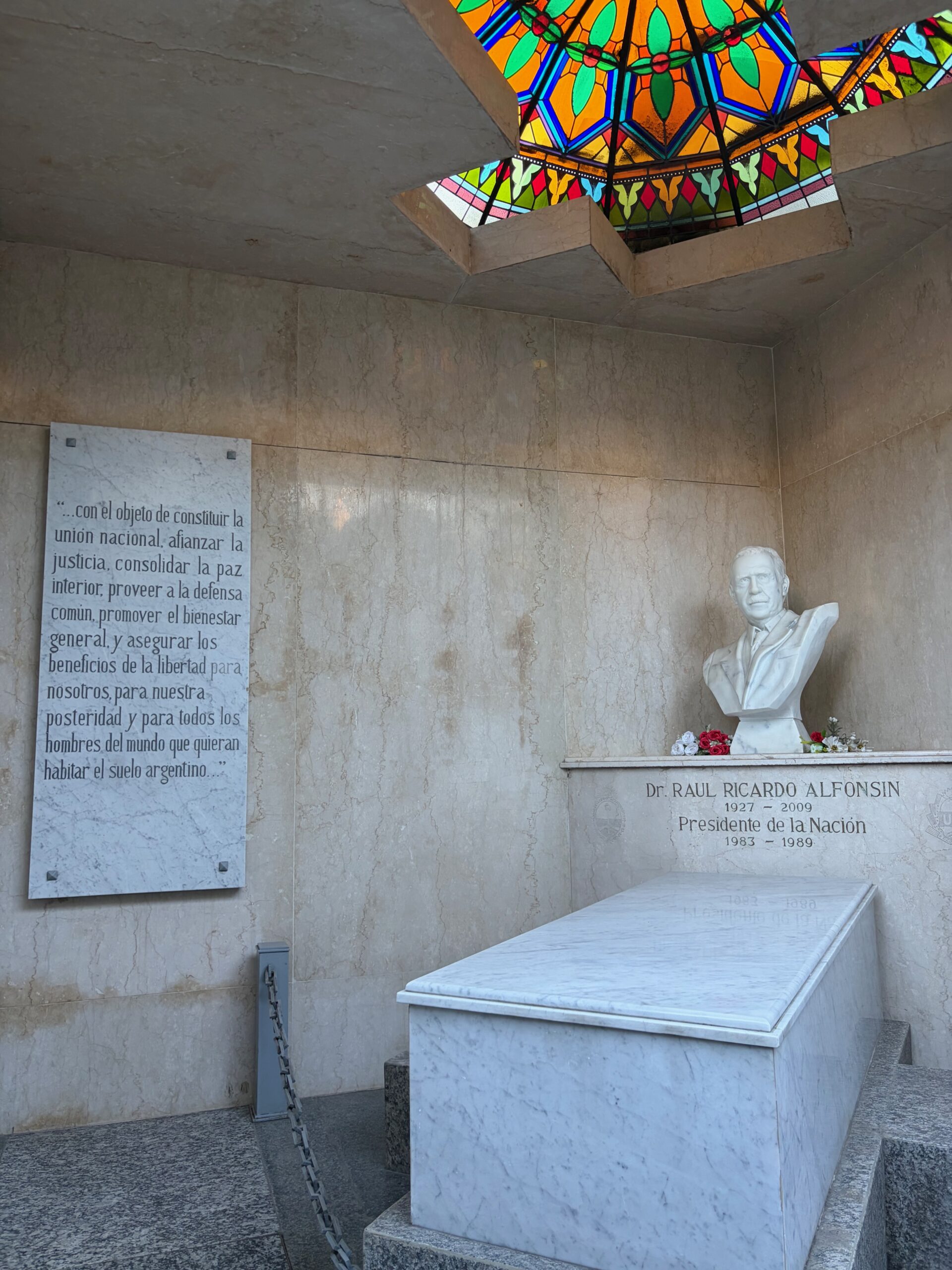
By This is the grave of Raul Alfonsín.
Born in 1923 in Chascomús, a small town a few hours south of Buenos Aires today, Alfonsín did not grow up in the Argentine elite. His parents ran a shop, They were upwardly mobile, but for the elite centered around Buenos Aires and the big ranches, his family would have been distinctly provincial. The family wanted Raul to get a good education but they didn’t have much money, so they sent him to military school instead of private school, figuring the education would be about as good but cheaper. He didn’t want to go. He got out as soon as he could, going into the law instead of the military. He went to the National University of La Plata and the University of Buenos Aires. He finished his degree and practiced, but he wasn’t very good at it–he was inattentive, in debt, and often just didn’t show up.
Alfonsín’s real interest was politics. He became a member of the Radical Civic Union in 1946, which is best described as a small l libertarian party that were deep believers in human rights and economic liberty and within the Argentine context, were more or less consistent and important. In short, a man like Alfonsín was going to be opposed to both Peronism and military-led government, believing in freedom of speech and the press but not being comfortable with big social programs or centering power in the government in Buenos Aires.
After Peron was evicted from office in 1955, the UCR split in various factions and we don’t need to follow all the details here. But Alfonsín was elected to the Argentine legislature for the first time in 1958 and was reelected in 1962. But then the military launched another coup and closed Parliament. Argentine politics have never been the most stable of global institutions. He went home to Chascomús. He spent the next years in and out of popularity, standing up against the military, sometimes being detained, but also writing a lot of editorials, frequently using pseudonyms. He became an occasional diplomat in the second Peron regime and also served as the lawyer for a leading radical accused of terrorism, not because he supported any of that but because he believed in the rule of law.
Then in 1976, the Argentine military rose up, evicted Isabel Peron from power, and started rounding up everyone it considered a threat, killing upwards of 30,000 people, with a wild proportion of them Jews compared to the overall population. They held power for the next 6 years, driving the economy into the toilet and facing widespread international condemnation for its habits of throwing people out of airplanes into the ocean.
Alfonsín was the perfect figure to replace the dictators because he hated everyone. He mostly opposed Peron, though he’d help out when he could. He opposed the dictatorship. He opposed the far left. He opposed the torture and disappearances of the military. He in fact intervened on several occasions during the disappearances, demanding writs of habeas corpus for the disappeared. He thought the invasion of the Falklands (or Malvinas as they are called by Argentine nationalists that include both the left and the right) was stupid and he opposed that. He also thought the British should leave the Falklands. In short, Alfonsín was a liberal in the best sense of the word, at least in the context of Argentine politics.
The first thing Alfonsín was revoke the military’s attempt to make itself immune from any of the many, many crimes it had committed. Reynaldo Bignone, the last of the military fascists to lead the nation and see the transition through, created the National Pacification Law, which was blanket immunity. Alfonsín responded by putting several junta leaders on trial. These issues would dominate Argentine politics for years, with the right repeatedly declaring amnesty for itself when they controlled the government and then the left revoking that. In 1985, the trial Alfonsín demanded led to the conviction of five military leaders, with Jorge Videla and Emilio Massera receiving life sentences in prison. Others were acquitted and then that neoliberal slimeball Carlos Menem pardoned the rest in 1990. Still those guys had to be in prison for five years. At least it was something.
Now, Alfonsín remained very much himself in a difficult atmosphere. Unlike in Chile, where the dictatorship really did kill off the spirit that led to the revolutionary movement to begin with, in Argentina, the left came out of the much shorter dictatorship ready to roll. The unions made big demands of the government. But he wasn’t going to pay them much mind and he opposed them almost as much as he did the military assholes. That probably gave him credibility with the larger public that was not associated with the left. At least he was fair or something.
Alfonsín also tried to be a peacemaker in the Latin America. This was the era of the Reagan administration illegally funneling money for the Contras to commit massive human rights violations in Nicaragua to bring down the Sandinistas after all. So he wanted to bring the more peaceful and stable nations in Latin America together to try and mediate the situation, which included the other nations who had recently thrown off their dictators in Brazil, Paraguay, and Uruguay, as well as a few others. Reagan had no interest in their mediations. But the Contadora Group, as they became known, was good at creating larger Latin American cooperation.
As a social liberal, Alfonsín worked to increase personal liberties. He fought for and signed the nation’s first ever divorce law. That’s right, it was the 80s when you could get an easy divorce in Argentina, exactly the kind of thing the military hated. The problem he faced was that the Argentine economy remained a disaster, which let’s face it, is endemic to that nation. In fact, it’s kind of amazing how good the standard of living is in Argentina given these problems that go back forever now. Because of rising inflation, Alfonsín lost his 1994 reelection to the right-leaning Peronist Menem.
Alfonsín remained in opposition for the rest of his life. He and Menem worked out changes to the Constitution among themselves in 1994 that helped bring more stability to the nation. He later moved his people to support Eduardo Duhalde’s bid to become president after the 2001 economic riots in the nation.
Alfonsín remained a critical figure in the nation until he died of lung cancer in 2009. He was 82 years old.
Raul Alfonsín is buried in Cementario de la Recoleta, Buenos Aires, Argentina.
If you would like this series to visit Argentines in the United States, you can donate to cover the required expenses here. Fernando Lamas is in Los Angeles. Felix Pogliano, who was a leader of the United Mine Workers in the West, is in Denver. Previous posts in this series are archived here and here.