
This Day in Labor History: April 7, 1947
 By
By 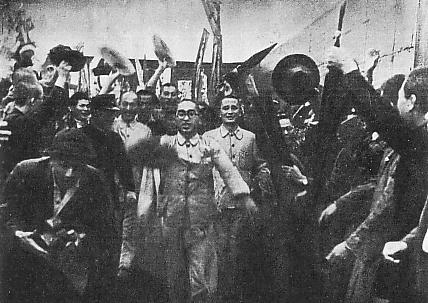
On April 7, 1947, Japan passed its Labor Standards Act. Based on the Fair Labor Standards Act in the United States, the Labor Standards Act is a way to understand the connections between work and rebuilding the Japanese state in the American image after World War II.
When the U.S. occupied Japan at the end of World War II, it had every intention to remake it as a stable ally in the East. The Cold War quickly settled in after the war. Japan became really important almost overnight due to the belief that the Soviets intended to expand their influence south. One thing the American and Japanese imperialist governments had in common was a disdain for communists. Communism was banned under the military regime. But in the aftermath, with the failure of the Japanese efforts in World War II, a fair number of workers began showing interest in communism.
Now, 1947 was around the peak of American liberalism and as such, organized labor had a role as a central part of the state apparatus. While hardly universally shared in either the political or employer classes, a consensus generally existed in the center and left of the American leadership at home that unions had to be part of a functioning modern state. They brought stability to the working classes, undermined communism if brought within the arms of the state, and ensured a check on untrammeled corporate greed. Moreover, the basic labor standards that became norm in the United States in the 1930s and in Europe both before and immediately after the war were issues of basic human dignity that also provided a bulwark against communism.
As such, the American military occupiers made it a central part of their mission to bring these labor standards to postwar Japan. In 1945, for the first time, Japanese workers gained the right of collective bargaining. Workers quickly joined unions, many of which had communist ties at first. Nosaka Sanzo was a Japanese communist who had worked with Mao in China and had a lot of charisma and became a the voice and symbol of a very different Japan upon his return for exile. By the end of the year, there were 380,000 union members in Japan. By the end of 1946, that rose to 5.6 million and about 6.7 million by the middle of 1948. which was about half of the non-agricultural work force, a rate even higher than that of the United States. In some ways, once unionization was allowed, it was reasonably easy to accomplish because of the preexisting structures of the mobilized Japanese workplace, which during the war was completely for the state, could be replicated in a way to form unions.
There were left-wing demonstrations in 1946 and finally, MacArthur cracked down. For Japanese who believed in the ideas of civil liberties the Americans had promised, they were really disappointed in the legal repression of communism. But then Americans always talk a big game about principles that turn out to be lies when dealing with foreign nations.
This was all followed by the Labor Standards Act in 1947. The law was in fact written by Japanese bureaucrats. The occupiers kept enough distance to know not to literally impose standards from the top. The latter was written by a guy named Teramoto Kosaku who worked in the new Labor Ministry and had a staff take this on for months. He appeared before Theodore Cohen, who worked directly for Douglas MacArthur and who was an energetic fellow in reshaping Japan, and just presented the draft to him out of nowhere, from Cohen’s perspective anyway. Somewhat surprised, the occupiers quickly gave most of the draft its approval. One thing Teramoto had done that Cohen and upwards to MacArthur did not understand was to include in the proposed law a provision for paid monthly menstrual leave. That was taken out of the law by the head of Cohen’s Wages and Working Conditions Branch of his agency, which was headed by a woman, as a matter of fact.
That the Americans so readily agreed to a partial copy of their own labor standards for Japan in part then came out of continued fears of left-wing agitation. There were, for examples, plans for a general strike on February 1, 1947 that had the support of non-communists as well. MacArthur had cracked down on this too a couple of days before this. But there were conservatives in the Japanese labor movement and this gave them an opportunity. If the Americans didn’t want communists, they should make sure that “respectable” unions could show to the Japanese people that their work lives would be decent.
It was only partially successful. MacArthur hated unions. He was the man who had burned down the Bonus Army encampment in Washington in 1932, thinking the veterans were all communists. So this was not a man likely to accept left-wing agitation. In 1948, MacArthur took away the right to strike from public employees, who had been leaders in the left-wing unions. Communists were increasingly purged from workforces. But this was something where MacArthur could find common ground with conservatives, employers, and more right-wing unionists. And in short, there was no way the U.S. was going to allow Japan to govern itself again until it had created a steady form of labor law that would marginalize leftists and keep things orderly.
So we need to look at the Labor Standards Act in the larger context of the American occupation of Japan, the creation of the postwar Japanese state, and the broader anti-communist policies of the U.S. at the time.
There is a Communist Party in Japan still today, although it is weak and I think mostly involved in electoral politics. I ran across the building the first day I was in Tokyo a few years ago, by complete accident. Pretty nice building.

Please note as well here that the usual American understanding of Japanese work is the office and the culture around that. That’s really a completely different kind of labor and economy than what the architects of postwar Japanese labor law were thinking about.
I borrowed from John Dower, Embracing Defeat: Japan in the Wake of World War II to write this post.
This is the 596th post in this series. Previous posts are archived here.