
Erik Visits an American Grave, Part 2,088
 By
By This is the grave of Robert Toombs.
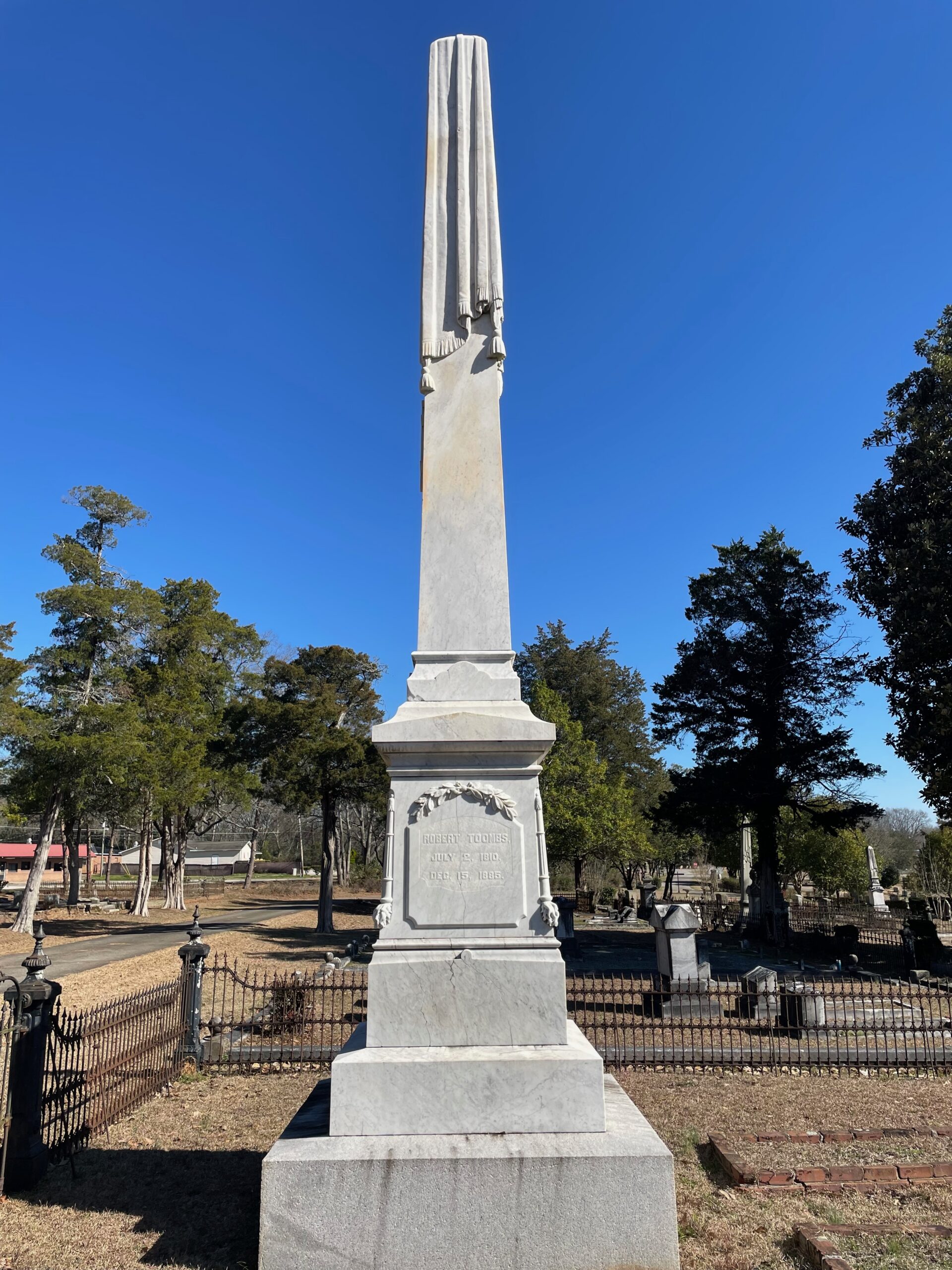
Born in Washington, Georgia in 1810, Toombs grew up in the slaver elite. His father ran his slaves in the fields, profiting from their free labor. Toombs was educated that this was the only way to live and he would spend his life promoting slavery like a religion. He went to the University of Georgia in 1824, right at the end of the era when people this young attended college. He got in trouble for card playing while there (laugh if you want to and fine, but what Toombs would also represent was a violent, drinking, gambling class of rich white men infused by their love of slavery to think rules didn’t apply to them) and then transferred to Union College in New York, where he graduated in 1828. Then came law school at the University of Virginia. He was admitted to the bar in 1830 and moved back to Georgia. Of course, Toombs owned dozens of slaves, possibly up to 100 at times. He had multiple plantations and this would fund his lifestyle and political ambitions.
Like a lot of people in this series, the bar meant an avenue to politics and that was very much Toombs’ ambition. Of course he had his plantation and his forced labor to support him in all of this. Toombs was a Whig in the 1830s and 1840s, back when the South had two parties because both swept the issue of slavery under the rug. That meant he believed in the growth of capitalism and modern development projects like roads and canals and a decent tariff. It was a pretty competitive district where he lived so he was constantly running for the state legislature, sometimes winning and sometimes losing.
Toombs set his sights higher in 1844, when he ran for Congress and won. This was the moment when the Whigs were starting to collapse, as the Democrats under James Polk had demagogued Texas expansion into a demand for purity on slavery. But he was locally powerful enough to get reelected, even as he thought Polk’s war to steal half of Mexico for slavery was illegal. In fact, in 1852, with old Whigs (now often technically Democrats as it became a one-party state by that year) in charge of the state legislature, they sent Toombs to the Senate to join fellow Whig Alexander Stephens. They became strong allies.
Toombs was initially considered a moderate on southern nationalism. He supported the Compromise of 1850 and said secession was a bad idea. He tried to start what he called the Constitutional Union Party so he wouldn’t have to join the Democrats, but that didn’t work out. But he watched with glee when Preston Brooks nearly beat Charles Sumner to death on the Senate floor in 1857 and actively intervened to stop John J. Crittenden from stopping Brooks. As a senator, Toombs combined being a really smart guy with a personality so acerbic that everyone hated him personally. By 1859, he was moving toward supporting secession. After John Brown’s raid, he stated of northern support (which really barely existed until Henry Wise, governor of Virginia, railroaded him to the gallows instead of handing him over to the federal government for a proper trial, all to promote his own presidential fantasies):
“The thousands of blind Republicans who do openly approve the treason, murder, and arson of John Brown, get no condemnation from their party for such acts. …It is vain, in face of these injuries, to talk of peace, fraternity, and common country. There is no peace; there is no fraternity; there is no common country; all of us know it.” Toombs declared that the South should “Never permit this Federal Government to pass into the traitors’ hands of the black Republican party. …The enemy is at your door; wait not to meet him at your hearthstone; meet him at the door-sill, and drive him from the Temple of Liberty, or pull down its pillars and involve him in a common ruin.”
Did he need a cigarette after delivering that?
By 1860, Toombs was openly an extremist, supporting John C. Breckinridge’s breakaway Democrats instead of the now unacceptable sellout Stephen A. Douglas, who had only done whatever the South wanted for his whole career. And lest anyone tell you that secession was not about slavery, you can quote from Toombs’ speech resigning from the Senate, where he stated, “We want no negro equality, no negro citizenship; we want no negro race to degrade our own; and as one man [we] would meet you upon the border with the sword in one hand and the torch in the other.”
Toombs was initially named Secretary of State for the Confederacy. He waned to president himself and thought he deserved it, but it went to Jefferson Davis instead. But he was a weird guy with strong opinions and there was only room for one weird guy with strong opinions in the Davis cabinet and that was Davis. Toombs resigned after Davis ordered the attack on Fort Sumter, which Toombs thought was a bad idea. A lot of these southern politicians really wanted to play at the military anyway and that included Toombs. So he became a brigadier general in the Confederate Army instead. Was he qualified for that? No, but these political generals were a problem on both sides.
Toombs had a significant role at Antietam and military historians generally say that he did an alright job there. But much later, he made a mistake. Robert E. Lee surrendered in April 1865, but that wasn’t technically the end of the war. Some still wanted to fight and so there were a few more battles later in the month. One was the Battle of Columbus, in western Georgia, where Union armies were finally getting to after all these years. The Confederates were going down, as they were in all the battles by this time. Toombs could have delayed the inevitable by firing cannon down on a bridge where both Union and Confederate troops were fighting. He would have killed some of his own boys but then the troops themselves would have lived to fight another day. He was ordered to do so by Howell Cobb, who was his commander. But he just couldn’t do it. Union troops under James Wilson swept through. This is arguably the last battle of the war.
Toombs was definitely not one of those Confederate leaders who reconsidered his life in order to salvage his career. He remained committed to his evil for his whole life. Even when Andrew Johnson just decided to pardon any Confederate who wanted one in order to promote his own white supremacy agenda, Toombs refused to lower himself to such actions. So he just waited out Reconstruction. His law practice thrived so he had plenty of money. With Reconstruction done, Toombs funded the Georgia Constitutional Convention of 1877 that reinstated all white supremacy officially. He also became something of a populist, ranting about the domination of the railroad s over the state.
Toombs’ last couple of years were rough. Most of his family died, including his beloved wife and son-in-law, who was also his political protege. He was always a heavy drinker and that got worse with the depression. He also went blind. Well, there really isn’t a fate bad enough for Toombs. He died in 1885, at the age of 75.
Robert Toombs is buried in Resthaven Cemetery, Washington, Georgia.
If you would like this series to visit other members of the Treason Cabinet, you can donate to cover the required expenses here. Such a great group of guys! Wade Keyes is in Montgomery, Alabama and so is Thomas Watts. Why do I think spending more time in Alabama would lead to a lot of good grave posts about terrible humans? Hmmm…. Previous posts in this series are archived here and here.