
Erik Visits an American Grave, Part 2,036
 By
By This is the grave of Gene Tunney.
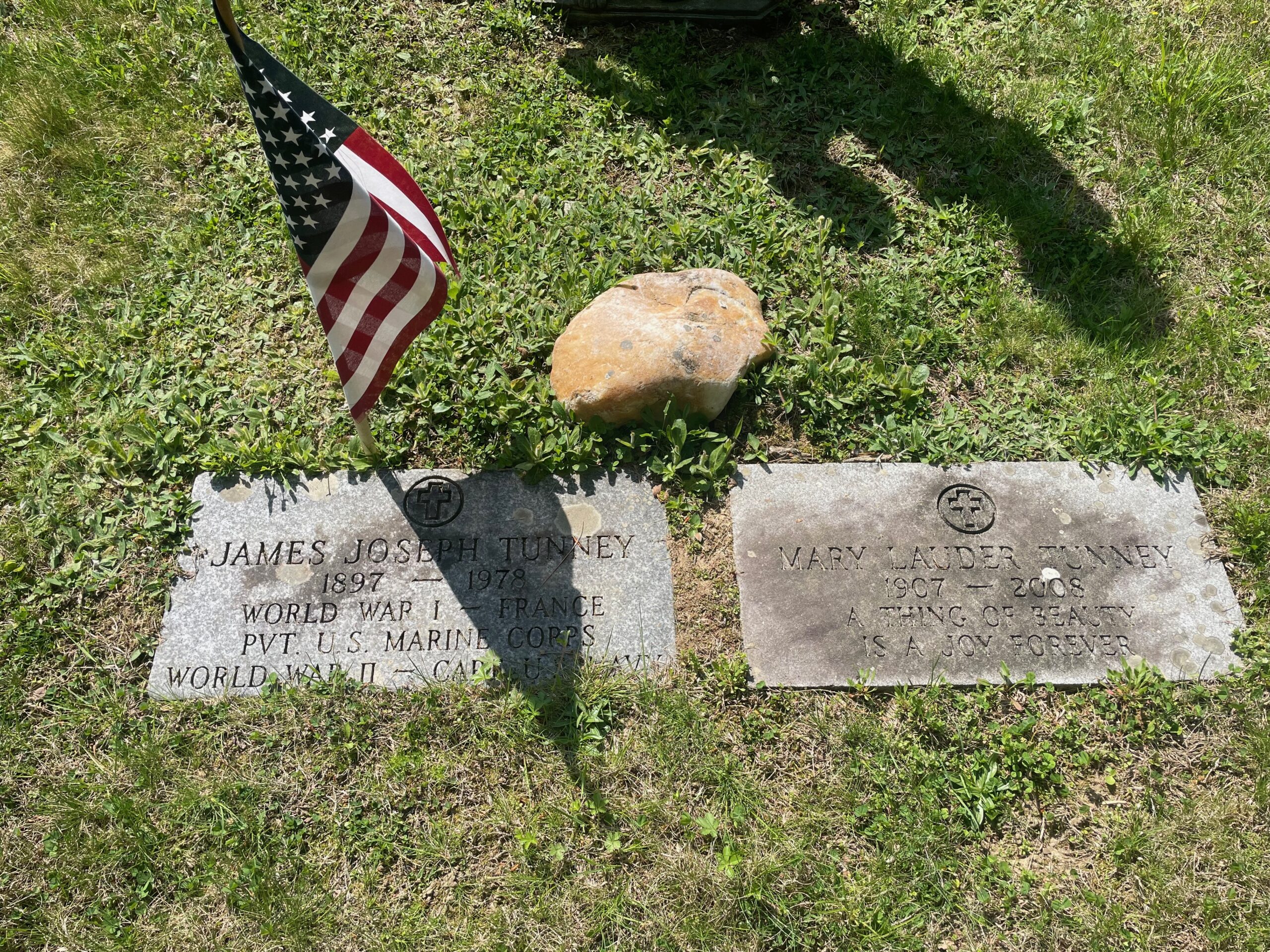
Born in 1897 in New York, Tunney grew up in an Irish-American family. His parents had come over from County Mayo. He did some schooling, but not a ton. In 1915, he got a job working as a clerk for the Ocean Steamship Company. He did this for a couple of years and then joined the U.S. military when the nation entered World War I.
Tunney went into boxing at a young age. It was America’s Pastime, by far the most popular sport in the country. Tunney became very good almost immediately. He started when working for the shipping company. Boxing was popular among American soldiers in World War I as well. The military set up tournaments and Tunney won the military’s Light Heavyweight title in 1919. He became a captain by the end of the war as well.
So by the time he returned from the war, Tunney was a top boxing prospect. He actually took some time up in Canada as a logger, not sure he wanted to keep doing this. But he did. The money was too good, among other things. He rose quickly and won the national Light Heavyweight title in 1922. He lost for the first and possibly the only time in 1923, losing a title defense to Harry Greb. But they fought again soon after and Tunney retook the title.
In 1924, Tunney decided to move up in class. He wanted to be Heavyweight champion. This was the most treasured title in all of American sports. You were the biggest man if you became the champ by beating the previous biggest man. You would be the most important representation of manhood in America. This is why whites freaked out when Jack Johnson won–how could the idealized symbol of manhood be a Black man. That he dated white women openly just rubbed the crackers’ noses in it. They just couldn’t stand it. After Johnson was brought down, for a very long time whites were going to be sure to refuse to fight Black fighters for anything that might lead to them having a shot at the title. So Tunney didn’t exactly always beat the best on his rise to the top. He beat the best whites, sure, but we all know that’s a rather limited crosssection of athletes.
In 1926, Tunney defeated Jack Dempsey to become the Heavyweight champion. He spent the next two years on top of the world. Dempsey wanted a rematch and got it in 1927. This became of history’s epic fights. Dempsey actually knocked Tunney down, which did not happen often. But when Dempsey put Tunney on the mat in the 7th round, he didn’t do what you are supposed to do, which is go back to your corner. Due to that, the referee did not start the count immediately. That gave Tunney extra time to get up. Thus, this became The Long Count Fight in the public imagination. In case you are confused at how popular boxing was at this time, the attendance for the fight was 104,943 people at Soldier Field in Chicago, plus the millions listening on the radio, so every second of this would be debated for a long time. Well, Dempsey might have won by TKO had he got to his corner. But the extra time allowed Tunney to get up and shake himself off. He survived the rest of the round, got himself together before the 8th round, and immediately knocked down Dempsey. But the accusations are that the ref started counting this time before Tunney got to his corner.
Incidentally, all of this made Dempsey the more popular of the two fighters with the public, but some of that also had to do with style, in that he was more the puncher and Tunney more the tactician, which led to a less exciting style. Tunney’s style was to hang back and see what the opponent was going to do for a round or two. He was a footwork guy, not a puncher. His style became quite influential though. Among those lauding him as a huge influence was Muhammad Ali, who later stated,
“If you look at Tunney is where boxing started to get better. He throws punches sharp and quick. Strong, fast and quick. He’s about the best of the old timers. I’d say Tunney is the greatest old timer as far as punching and skill is concerned. Tunney used footwork – something that most heavyweights don’t have. I thought I was the only heavyweight to do that. He’s jabbing and moving. Tunney didn’t fight like old timer fighters, he’s moving like me but with no rhythm. Dempsey is dangerous in close like Frazier and Marciano. Dempsey is a good ducker, he could bob a lot. Tunney is the best of that era. I see him sometimes, tell him he was one of the best of all time.”
Tunney never was defeated again. But in 1928, after defending his title against Tom Heeney, he decided to hang up his gloves. It made sense–he was rich and he was about to marry a wealthy socialite by the name of Polly Lauder. She was Andrew Carnegie’s great-niece, so it’s that kind of wealth. Tunney was never your regular boxer anyway. He was always really into the arts and literature and so was Polly, so they got along quite well and spent their money supporting the arts. They would have a son named John Tunney who became a pretty good Democratic senator from California who served two terms from 1965-77.
Tunney has remained famous enough over the years to be referenced in all sorts of popular culture. The first thing that came to my head was Richard Thompson’s “She Twists the Knife Again.” Arthur Miller referenced him in Death of a Salesman. Tunney, whose reputation as an intellectual type was well-known, was referenced in 1932’s Winner Take All by James Cagney’s character, who said Shakespeare “was the one who ruined Gene Tunney.” I guess no one wants their boxers reading. In fact, he gave lectures at Yale on Shakespeare during his boxing career, so this was no obscure reference. But really, he was quite unpopular with the general public due to his intellectualism and his decision to retire undefeated, which many fans thought robbed them of some good fights.
Tunney died in 1978. He was 81 years old. He and Dempsey were close friends. Upon his death, Dempsey stated, “I feel like a part of me is gone. Because I was three years older than Gene, I always thought I would be the one to go first. As long as Gene was alive, I felt that we shared a link with that wonderful period of the past. Now I feel alone.”
Gene Tunney is buried in Long Ridge Union Cemetery, Fairfield, Connecticut.
If you would like this series to visit other boxers, you can donate to cover the required expenses here. Jack Dempsey is in Southampton, New York and Fireman Jim Flynn is in East Los Angeles, California. Previous posts in this series are archived here and here.