
Erik Visits an American Grave, Part 2,032
 By
By This is the grave of Edmund Ross.
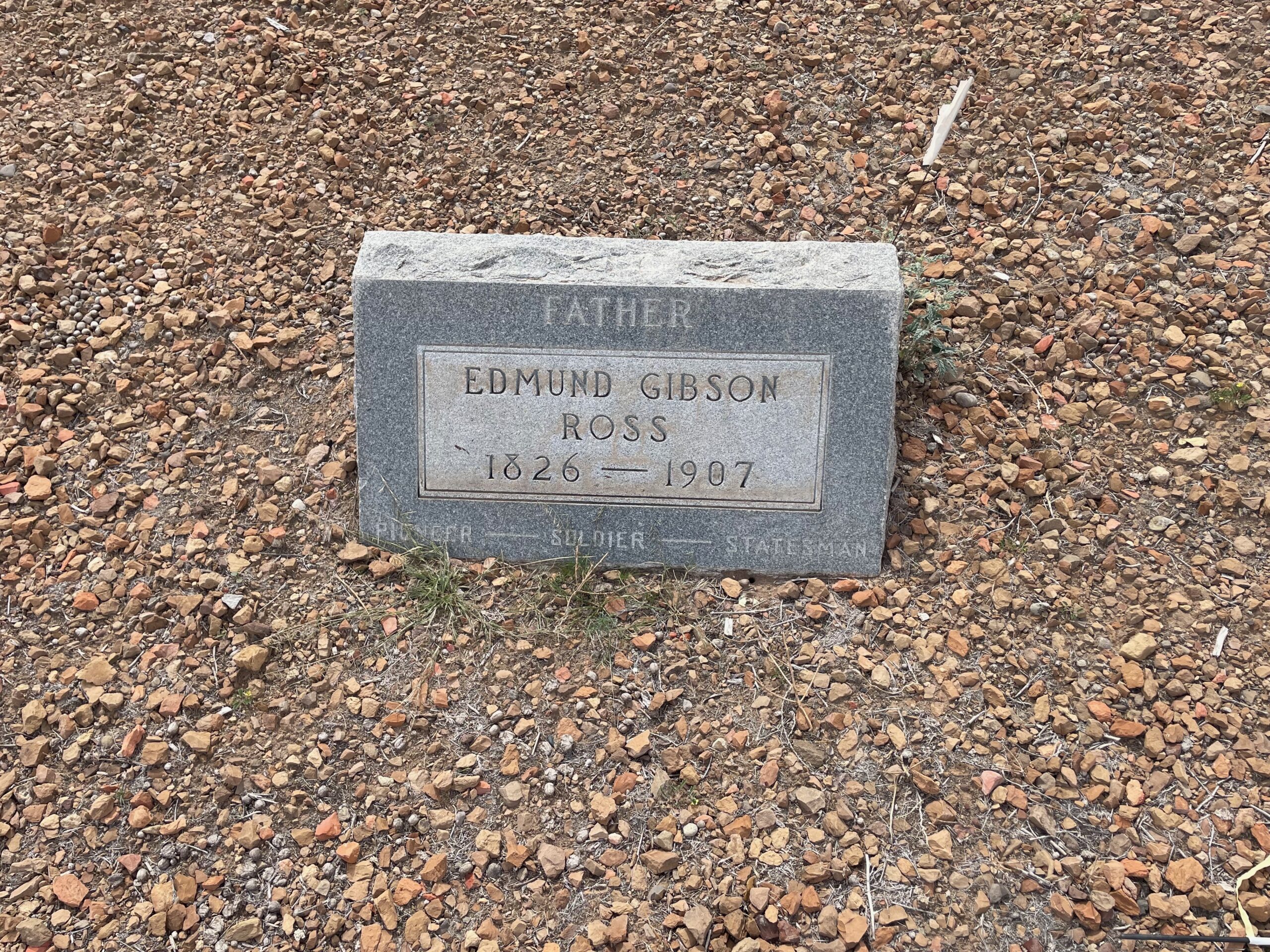
Born in 1826 in Ashland, Ohio, Ross grew up in the working class there. At the age of 11, he was apprenticed to a printer and so went into the newspaper business as he learned the trade. His older brother had done this as well and he would later work for him on a paper in Sandusky, Ohio. He spent his 20s moving around a lot, working at various papers, getting experience, and enjoying his wanderings. He ended up in Milwaukee, Wisconsin. Of course being a printer meant that you could print your politics if people wanted to buy your thoughts. Ross was a Democrat but an anti-slavery one, which meant he was completely alienated by what the Democratic Party had become after James Polk stole half of Mexico to expand slavery. Instead, Ross was helping slaves escape to Canada, including attacking a prison and overwhelming guards to a free a slave named Joshua Glover who was about to be returned South due to the Fugitive Slave Act.
Unsurprisingly. Ross joined the Republican Party when it formed in 1854. He was editing a Milwaukee paper at the time so it became a Republican organ. Incensed by the slave power’s expansion, he moved to Kansas in 1857 to assist the anti-slavery side in Bleeding Kansas. He opened a newspaper in Topeka that became probably the most important anti-slavery paper in that territory. This made him a powerful figure in Kansas as the anti-slavery forces won the battle. He was placed on the board of the new Atchison, Topeka, and Santa Fe Railroad for his services. He was also a delegate to the Kansas constitutional convention.
Ross joined the Army during the Civil War, quite willing to fight for his beliefs. He was commissioned as a captain in the 11th Kansas Volunteer Cavalry Regiment. He was involved in the nastiness of the Civil War in the southwest, places such as Missouri and Arkansas, where the battles generally weren’t huge, but really were brother against brother and replicated the violence of Kansas before the war, with all the individual killings and personalized awfulness. He stayed in the military the entire war and was a major by the end.
After the war, Ross went back to his newspapers. He was editor of the Kansas Tribune when Kansas Republicans decided to send Ross to the Senate in 1866 after James Lane died. This was early in Lane’s term, so Ross would have nearly five years in Washington. That put him there for the battles of Reconstruction. And Ross would become famous–or infamous more like it–for being the decisive vote to not convict Andrew Johnson and thus keep the awful president in office. Why Ross–perceived as pretty radical before this–made this decision remains unknown. John F. Kennedy of course wrote–er, I mean “wrote”—about Ross in Profiles in Courage, that awful book that said a lot about the visions of the past popular even among liberals at this time.
So why did Ross make this vote? Some have speculated that this was around internal patronage issues. In other terms, the radical Benjamin Wade of Ohio would have become president (I wonder how different American history might have been had this happened, probably not that much given he would have only served for a year or so before Ulysses S. Grant won in 1868) and Wade was much closer to the other Kansas senator, the notoriously corrupt Samuel Pomeroy. Given the issues around patronage and corruption in the Gilded Age (and the crossover between abolitionist and being super corrupt was awfully high), this is entirely possible.
It’s also actually possible that Ross thought the Tenure of Office Act was unconstitutional and, to be fair, it would have eviscerated anything like separation of powers had it worked. To revisit this, the idea was that if the Senate’s advise and consent functions exist to confirm a presidential appointee, it should also protect that appointee from a firing unless the Senate approves it. This was passed over Andrew Johnson’s veto because he was firing all of Lincoln’s appointees. When he tried to fire Edwin Stanton as Secretary of War, Congress impeached Johnson. In an era today when the Supreme Court and Trump have teamed up to make any Republican president a near king with Congress having no role at all (Note: none of this applies to Democratic presidents), having a stronger Congress seems awfully appealing, but what is happening today is really just another version of what the Tenure of Office Act would have meant, which is a government completely dominated by one political party. Of course, it might well have been worth it given that Wade would have been president, that most presidents have been somewhere between mediocre and disastrous, and that a hard Reconstruction would have been worth almost anything. But there was a real reason to be skeptical of this law and it’s fair to note that.
Others suggested that Ross betrayed his principles because he was bribed. In the Gilded Age, anything is possible there, but there’s no evidence to support to the point. Finally, others have pointed to the fact that Ross’ political mentor, Thomas Ewing, was a Johnson supporter and may have influenced the senator. Possible. We won’t really ever know. What we do know is that Profiles in Courage is a dumb. book.
I think the most likely scenario is none of the above: it’s that Ross was moving to the right. There’s nothing in his later career that suggests he cared much about Black folks at all. He became a Democrat in 1872 and remained one the rest of his life. He tried to become the leader for Democrats in Kansas and was in fact the nominee for governor in 1880, but the Republicans rightfully considered him a traitor. He had no chance to return to the Senate and no real chance to become governor either.
In 1882, Ross went to New Mexico. This was the beginning of people going to the Southwest for health reasons. He felt better out there so he moved there. There, he became a Cleveland appointee as governor of New Mexico Territory between 1885 and 1889. When Cleveland returned to office, he then appointed Ross as secretary of the New Mexico Bureau of Immigration, whatever that was. Later in life, with the nation’s whites uniting around Reconstruction being bad and southern whites being right in their race relations, Ross wrote a memoir about his role in the Senate trial. At that point, Kansas Republicans, believing mostly that the South was right all around about race, sort of rehabilitated Ross before he died. That happened in 1907. He was 80 years old.
Edmund Ross is buried in Fairview Memorial Park, Albuquerque, New Mexico.
If you would like this series to visit other senators around the Johnson trial, you can donate to cover the required expenses here. John Sherman is in Mansfield, Ohio and Simon Cameron is in Harrisburg, Pennsylvania. Previous posts in this series are archived here and here.