
The political failure of slopulism
 By
By 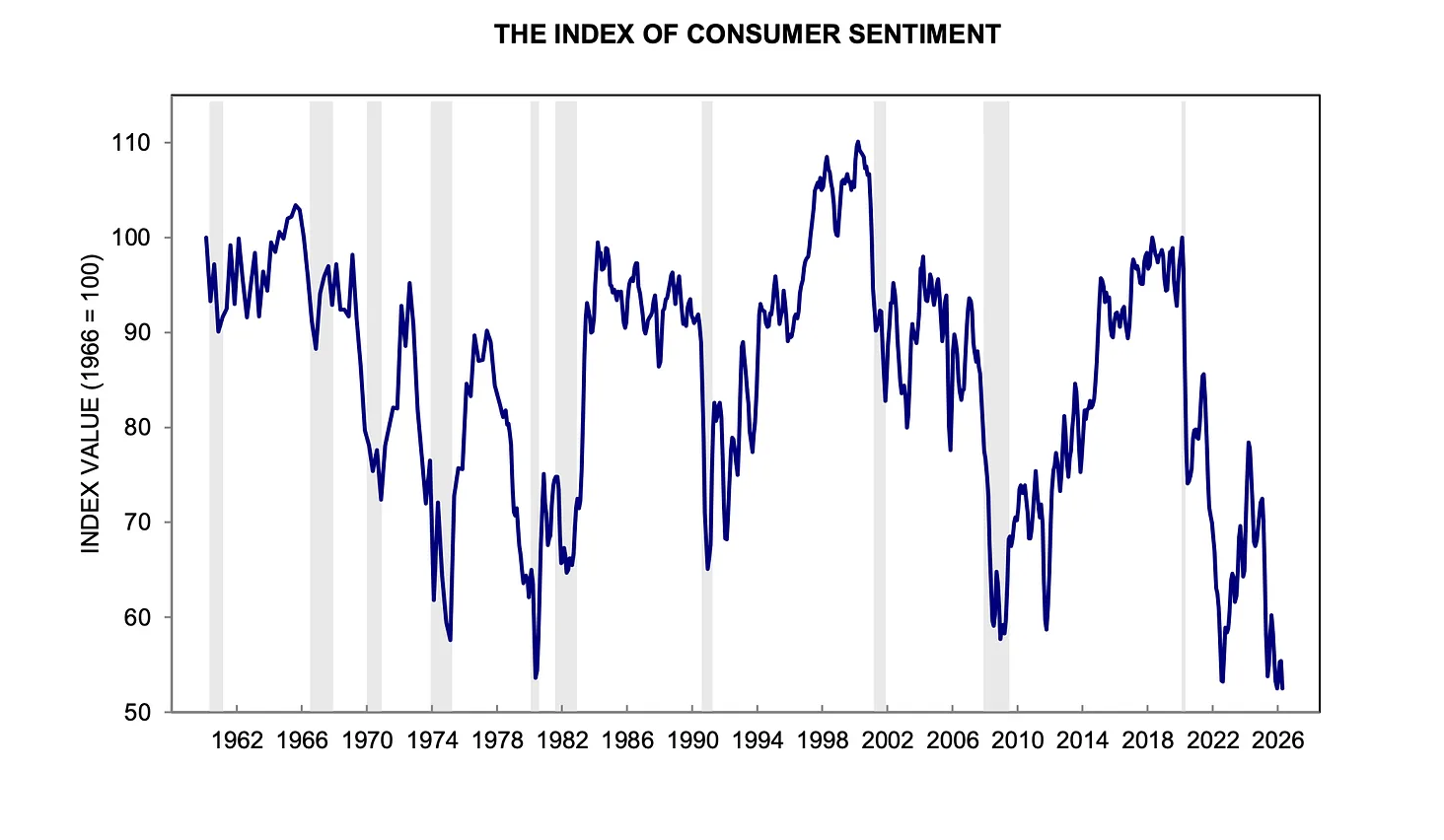
There was a good Times story preceding the election in Hungary about how a former Orban stronghold turned against him because the evidence of his extraordinary corruption had become too tangible to ignore, particularly in the context of a stagnating economy. The danger to competitive authoritarianism is that their electoral advantages push them further and further away from any actual populism, and the dam breaks.
Something like this seems to be happening in the US. Elliot Morris looks into why economic sentiment is worse (indeed, the worst on record) than the objective performance of the economy:
The economist Jared Bernstein and I were not colluding on Sunday when we both wrote about the effects of long-run inflation on consumer sentiment. I guess the topic was on our minds because the new University of Michigan Index of Consumer Sentiment release last week was literally the worst release ever in the history of the survey…
[…]
So we’ve got two independent measurements of the same underlying dynamic, both flashing red while consumer sentiment plunges. Let’s get real nerdy and dig into the hard data on what actually explains consumer sentiment today.
Here’s the spoiler, so you know where we’re headed: the single best predictor of how Americans feel about the economy is how Americans feel about prices. The second best predictor is with actual structural data on prices. It’s not unemployment, not the S&P 500, not the year-over-year rate of inflation or the tone of economic news coverage. Prices — specifically, the share of Americans who tell the University of Michigan that higher prices are making their household finances worse than they were a year ago — beat every other variable I tried, in every specification I ran, by a comfortable margin. The rest of this piece is me showing my work.
So, why is the index of consumer sentiment so low when aggregate economic statistics are otherwise pretty okay-ish? Because people don’t like paying so much money for things. Yes, it really is that simple.
[….]
This is where Bernstein and I re-enter the chat. I argue that the disconnect between the official numbers and how Americans feel about the economy comes down mostly to one thing: nominal prices. It’s not the rate of price change that’s bothering people. It’s the level. When you fill the grocery cart, pay the rent, cover the utility bill, or renew the car insurance, you’re paying today’s sticker — not today’s sticker minus last year’s. When you compare what groceries cost today to what they cost in 2019, things still look terrible even though inflation has cooled off. As I said earlier, people don’t forget the original price shock just because the rate of change stopped rising.
On some level, the consumer obsession with nominal prices is unfair, since there’s no way of bringing back 2020 prices without a catastrophic recession. But it’s hard to see much unfairness in this case given that 1)Trump’s campaign was successful in large measure because he shrewdly exploited this obsession, and 2)as president he has gone out of his way to make the issue worse. “You’ll still be paying more than $4 a gallon in November because we have to bomb Iran” is quite the message, and I just hope Dem Senate candidates in leading-edge races can run good enough races to make it really hurt.