
Erik Visits an American Grave, Part 2,224
 By
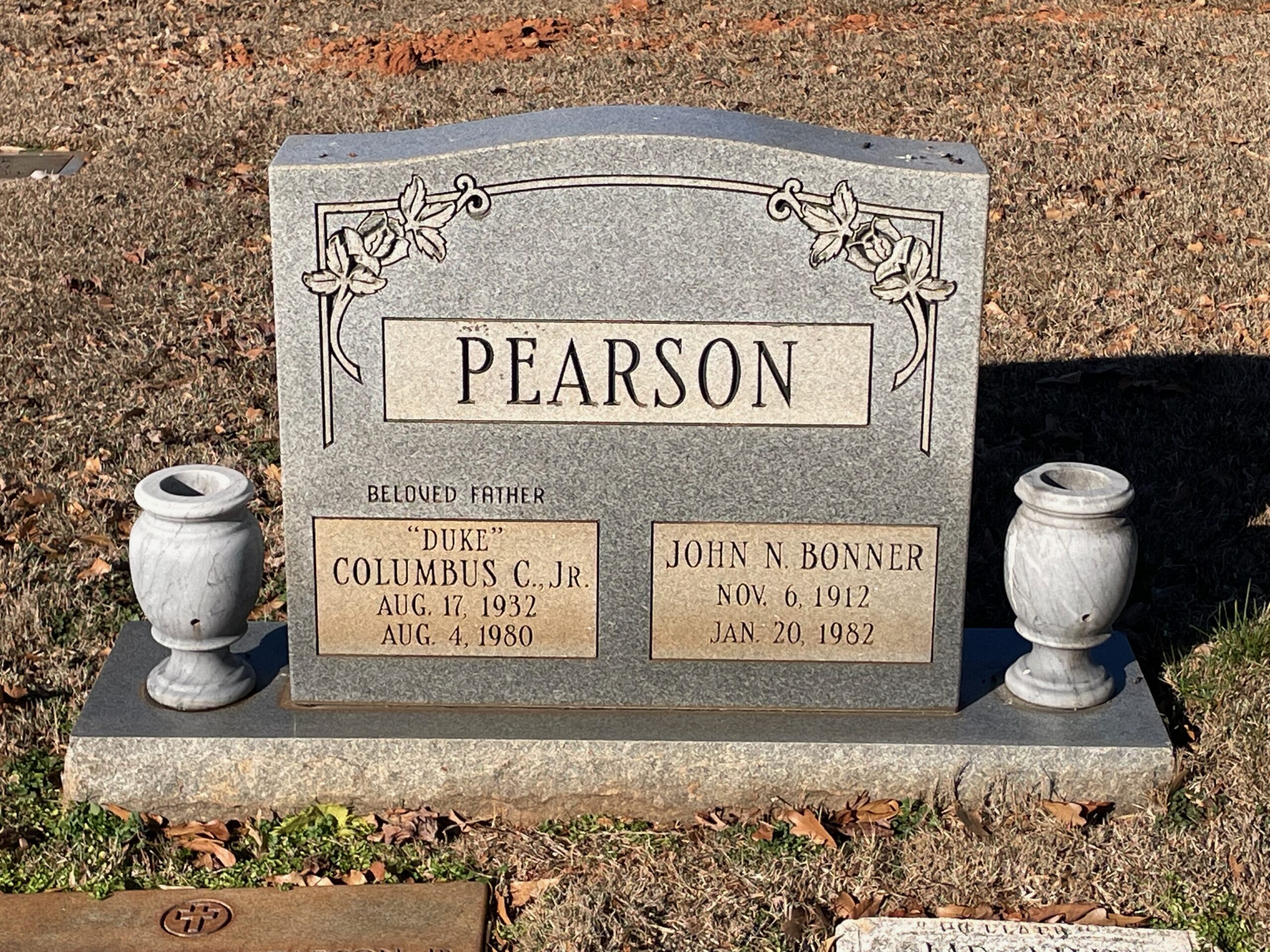
By This is the grave of Duke Pearson.
Born in 1932 in Atlanta, Columbus Calvin Pearson Jr. grew up in a jazz family. His nickname of Duke, which is probably better than being called Junior, came from an uncle who loved Duke Ellington. Doesn’t mean he was destined to become a jazz pianist, but he did in fact become a jazz pianist. That took awhile though. He got piano lessons as a kid, but really enjoyed horns more. The family was firmly in the black middle class, so he got to go to pretty good schools and then Clark College, where he was still playing trumpet in local bands. What changed him back to the piano was his year in the Army. He was drafted in 1953 and was placed into service playing in bands. One of the other musicians doing this at the same time was the pianist Wynton Kelly, whose playing was so wonderful that instead of intimidating Pearson, convinced him to take the instrument seriously again.
Well, it worked out. Pearson became one of jazz’s core pianists after his 1954 discharge from the military. That really began after a 1959 move to New York. No one was going to be a top jazz pianist based out of Atlanta, which isn’t a slight on musicians there (and of course Atlanta has been a real center of American music for many decades now), but simply that no one would notice you in the jazz world if you were in Georgia. Pearson had worked hard on the piano and toured with a lot of musicians around the South, including Little Willie John and Tab Smith. The latter was a bit more jazz-oriented, but fundamentally both were R&B musicians. So if Pearson was going to live out his jazz dreams, it was going to have to happen in a jazz town.
Pearson already had something of a reputation as a writer and arranger. He had managed to get a song called “Tribute to Brownie,” a tribute to the recently deceased trumpeter Clifford Brown, recorded by the Cannonball Adderley Quartet on Sophisticated Swing, released in 1957. I don’t know that album though I am sure it is pretty good given what Adderley was doing in the late 50s.
It didn’t take long for Pearson to get gigs in New York. One evening, he was playing with the Jazztet. This was a sextet founded by Art Farmer and Benny Golson in 1959. A lot of big players came up through this band, including McCoy Tyner and Grachan Moncur. It wasn’t exactly the most forward thinking of groups, as people would notice when its first major gig was also the gig that led to Ornette Coleman first getting attention, a point that annoyed Farmer and Golson. But you couldn’t complain about the quality of musicians moving through the band. Tyner didn’t stick around long, as John Coltrane hired him in 1960. Pearson got the job replacing Tyner. One reason for the constant turnover here is that Farmer and Golson took almost all the money. Anyway, Donald Byrd saw the band one night and asked Pearson to join his new project, the Donald Byrd/Pepper Adams Quintet. Pearson agreed, again, because the money was better. Cedar Walton took over for him in the Jazztet, himself no slouch who later played for years in Art Blakey’s Jazz Messengers.
Now, Pearson didn’t have the Byrd/Adams gig for that long. See, one night he got sick. They needed a replacement for the evening. That replacement was a young fellow named Herbie Hancock. Well, Pearson was pretty fine pianist, but he was not Herbie Hancock. Still, working for Byrd and Adams continued to raise his profile. He worked a lot with Nancy Wilson in the early 60s as well.
But Pearson’s real contribution was as a producer and arranger. Blue Note hired him to do a lot of this work, paying him as an A&R man, while he also recorded for them. He was really pretty skilled at this work. He worked on Donald Byrd’s 1963 album, A New Perspective, where he arranged four of the tracks. It’s worth a note here as well–some might say arranging and jazz don’t belong together, at least not outside of an orchestra. There’s a mistaken belief that jazz is fundamentally about improvisation. That’s at best a half-truth. Even in a lot of modern more experimental stuff, a lot of this is happening within some pretty strict compositional rules. When people say jam bands are like jazz, this is what they are really misunderstanding–they aren’t similar at all. There can be some crossover, sure. But a lot of jazz, from the distant past to the present, has been relatively tightly arranged. No, not every performance is the same and there is room for musicians to do their thing, but we need a greater understanding of what jazz is and is not and Pearson is a good chance to do that.
Pearson worked with a lot of artists in a similar capacity during the 60s, with a particular emphasis on shaping the hard bop era at Blue Note. That included Grant Green’s Am I Blue album from 1963, a couple of Blue Mitchell albums, Hank Mobley’s 1966 album A Slice of the Top, Lee Morgan’s 1967 release Standards, and a lot of Stanley Turrentine albums.
Pearson also worked consistently in Donald Byrd’s band while releasing his own albums. He had great sidemen too–Freddie Hubbard, Stanley Turrentine, Joe Henderson, Ron Carter, Pepper Adams–many of the best musicians of the era appeared on Pearson’s Blue Note releases.
But his last album was recorded in 1970 and not released until 1974. A few things happened that ended his active career. First, Blue Note had a lot of management changes and whether they didn’t want him anymore or he didn’t want them, he stepped away. Second, he got a job teaching back at Clark College. He did a little touring as a sideman in the early 70s and did a big band tour of his own people in 1973, but didn’t record again. Unfortunately, his health started to decline as well. He came down with multiple sclerosis.
It was the MS that killed Pearson in 1980. He was only 47 years old.
Let’s listen to some Duke Pearson:
That ought to get your Saturday going.
Duke Pearson is buried in South View Cemetery, Atlanta, Georgia. And….we have extremely rare video funeral footage, a new frontier for the grave series.
If you would like this series to visit some of the jazz greats who worked with Pearson, you can donate to cover the required expenses here. Lee Morgan is in Feasterville, Pennsylvania and Stanley Turrentine is in Pittsburgh. Previous posts are archived here and here.