
The Great Tolkien Reread: The Great River, The Breaking of the Fellowship
 By
By 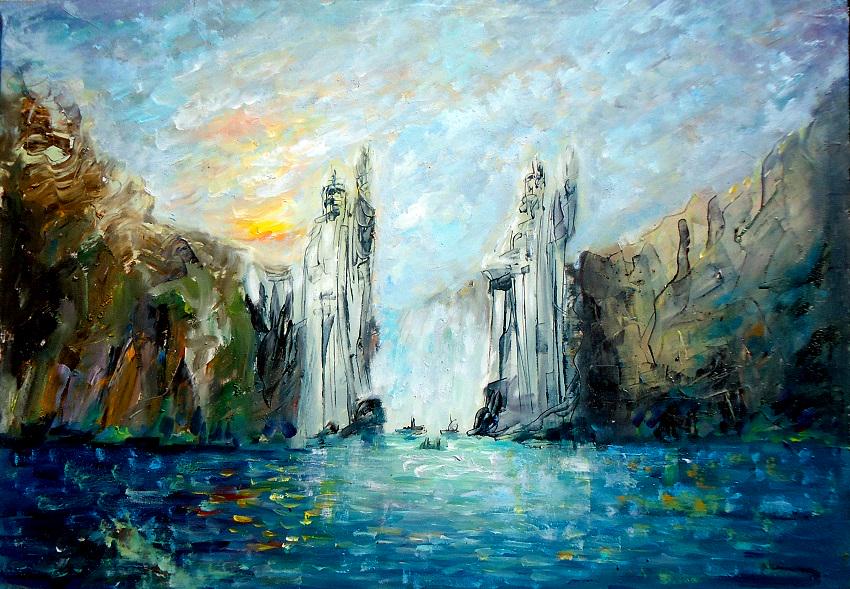
‘Begging your pardon,’ said Sam. ‘I don’t think you understand my master at all. He isn’t hesitating about which way to go. Of course not! What’s the good of Minas Tirith anyway? To him, I mean … he knows he’s got to find the Cracks of Doom, if he can. But he’s afraid. Now it’s come to the point, he’s just plain terrified.’
At long last, we have arrived at the end of The Fellowship of the Ring. And indeed, the end of the fellowship. As the travelers make their way down the river Anduin, the question of their next steps looms ever more urgently. Should they return with Boromir to Minas Tirith, to either regroup before the journey to Mordor or remain there for the duration of the war? Or should they proceed directly into Mordor, and attempt to seek out Mount Doom?
Before we get to this question, there is yet another phase change in the landscape the story moves through. Up until now, our heroes have traveled in a world that has been diminished by the effects of wars long past. A world where the roads are no longer safe and strangers are treated with suspicion. As they move south, they enter an active theater of war. Observing the geography, Boromir and Aragorn keep referring to settlements of Gondor or Rohan that have been abandoned because they could not be defended. Orcs prowl the eastern shore of the river. A nazgûl riding a flying mount appears for the first time. The sounds and smells of war grow ever closer.
Horsemen were galloping on the grass of Rohan; wolves poured out from Isengard. From the havens of Harad ships of war put out to sea; and out of the East Men were moving endlessly: swordsmen, spearmen, bowmen upon horses, chariots of chieftains and laden wains. All the power of the Dark Lord was in motion.
It is against this backdrop that one small hobbit must decide the fate of the world. But this is The Lord of the Rings, a novel that, as we’ve said many times already in this series, does not go in for surprise plot twists. We already know what the correct choice—morally, pragmatically, and dramatically—is. So does Frodo. The only question is how he will find it within himself to make it.
We’ve spoken already about The Lord of the Rings as a religious, and specifically Christian, work. We have seen this religious subtext in the presence of hope and despair as the poles around which the book’s morality is organized, and in its heroes’ reliance on providence to catch them when they make a leap of faith. “The Breaking of the Fellowship” introduces the next plank in the novel’s religious underpinning. By hinging its story on his self-sacrificing choice, it reveals (in case this wasn’t already clear) that Frodo is Jesus. Like Jesus, he is an increasingly ethereal being trapped in a corporeal body. Like Jesus, he is doomed to suffering. And like Jesus, he has to wander a bit with his thoughts and fears before agreeing to sacrifice himself for the good of all.
Frodo did not answer at once. Then he spoke slowly. ‘I know that haste is needed, yet I cannot choose. The burden is heavy. Give me an hour longer, and I will speak. Let me be alone!’
Playing both the tempting devil and Judas in this scenario is, of course, Boromir, whose obsession with the Ring gets the better of him. This has been a long time coming, and both the reader and Frodo himself will have noticed the signs of Boromir’s growing preoccupation with the Ring: from his insistence that it could be used against Sauron at the council of Elrond, to his slip of the tongue in Lothlórien (“‘if you wish to destroy the armed might of the Dark Lord, then it is folly to go without force into his domain; and folly to throw away.’ He paused suddenly, as if he had become aware that he was speaking his thoughts aloud”), to his increasingly erratic behavior on the journey south.
Merry and Pippin in the middle boat were ill at ease, for Boromir sat muttering to himself, sometimes biting his nails, as if some restlessness or doubt consumed him, sometimes seizing a paddle and driving the boat too close behind Aragorn’s
As I’ve written already in this series, Tolkien has gone to some lengths over the course of Book Two to put Boromir in the wrong and make him a less likable figure. In the modern era, these efforts are mostly wasted. Most people have read backwards from the movies—in which Boromir is open-hearted and driven by genuine love of his city—to see Boromir’s story as a tragedy of a hero who is consumed by evil, and who redeems himself through death. But every time I return to the novel, I am reminded that my original reaction to Boromir—the one that I believe I was intended to have—was genuine dislike.
Tolkien’s Boromir is precisely the sort of complex, ambivalent character we keep being told the man could not write. He’s a man of definite virtues. He is brave, loyal, and by his own lights, honorable. If he had never left Minas Tirith, he might have lived and died a hero. But in the wider world, where choices are not so simple, and virtue is more complicated than martial strength, all of his flaws—his arrogance, his self-importance, his inability to admit fault or error—come to the fore. When Galadriel tempts the members of the fellowship with the offer to abandon the quest, he huffs: “It need not be said that I refused to listen. The Men of Minas Tirith are true to their word.” When Aragorn and Frodo decide on a route that does not commit them to the path to Minas Tirith, he whines: “I shall turn to my home, alone if my help has not earned the reward of any companionship.” When Frodo refuses to show him the Ring, he feigns indifference: “‘As you wish. I care not,’ said Boromir”. And when he returns to the company after trying to take the Ring from Frodo, he lies.
‘Where have you been, Boromir?’ asked Aragorn. ‘Have you seen Frodo?’
Boromir hesitated for a second. ‘Yes and no,’ he answered slowly. ‘Yes: I found him some way up the hill, and I spoke to him. I urged him to come to Minas Tirith and not to go east. I grew angry and he left me. He vanished. I have never seen such a thing happen before, though I have heard of it in tales. He must have put the Ring on, I could not find him again. I thought he would return to you.’
In between these scenes we have the confrontation between Frodo and Boromir, which is one of Tolkien’s small masterpieces of character writing. The man speaking both is and is not Boromir. He is eloquent and persuasive, full of a kind of oily compassion (“‘Are you sure you do not suffer needlessly?’ he said. “I wish to help you'”). He speaks with the same chauvinistic valor that has characterized him from day one, but instead of being straight and to the point he’s suddenly spinning castles in the air. And the more he talks, the more he reveals the derangement that underlies his seeming good sense.
Boromir got up and walked about impatiently. ‘So you go on,’ he cried. ‘Gandalf, Elrond—all these folk have taught you to say so. For themselves they may be right. These elves and half-elves and wizards, they would come to grief perhaps. Yet often I doubt if they are wise and not merely timid. But each to his own kind. True-hearted Men, they will not be corrupted. We of Minas Tirith have been staunch through long years of trial. We do not desire the power of wizard-lords, only strength to defend ourselves, strength in a just cause. And behold! in our need chance brings to light the Ring of Power. It is a gift, I say; a gift to the foes of Mordor. It is mad not to use it, to use the power of the Enemy against him. The fearless, the ruthless, these alone will achieve victory. What could not a warrior do in this hour, a great leader? What could not Aragorn do? Or if he refuses, why not Boromir? The Ring would give me power of Command. How I would drive the hosts of Mordor, and all men would flock to my banner!’
Reading these words in 2026, I can’t help but hear the sort of men who have become too prominent in our public discourse. The kind who dismiss experts as weaklings, who believe that ruthlessness is the same thing as strength. Who think their race and gender confer on them superior traits, and do not understand that they are merely expendable tokens for the far worse men they’ve given their loyalty to. (There’s a fascinating but terrifying alternate version of the story in which Boromir brings Frodo to Minas Tirith and promptly becomes an irrelevancy as soon as Denethor gets a whiff of the Ring.) These are the same men who, incidentally, keep telling us that they are fans of The Lord of the Rings, and keep using it to justify their poisonous worldview, apparently without ever having read it.
Boromir is not these men, but a lot of what they say sounds like him. And so, for all that he clearly regrets his actions, I tend to take his final statement (“A madness took me, but it has passed”) with a grain of salt. It’s not that I think he’s lying, exactly; but I suspect that this is the version of the truth that Boromir prefers.
Happily, like Judas, Boromir’s only effect is to achieve the thing he thought he was preventing. Frodo, realizing that the Ring has begun its work within the fellowship, runs off. At the summit of Amon Hen he struggles with the Eye of Sauron, and emerges from that crucible ready for his sacrifice.
Frodo rose to his feet. A great weariness was on him, but his will was firm and his heart lighter. He spoke aloud to himself. ‘I will do now what I must,’ he said.
But though Frodo vows to make that sacrifice alone, the nice thing about writing a character who is Jesus-like is that you don’t have to make them exactly like Jesus. And unlike Jesus, Frodo has Sam Gamgee.
Next time: We are taking another break between books. On August 25th, we will discuss Unfinished Tales, and the entire Tolkien industrial complex that emerged after his death. Those of you who are reading along don’t have to cram the entire 600-page book. Our discussion will be fairly high-level, though we will focus some attention on the chapter “Aldarion and Erendis”.