
Erik Visits an American Grave, Part 2,192
 By
By This is the grave of Erving Goffman.
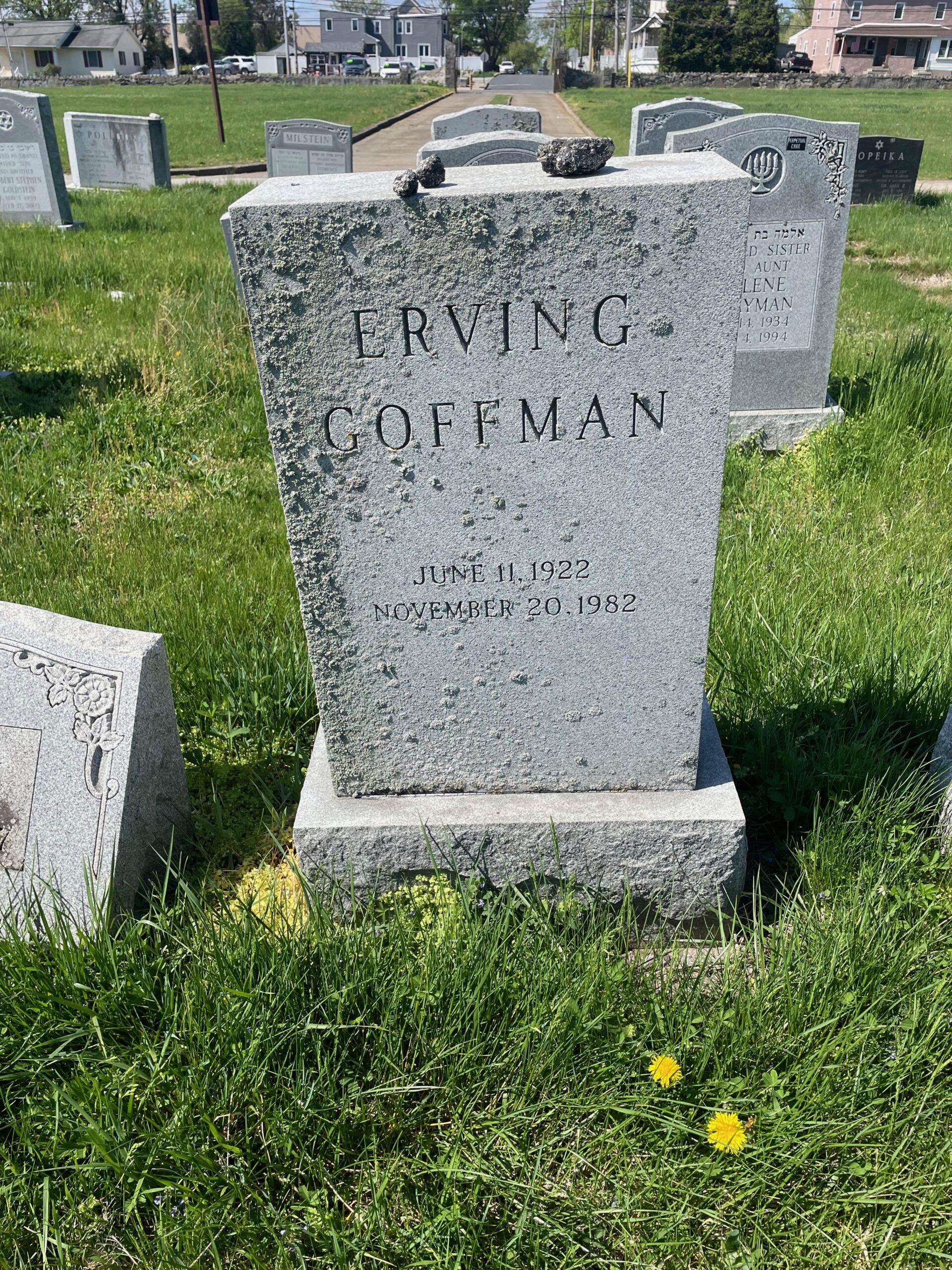
Born in 1922 in Mannville, Alberta, well, wait a minute. If there’s one thing this blog has proven, it’s that nothing good can come from Alberta. Anyway, Goffman grew up in a Jewish immigrant family. His parents had come over when they were young, from what is today Ukraine, at the end of the 19th century. He mostly grew up in Minnesota, where his father moved to start a tailoring business. And who’s ever heard of a Jewish tailor?
The family later moved back to Canada and Goffman went to high school in Winnipeg. He then went to the University of Manitoba. He was a chemistry major. He did not become a chemist. He was interested in other things. He dropped out and took a job with the National Film Board of Canada, living in Ottawa. That sounds fun. While there, he met the sociologist Dennis Wrong (what a last name to be stuck with). He decided that thinking about people was more fun and engaging than thinking about chemistry and he transferred to the University of Toronto, He finished there and started graduate study at the University of Chicago, finishing his PhD there in 1953, working on a project in Unst, in the Shetlands.
Goffman wasn’t really interested in traditional academic sociology so much though. He wanted a bigger audience. He took his dissertation and instead of turning it into the kind of narrow academic volume that most people do (and there’s nothing wrong with that, to be clear), he wrote The Presentation of Self in Everyday Life, his 1956 book that put him on the map as a major intellectual of the postwar era. He actually published it in Scotland first and it didn’t come out in the U.S. until 1959, which is interesting. Goffman brought ideas from the theater into his analysis of this obscure island’s people. Basically, his interest was how people interacted face-to-face and he was, as I understand it, the first person to center this in their sociological analysis. For example, how do people avoid embarrassment? He came up with what he called dramaturgical analysis to understand this. You can go pretty far in the weeds here in understanding his ideas developed in this book, but suffice it to say for our purposes that this was a foundational and transformation text in the history of sociology.
As he published this, Goffman wasn’t even working in the academy. He had a job as the assistant to the athletic director at the National Institute for Mental Health in Maryland. Pretty quickly though, the University of California called and he started there in 1958. He was already working on his second book, based on his time at that institution. That became 1961’s Asylums: Essays on the Condition of the Social Situation of Mental Patients and Other Inmates. This was an important book in understanding the process of institutionalization. He brought his theatrical analysis back again to understand how institutions, everyone performed a role, whether guard or patient, or I suppose, assistant to the athletic director. This book was another foundational book in the sociological literature of the late 20th century.
In 1968, Goffman got an endowed chair at the University of Pennsylvania and he’d stay there the rest of his career. He was politically active based on his work, opposing the routines of mental hospitalization, especially its forced nature. He was a cofounder, along with Thomas Szasz and George Alexander, of the American Association for the Abolition of Involuntary Mental Hospitalization in 1970. They wrote in 1971:
Throughout the entire history of psychiatry, involuntary psychiatric interventions, and especially involuntary mental hospitalization, have been regarded as morally and professionally legitimate procedures. No group of physicians, lawyers, or social scientists has ever rejected such interventions as contrary to elementary principles of dignity and liberty and hence as morally and professionally illegitimate. The AAAIMH does.
The books kept coming at a solid pace as well–Stigma (1963), Interaction Ritual (1967), Frame Analysis (1974), and Forms of Talk (1981). These, from my outsider perspective, seem to be more theoretical than case studies. He was so influential by this time that this is where the value in his mind made sense to lead. Stigma: Notes on the Management of Spoiled Identity explored how people manage their identities when they fall outside of social norms, maintaining their dignity by, say, not telling someone that they have a criminal record. So yeah, a lot of dealing with a stigma is just not telling people about it. Makes all the sense in the world. Interaction Ritual: Essays on Face-to-Face Behavior was a book of essays that built on these previous ideas around how people handle each other in one-on-one scenarios. Strategic Interaction, from 1969, was a game theory book that applied those newer ideas to his overall insights. Frame Analysis: An Essay on the Organization of Experience is about how people organize their experiences. He thought it was his best book, though he evidently was in the minority on that point. It continues to build on his ideas of personal interaction through understanding how we talk to each other, in part.
1979’s Gender Advertisements was an early look at, well, how gender was used as advertising to portray women as passive. A big shift for a guy like this, even looking at gender in 1979 was still new stuff. Note: analyzing the world through a gendered analysis in 2026 is not something new, original, or insightful. It’s something that every scholar and every human should just do every single day of their lives. We don’t need to pretend it is 1979 anymore on this. If you aren’t analyzing the world through gender, race, and class every single day, you are intentionally not understanding the world. Forms of Talk was another book of essays that included an early essay on the impact of what listening to people talk on the radio does to you.
Now, I am not a sociologist and I am sure some readers are. So I hope I relayed all this information correctly. What I can say that is Goffman is one of the most important sociologists of the late 20th century, someone everyone else cites, even to the present.
And yes, Erving Goffman is the father of the infamous sociologist Alice Goffman, whose, er, questionable methods and findings have been discussed by my comrade Paul Campos in many posts here over the years.
One more thing about Erving other than having ethically impaired children; He was a big time gambler and worked as a casino pit boss for awhile. This was for “ethnographic” purposes. Sure, OK.
Goffman died in 1982, at the age of 60. Stomach cancer. Ouch.
Erving Goffman is buried in Mount Lebanon Cemetery, Collingdale, Pennsylvania.
The year Goffman died, he was president of the American Sociological Association. If you would like this series to visit other ASA presidents, who mostly do not have children who fabricate their research, you can donate to cover their required expenses here. Peter Rossil, who mostly studied homelessness, is in Colma, California. Matilda White Riley, a specialist in aging, is in Brunswick, Maine. Previous posts are archived here and here.