
Erik Visits an American Grave, Part 2,188
 By
By 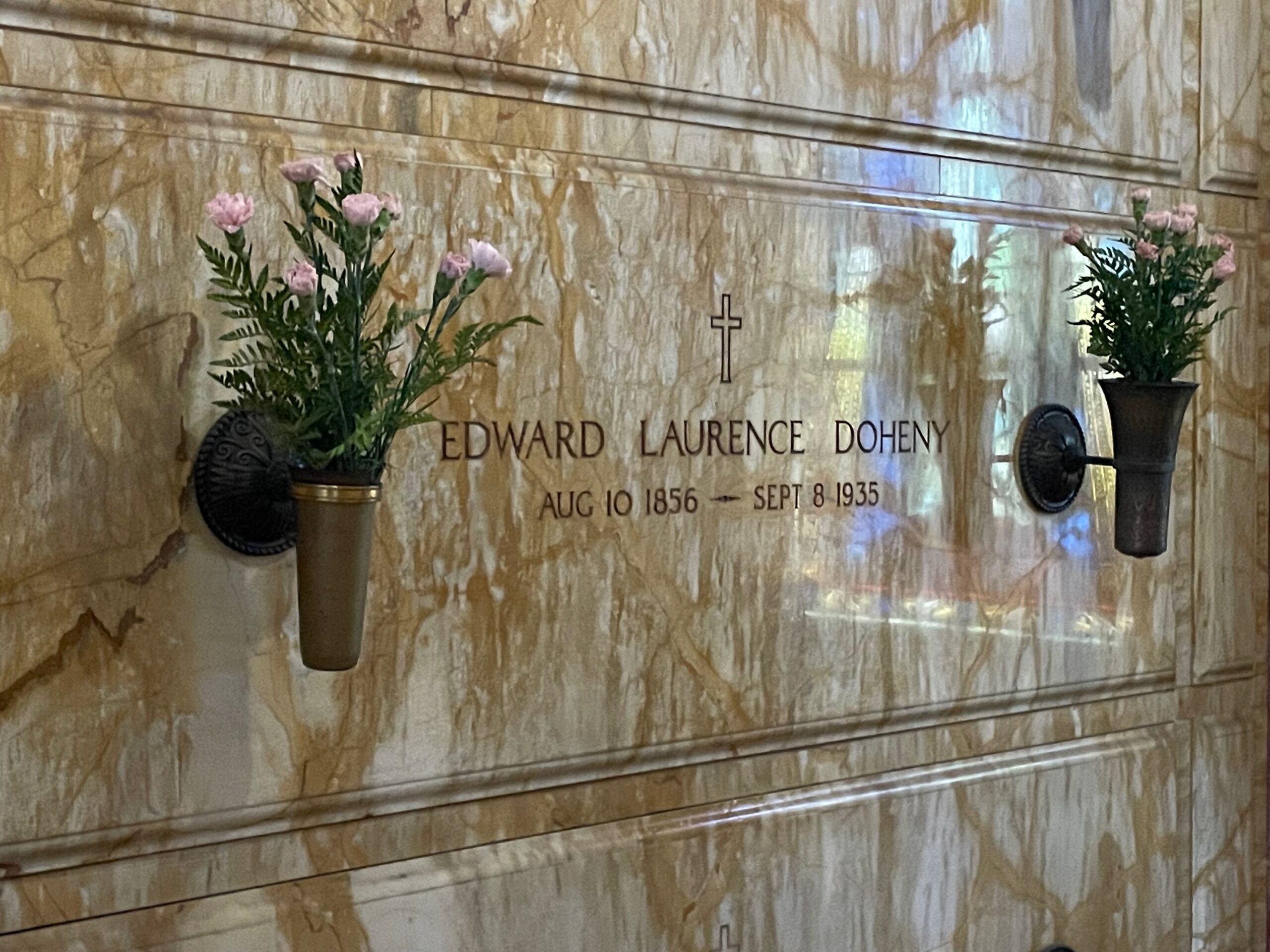
Born in 1856 in Fond du Lac, Wisconsin, Doheny grew up there, the son of an Irish immigrant who worked hard jobs and a Canadian mother. He was a smart kid, graduated from high school in 1871, only 15 years old. His father died and he went west, getting a job with the U.S. Geological Survey in 1873 as a surveyor when whites were stealing lands from the Kiowa and Comanche, part of the genocide that defines this nation’s horrific history. He then left that and decided to go hunt for minerals in the West, like so many other crazy prospector types, determined to make it rich. The vast majority of them–enormous, overwhelming majority–failed. Edward Doheny did not fail.
Now, it took him a long time. He was in Arizona and New Mexico during the early 1880s, working in the mines or working to raise money to his mineral pursuits through regular jobs. The 1880 census listed him as a painter in Prescott, Arizona. He then was in Iron King Mine outside of Hillsboro, New Mexico. Here, he met Albert Fall, the future extremely corrupt Secretary of the Interior under Warren Harding, and Charles Canfield, who became his business partner in the future. But really, Doheny for years and years was just another miner and prospector. There were small successes here and there. He wasn’t bad at it. Canfield had been a lot more successful though and in the early 1890s, he lured Doheny went to Los Angeles.
It wasn’t until 1892 that anything really happened for Doheny. He heard that natural asphalt was coming up at the LaBrea Tar Pits, so he started prospecting. There was oil. It did OK, but it was enough to keep investing. Now, unlike the fictionalized story told about Doheny’s life, first in Upton Sinclair’s novel Oil and then in Paul Thomas Anderson’s astounding film, There Will Be Blood, itself sort of based on Sinclair, Doheny did not discover the gigantic strike out in the middle of the desert. He built up well after well in the Los Angeles area and came to dominate the California oil industry in that way.
And yet, those stories, even if the details are vastly different than Doheny’s actual life, really do ring true of the man’s character. He was brutal and completely unscrupulous. He made tons of money, in part by buying influence. That’s where Albert Fall came back into his life. In 1921, Doheny paid Fall off to gain an oil field in California. That led Fall to start accepting bribes all the time, which itself lead to the legendary Teapot Dome scandal, though Doheny did not have anything directly to do with that, which was Harry Sinclair’s bribed deal. Both of these were owned by the U.S. Navy.
Doheny expanded his power constantly, buying off the railroads to change their fuel from coal to his oil. He started expanding in Mexico, sending his men to find the first oil well in that nation in 1901. This was the era of Porfirio Diaz and his cientifico and men such as Doheny were welcomed to modernize the nation and bring money to rich people. So Doheny dominated the Mexican oil industry until the Mexican Revolution, which started in no small part as a rejection of dominating American investors such as he. It wasn’t until the nationalization of the Mexican oil industry under Lazaro Cardenas in 1938 that men such as Doheny would lose their holdings. He got extremely rich from Mexican oil, more than he ever did from California oil. The big gushers that There Will Be Blood shows him getting in the deserts of California were really on the Gulf coast of Mexico. He invested heavily in the early Venezuelan fields as well. In fact, at one point, he was America’s richest person. He also was smart enough to start divesting from his Mexican investments in 1927, a decade the nationalization he thought likely happened.
Eventually, Doheny did come under pressure for the bribes to Fall. He had to go on trial in 1929. In fact, the end of There Will Be Blood–in fact shot in Doheny’s mansion in LA–sorta kinda happened, but in a very different way than that film. Basically, Doheny’s son Ned got into an argument with a man who was going to testify against his father and the company in said mansion, which at that time Edward had given to his son. Ned Doheny killed the guy and then shot himself dead. Ned had delivered the money to Fall personally, so he was in big trouble here.
After Ned’s death, Doheny largely disappeared from public life, becoming a recluse. He still had to go on trial, which happened in 1930. They pulled the later mafia trick of making him seem old and frail, though it wasn’t entirely untrue by this time. Even though Fall was found guilty of accepting the bribe, Doheny was found innocent of offering the bribe. Ah, juries.
Doheny died in 1938, at the age of 78.
Edward Doheny is buried in Calvary Cemetery, East Los Angeles, California.
If you would like this series to visit other oilmen, you can donate to cover the required expenses here. J. Paul Getty is in Pacific Palisades, California and T. Boone Pickens is in Stillwater, Oklahoma. Previous posts in this series are archived here and here.