
Russian Sovereignty
 By
By
The Economist has published an essay by Andrey Melnichenko, a Russian industrialist who is under sanctions. There is nothing new in it.
Melnichenko makes an argument about the war in Ukraine and the time following that is different from Vladimir Putin’s extensive rants on historical determinism requiring that Ukraine submit to Russia’s domination. But it is an argument that can support those rants and one that has been made before in favor of Russia.
Putin has also made Melnichenko’s argument: Russia must be sovereign. The war in Ukraine is an attempt by the West to force Russia under its domination and deprive it of its sovereignty. That word – sovereignty – has often featured in Russian arguments about its place in the world, but its proponents never define it. The closest Melnichenko comes is
Russia today possesses sovereignty: it has made and continues to make its decisions independently.
Melnichenko posits four outcomes that he believes are acceptable to the West as the outcome of the war with Ukraine: “a humiliated Russia, lingering on the periphery of the West;” Russia subordinate to China; a fragmented Russia; and a fortress Russia, under permanent siege. He does not work out what a future with his “sovereign Russia” would entail. The bottom line is that if the West doesn’t give Russia what it wants, the West will be sorry.
It’s an old argument. Russia must be part of Europe’s security architecture, but Russia must be free to do whatever it wants. The nature of a security architecture is that each participant gives up a bit of freedom of action to support that security.
Back in the 1990s, there were times when it looked like Russia might almost join NATO. Joint projects were undertaken between Russia, the US, and Europe. But when push came to shove, Russia wanted to be able to shove to preserve its “sovereignty.”
The fact that the US is much more powerful than Russia militarily and economically impinges on that sovereignty. Russia would like to be considered the other major world player. It has nuclear weapons to assure that it can’t be counted out, but Russia making decisions that France and Germany would have to accept? Uh, no.
What is more interesting than the argument itself is its timing, when Ukraine may be seizing the initiative in the war. Reporting on the internal workings of Russian politics has always been difficult, moreso under Putin, and now by understaffed news services.
There is some mumbling aroundthat big changes are at hand in the Russian government. The Wall Street Journal even indulged in this speculation this week.
Putin is running into problems. Ukraine is cutting off Crimea from military supplies and water.. The Ukrainian campaign against Russian oil refineries and storage facilities is paying off in long gas lines and increasing unavailability of gasoline in Russia. This is the kind of thing that can lead to a change in government, or at least a willingness to negotiate for peace.
Is Melenchenko speaking for Putin? Is the essay a feeler to assess Western reaction?
If Melenchenko is not speaking in a way that Putin approves, then we can expect to hear of his falling out of a window or becoming suddenly ill. Or perhaps leaving Russia.
More interestingly, is he speaking for a group of industrialists who see the war as unwinnable and want sanctions removed? He has framed his argument in a way that Putin can find consistent with his aims, but he may be trying to move Putin toward a settlement. The dour four outcomes would be unacceptable to him and his fellow industrialists too.
For now, it looks like a small feeler to judge Western reaction.
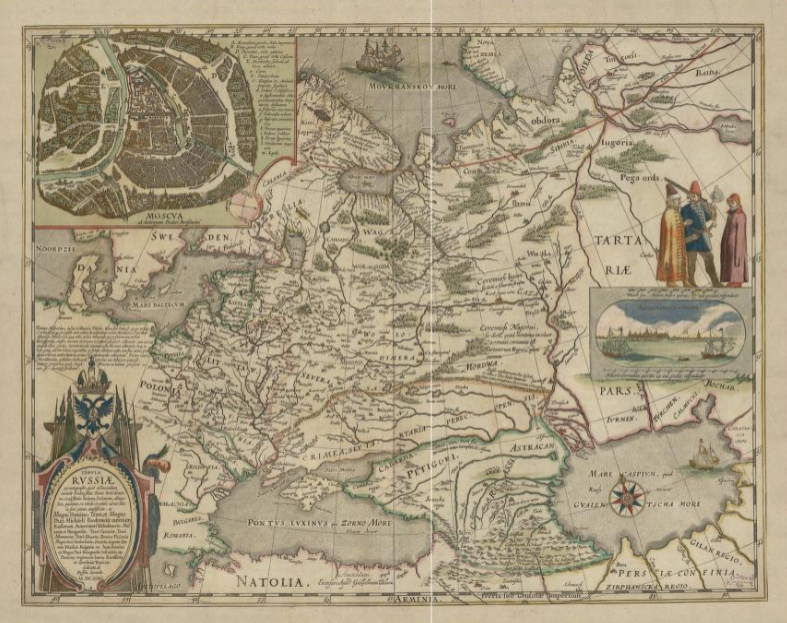
The map is Tabula Russiae ex autographo, quod delineandum curavit Foedor filius Tzaris Boris desumta; et ad fluvias Dwinam, Zuchanam, aliaque Loca, quantum ex tabulis et notitus ad nos delatis fieri poluit, amplificata : ac Magno Domino, Tzari, et Magno Duci Michael, published in Amsterdam, 1614.