
Erik Visits an American Grave, Part 2,157
 By
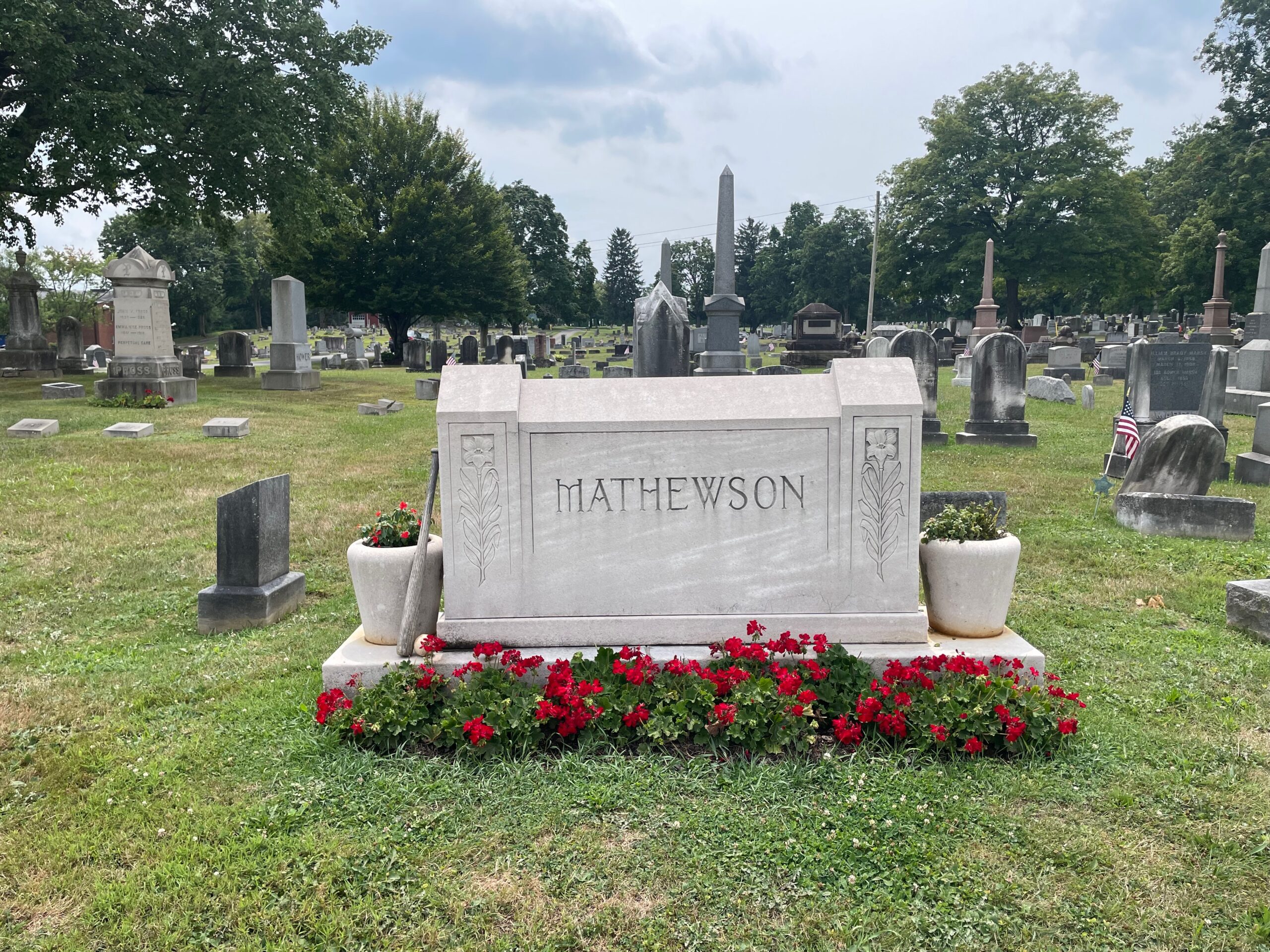
By This is the grave of Christy Mathewson.
Born in 1880 in Factoryville, Pennsylvania…ok wait a minute. Factoryville? Let’s just say that was a naming of ambition rather than reality. The 1880 census showed 462 people in that tiny northeast Pennsylvania town and it never had more than 1,300 (in 1990). So that’s that. Anyway, Mathewson wasn’t your usual coal mining kid. He went to good schools and then got into Bucknell University, a very fine liberal arts school in Pennsylvania. It’s in Lewisburg, which I will also note might be the only decent small town in the Keystone State. He was a great athlete and a very popular kid, class president as well as being a star in all three major sports. He was already a good pitcher in his teens and pitched some semipro ball during high school.
Now, we all know that Mathewson made his name as one of the greatest pitchers in baseball history, but before we get to that, I want to note that he was also a two-sport professional athlete. He was playing a bit of pro football as early as 1898, as early as professional football gets. He then played for the Pittsburgh Stars in the first NFL (not connected to the current rendition) in 1902, but then stopped in the middle of the season, possibly because the New York Giants, the baseball version for whom he played, found out and told him to knock it off.
In any case, Mathewson played minor league ball in 1898 and 99 and then the Giants signed him in 1900. He was terrible, which is hilarious given what was to come. In fact, he was so bad, they sold him back to Norfolk after six games. Norfolk then moved him back to the majors, to the Cincinnati Reds, just after the season. The Reds then traded him back to the Giants. That worked out pretty well for New York.
Mathewson immediately dominated the National League. In 1901, he led the league with 8.8 WAR on the Baseball Reference version of the stat. He only went 20-17, pitching a mere 336 innings. But of course wins is not a pitching stat, despite the thickheadnesses of so many writers over the years. The thing about Mathewson is not just that he was awesome, but he had an iron arm. He pitched over 300 innings a year every single year through 1914, except for two, when sickness or injuries moved him only into the high 200s. He had diphtheria of all things in 1906, which limited him to 266 innings. He was the first pitcher to perfect the screwball and that was something that hitters could not figure, especially when added to a plus, if not super elite, fastball. Mathewson led the league in wins four times, in ERA five times, and strikeouts five times. He only led the league in innings once, suggesting just how much these guys were pitching. He was great throughout, but his peak was 1907-10. He led the NL in WAR all four of those years. In 1908, he was worth an astounding 11.8 WAR, pitching 56 games and starting 44 of them, with 11 shutouts, 37 wins, and 259 strikeouts. The next year, in 1909, he went 25-6 with a ridiculous 1.14 ERA. That was the year he only pitched 275 innings and still was worth 9.7 WAR. Had he pitched at that quality for his normal year, he would have surpassed even the year before. Just totally ridiculous stuff here.
All of this happened with Mathewson refusing to play on Sunday. He was a devout Christian and would not engage in such sin. He wanted to get paid, which was so hard to do in these years. The Cleveland Browns signed him away from the Giants in 1903 for four times the salary, but then the contract was cancelled after the NL and AL made peace and stopped stealing each other’s players. Need to keep the players making nothing after all. He wasn’t a bad hitter either, at least for a pitcher, and could knock one out of the park every now and then. In his free time, he started writing, including a memoir that went well and even a play about baseball.
Mathewson’s arm finally gave out before the 1914 season. He pitched a bit longer, but was terrible. He was traded to the Reds in 1916 and finished his career there, with a mere 373 wins. He started managing the Reds at this time. But then in 1918, he quit to join the Army in Europe. He was commissioned as a captain in the Chemical Warfare Service. While there, he might have been exposed to poison gas. There are differing stories here. but either way, he also developed tuberculosis–which had already killed his brother (who had himself pitched for the Giants briefly). The Giants hired him to coach in 1919, but he wasn’t healthy enough to do so that much of the time. Instead, he was spending much of his time at a tuberculosis rehab facility in Saranac Lake, New York. But recovery was not in the cards. Mathewson died in 1925. He was 45 years old.
Christy Mathewson is buried in Lewisburg Cemetery, Lewisburg, Pennsylvania.
Mathewson was named to the first Hall of Fame class in 1936, along with Babe Ruth, Ty Cobb, Walter Johnson, and Honus Wagner. They were all living, but not Mathewson.
According to Baseball Reference’s JAWS stat, Mathewson is the 10th best pitcher of all time. If you would like this series to visit other top pitchers, you can donate to cover the required expenses here. Randy Johnson is #9 and Greg Maddux is #8. They still live. Tom Seaver is #7, but has no grave at this time. We have visited Kid Nichols at #6. Lefty Grove is #5 and is buried in Frostburg, Maryland. Warren Spahn is #11 and is in Hartshorne, Oklahoma. Previous posts in this series are archived here and here.