
This Day in Labor History: June 7, 1912
 By
By 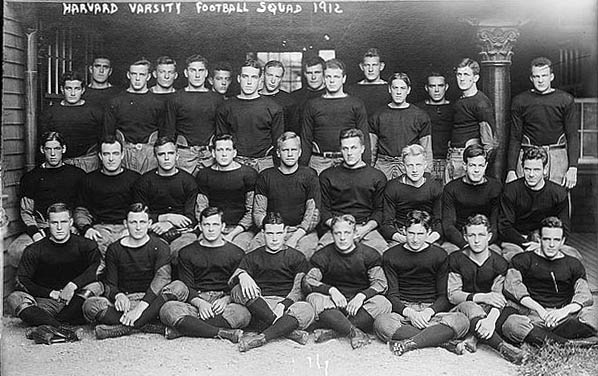
On, June 7, 1912, Boston Elevated Railway workers called a strike. But the company had a secret force–Harvard students. Harvard men were more than happy to be hired thugs to break this strike in an act of class solidarity we rarely see from the working classes. This is a good chance to talk about the strikebreaking college student of the early 20th century.
College students in the early 20th century nearly all came from the middle classes and above. And while some upper class kids might express some level of solidarity with strikers–see upper class women coming out to support the Uprising of the 20,000 in New York in 1909, including J.P. Morgan’s daughter of all people–the vast majority were ready to take over daddy’s company and daddy’s ideas and that very much included busting labor.
Now, most college students were men and elite ideas of masculinity could very much play into class-based violence against striking workers. Upper class men were obsessed with proving themselves as men in the late 19th and early 20th century. This created all sorts of new things in America (and also western European) society. The Marquis of Queensbury Rules in boxing (the Marquis is also who had Oscar Wilde imprisoned for having sex with his son). Hunting laws to protect game for the rich. The Boy Scouts. The rise of college football and the NCAA to regulate it so that upper class men could prepare themselves for the ultimate combat–war. The Spanish-American War had given this class just a taste of the fun war could be. But could our upper class men really be the leaders America needed to lock in its dominance as an Anglo-Saxon power? Lots of people questioned this.
Meanwhile, who were striking workers? Catholics. Italians. Jews. Eastern Europeans. The unwashed proles. College students expressed an amazing sense of class solidarity, the kind that labor activists only wish the working class had–they hated the poor. They had leadership from the top there. Harvard president Charles Eliot was called “the greatest labor union hater in the country” by labor publications. Eliot called the strikebreaker “a kind of hero.” It wasn’t just radical labor who hated Eliot either. American Federation of Labor president Samuel Gompers routinely denounced Eliot, saying, for example, that Harvard’s president had the “inordinate desire to make the institution over which he presides the mentor and apologist for predatory wealth.” My friends, that has not changed one bit in university administration. But it was hardly just Eliot. After he retired, A. Lawrence Lowell did the same thing in recruiting students to bust the Boston police strike of 1919. Nicholas Murray Butler, president of Columbia, called the strike “an act of war.” And really, what is more class warfare than the rich seeing strikes in this way.
So of course college students were going to bust strikes. They came from wealthy backgrounds or they wanted to be accepted by the wealthy. They were going to take over Daddy’s companies. Their professors and university administrators were telling them to go beat up Italians and Jews. When William Jennings Bryan spoke at Harvard in 1896, the students shouted him down.
So in 1912, Harvard students were already motivated to bust strikes. That year, textile workers in Lawrence, Massachusetts had gone on strike. This is the famous “Bread and Roses” strike that the IWW helped lead. Town elites set up Wobbly leaders for murder, imprisoned organizers, and then when workers tried to get their kids out of town to sympathetic socialists elsewhere, the cops beat the shit out of the mothers and children. Well, Harvard students thought this was all great and participated in strikebreaking and beating up immigrant workers north of their bastion of elite privilege.
Boston’s rail workers had tried to organize since at least 1897, when an initial strike failed. In 1912, having formed the International Association of Car Men, the rail workers tried to convince the management of the L as it was called (as opposed to the T today) to negotiate an agreement. The L’s leader, William Bancroft, responded by hiring over 200 union workers. With Bancroft unwilling to be a decent human being, the workers voted 1389-8 to strike. Over the next 6 weeks, an intense strike took place.
The strikers were willing to enforce order through beating scabs. So Bancroft called over to Harvard and had students come to work as enforcers against the union. The courts, staffed heavily with Harvard graduates, were happy to do things such as sentence union members to prison for using the word “scab” as an insult. Things got so bad that finally the Boston political class intervened, including John “Honey Fitz” Fitzgerald, a rising power in the city. Arbitration and a political class with working class roots now turned on the elites used to running the city forced the company to back off, with very real threats of the city taking over the rails. Eventually, an open shop was established, but also a union contract. It was a real win for the workers.
Interestingly here, the region’s women’s colleges saw students come up to support the strikers and lambast college men for hurting the poor. Wellesley students particularly challenged the Harvard, as well as Yale, students who came up to strikebreak. Wellesley students raised over $1,000 to support the strikers and wore buttons proclaiming their support of a boycott. And lest you think that these women’s college students were some sort of radicals, in 1911, the students at Wellesley–considered the most liberal of the women’s colleges–voted down support for suffrage by a 2-1 margin.
Again, Harvard would learn nothing here and its students remained active strikebreakers for years. Sometimes, workers struck back against these Harvard assholes. In 1919, Harvard, MIT, Tufts, and Brown students all came together to try and break the telephone operators strike. Some of the strikers began targeting college students and beating them nearly to the point of death. At least one had his teeth kicked out. These were male supporters their sisters and girlfriends and wives striking, which tells us that these college students were happy to break any strike. And they were back in the 1923 telephone operators strike too. Oh, and guess which major really was into strikebreaking? Oh yeah, it was the engineers. Some things never change. After all, those damned strikers got in the way of efficiency and getting the job down to maximize profit. Is there anything engineers won’t do in service of that goal? That’s a rhetorical question–morals have never entered into the minds of engineers.
This Harvard example of strikebreaking is far from the only one. There’s a bunch. My favorite is a bunch of University of Washington students busting a strike in Seattle around this time. This is my favorite for the simple and pure reason that I hate the Huskies and Go Ducks so now I can use this against the evil purple people.
I borrowed from Stephen Norwood, Strikebreaking and Masculinity: Mercenaries and Masculinity in Twentieth Century America to write this post.
This is the 606th post in this series. Previous posts are archived here.