
Erik Visits an American Grave, Part 2,156
 By
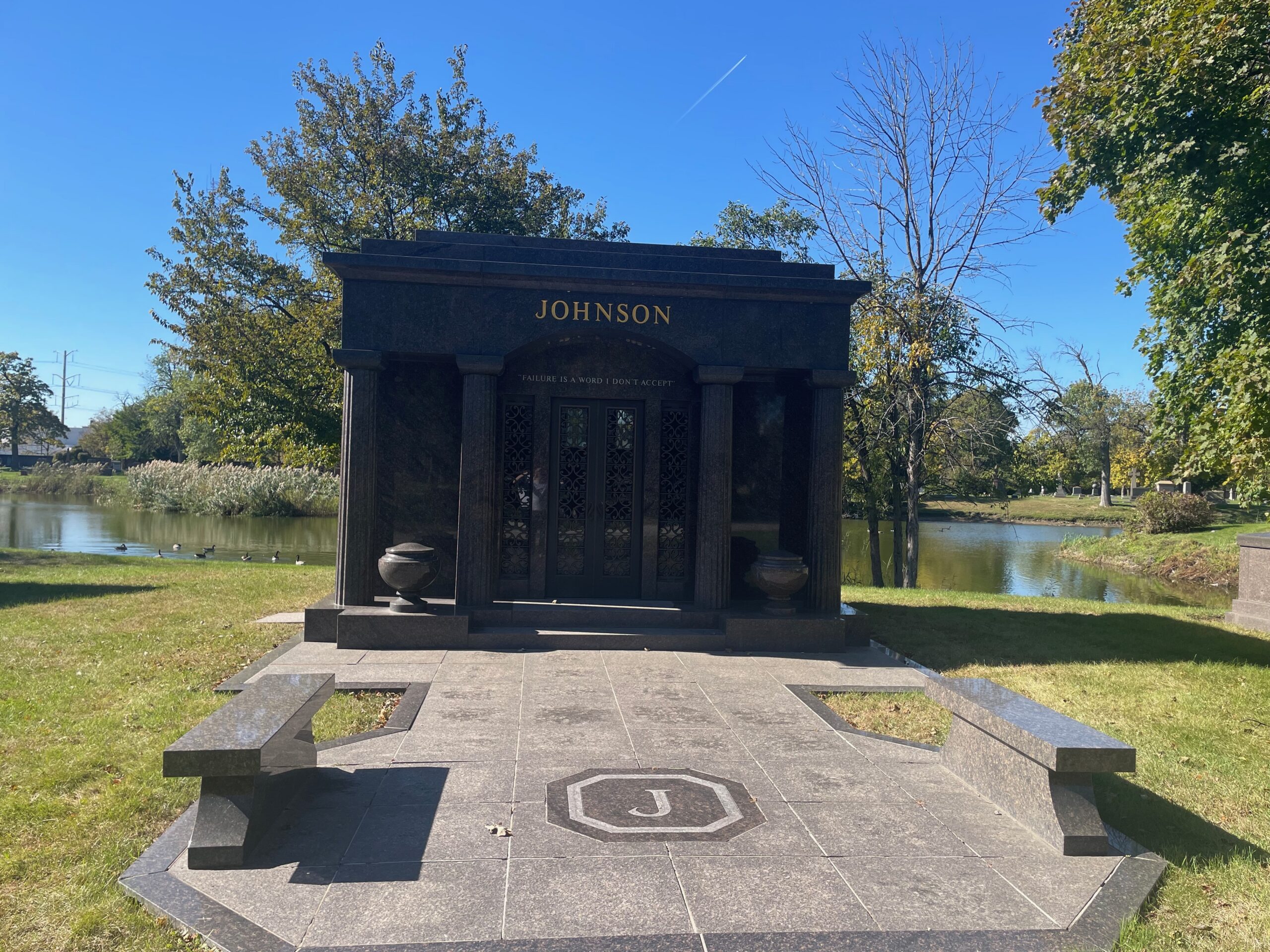
By This is the grave of John and Eunice Johnson.
Born in 1918 in Arkansas City, Arkansas, John Johnson grew up poor, like so many black Americans. His father worked as a logger, a very dangerous job that thus was coded as a black job in the South. He was killed in an accident in 1926. Then the Mississippi River flooded in 1927 and the Johnson family lost everything. The family moved, first to Vicksburg and then in 1933 to Chicago, following the Great Migration. They remained extremely poor. But Johnson really wanted an education and he showed a lot of determination to get that in an atmosphere where that was very difficult. He started giving speeches and winning little scholarships and then the University of Chicago offered him free tuition. He thought he wouldn’t accept it–how would he pay the rest of the expenses? But then he gave a talk to some civic group and a life insurance exec named Harry Pace said he’d hire him so he could work his way through school. The answer of this Horatio Alger-type story (presumably without with the pedophilia of the actual Alger) was that Johnson became a huge promoter of black capitalism as he found success.
Johnson actually didn’t finish college. He dropped out in 1939 because he was so successful with Pace. He started editing the company’s magazine and he moved into media. He started compiling news stories related to the black community and thought about a black version of Reader’s Digest. This became Negro Digest, founded in 1942. At about the same time, he met a woman named Eunice Walker. Born in 1916 in Selma, Alabama, Walker stayed there growing up and went to Talladega College. She then went to Chicago for a master’s degree at Loyola. She and Johnson met and they married in 1941. They would prove a formidable couple of black media for the rest of their lives. She worked very closely with him on the Negro Digest and then they became powerhouses for new forms of black media.
In 1945, the Johnsons created Ebony. It’s hard to overstate the power of this magazine. It was a glamorous publication, a real nice glossy, that portrayed middle and upper class black life. Eunice named it and she really nailed that name. The first issue read:
We like to look at the zesty side of life. Sure, you can get all hot and bothered about the race question (and don’t think we don’t), but not enough is said about all the swell things we Negroes can do and will accomplish. Ebony will try to mirror the happier side of Negro life – the positive, everyday achievements from Harlem to Hollywood. But when we talk about race as the No. 1 problem of America, we’ll talk turkey.
Ebony became THE publication of black America by the 50s and 60s. The Johnsons were of course good civil rights figures, but they were not radicals, certainly not on economic issues. But they held true to their vision for a long time. Ebony would profile the black community very widely. When the Black Power era rose, they included that too. There were profiles of Stokely Carmichael and other radicals. There were columns by and about radicalism. And of course there was Lena Horne and Sidney Poitier and Willie Mays and Adam Clayton Powell. The whole idea behind Ebony was Life for a black audience. They succeeded, quite profoundly, in this goal.
There was also Jet. Founded in 1951 by the Johnsons, Jet was intended to be a less glossy news and entertainment magazine, or as he put it “The Weekly Negro News Magazine.” There would be a ton of coverage of civil rights issues in Jet. That included publishing the famous photos of Emmett Till’s beaten body from his open-casket funeral. Right there, Jet sparked a lot of change in America, since actually seeing the body of a lynched kid really did move a lot of people who didn’t care that much about civil rights into caring a lot, and that very much included whites. In 1973, they created Ebony Jr, which was a Highlights-like magazine for young black kids. This didn’t do so much, but it was a good try and it got me thinking about Highlights for the first time in many moons.
One of Eunice’s big projects was fashion. Basically, the fashion industry was and is super racist. Starved young white women remains the order of the day. The Ebony Fashion Tour started in 1958 to raise funds for a black hospital in New Orleans, but it became a thing that would increase the prominence of black models and raise a ton of money for charity. In 1973, Johnson also created Fashion Fair Cosmetics, specializing in makeup for black skin tones. It’s hard to overestimate the importance of the fashion side of the Johnsons’ missions here. Eunice especially but also John really understood how western standards of beauty affected black communities and the need to push back on this. Now, they weren’t totally immune–light-skinned black people did dominate covers and models for a long time, but as you are trying to fix major issues in the world, you also have to fix them in yourself, as those major issues have impacted you too. So they were trying and, for the most part, they were succeeding.
As John Johnson became rich, he also really enjoyed being a power player in our capitalist institutions. He got onto the board of 20th Century Fox, Zenith, Chrysler, all sorts of places where whites felt they needed a rich black guy who wouldn’t rock the boat too much and defend labor unions or stuff like that He bought radio stations and tried to go into TV, though never had a ton of success there. Bill Clinton gave John Johnson the Presidential Medal of Freedom in 1996. Johnson made the Forbes 400 Richest Americans list as well. There was a big market for what he was selling and he knew how to tap it.
John Johnson died of heart failure in 2005. He was 87. Eunice died in 2010 of renal failure, at the age of 93.
John and Eunice Johnson are buried in Oak Woods Cemetery, Chicago, Illinois. Prime real estate in there too.
If you would like this series to visit other black media figures, you can donate to cover the required expenses here. Robert Abbott, founder of the Chicago Defender, is in Blue Island, Illinois and Samuel Cornish, who co-founded the first black newspaper in American history, is in Brooklyn. Previous posts in this series are archived here and here.