
The politics of water in Iowa
 By
By 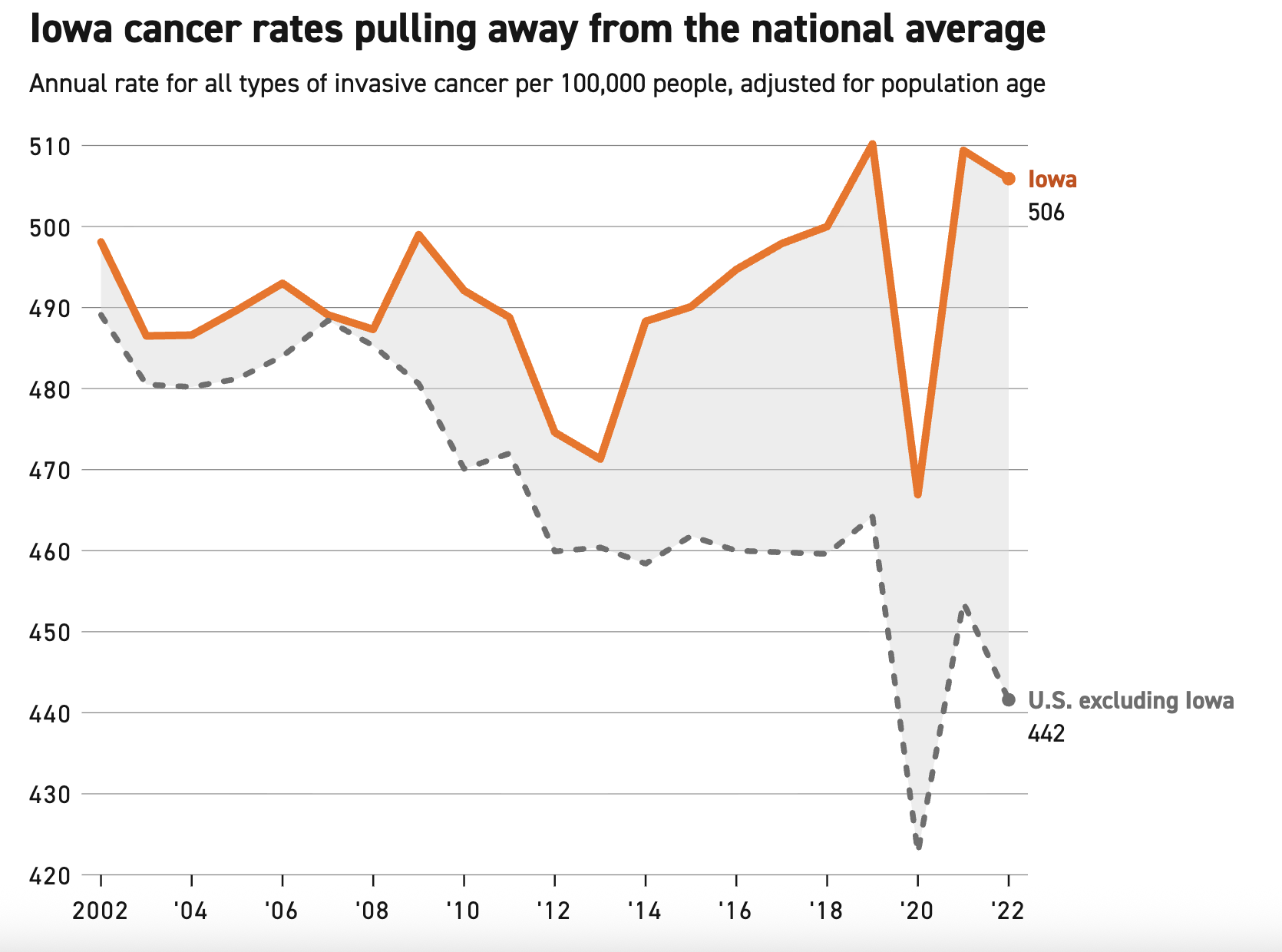
One interesting thing about the political landscape in 2026 is that Democrats are looking surprisingly competitive in statewide races in Iowa. even relative to the favorable national context. According to this story, one reason for that is the increasing risks being posed by water pollution in the state:
Iowa has a long-simmering water problem that has finally begun to boil over — and it’s changing Iowa politics. People are angry and worried about the quality of the state’s water, the health risks it poses and its increasingly undeniable tie to the state’s signature industry: agriculture.
In recent years, Iowa’s cancer rate has climbed significantly above the U.S. average. It now stands as the nation’s second highest, and Iowa is one of only three states where the rate is rising. The situation has put a spotlight on nitrates, which are linked to a growing body of science to kidney, brain and ovarian cancer. Nitrates are a key component in the deluge of chemical pesticides and fertilizers used by the state’s farmers, some of which washes off farm fields and into waterways. A second culprit is glyphosate, the active ingredient in Roundup, the world’s most common weedkiller, which the International Agency for Research on Cancer declared “probably carcinogenic” in 2015, an assessment rejected by the U.S. Environmental Protection Agency.
Historically, candidates for state-wide office in Iowa, from governor to agriculture secretary, Republican or Democrat, have avoided criticizing the agriculture industry, opting instead for platitudes about how Iowa’s farms “feed the world.” This year is different. Voters are steaming mad, and candidates on both sides of the political aisle are pointing fingers at Big Ag — and winning.
And in a change that has drawn national attention, some of those winning candidates are Democrats. The water crisis and the shifting views of agriculture are scrambling Iowa’s politics, including its traditional partisan divides. In last month’s primary, voters delivered surprises to candidates on both the Republican and Democratic sides of the ballot.
[…]
As for the Democrats, they have their best shot in a decade or more of winning statewide offices in November’s election. Democrat Josh Turek is neck-and-neck in recent polling with Republican Ashley Hinson in the open race for U.S. Senate. And Lahn’s Democratic opponent, Rob Sand, bested him by one percentage point, within the margin of error, in recent polling in the governor’s race.
And then there’s Chris Jones. His bid to become secretary of agriculture — as a Democrat —may be the most unexpected development so far. He’s running an insurgent campaign in a deep red state to reduce the agriculture industry’s dependence on toxic chemicals, crack down on large livestock confinements, and most important: to clean up the water.
[…]
His Republican opponent is the incumbent secretary of agriculture, Mike Naig, who can’t really run on water. That’s because, of all things, he actually worked as the manager of state and local government affairs in Iowa for Monsanto, the maker of the widely used herbicide Roundup, which is now owned by Bayer. Naig puts a sunny spin on the water problem, doubling down on the state’s voluntary approach to cajoling farmers to pollute less while insisting that things are getting better — a claim that isn’t backed by data collected from waterways. “We have made tremendous progress working with farmers and landowners and hundreds of public and private partners to incorporate responsible farming practices, but there’s no finish line when it comes to conservation,” he said, in a June press release. (Naig did not respond to a request for comment sent to his campaign.)
ones is at the vanguard of a crop of Democrats who see a new political opening in rural and red states, trying to make a case that Republican policies have not well served the voters of states like Iowa who are living with the consequences — from tariffs on agriculture to the shuttering of rural hospitals to stagnant wages and rising prices. But none of those issues seem to have galvanized Iowa’s electorate like the state’s polluted water and rising cancer rates.
The possibility that Jones and other Democrats have a chance to win, in a state so dominated by Republicans for two decades, is due in no small part to the motivating power of the water crisis.
“Cancer doesn’t care what party you belong to,” Jones said. “Republicans don’t like drinking poisonous water any more than Democrats do.”
It’s pretty common for midterm races to look competitive in the summer and regress to the norm as partisans come home before election day. But Joni Ernst stepping down at age 56 — which is like 25 in U.S. Senator years — suggests to me that there might be something there.