
Erik Visits a (Non) American Grave, Part 2,163
 By
By This is the grave of John Everett Millais.

Born in 1829 in Southampton, Hampshire, England, Millais mostly grew up rich in Jersey, a place he truly loved. No one says that about New Jersey, so maybe Old Jersey is nicer or at least has less offensive accents. His mother was a strong-willed woman who loved art and when her son showed interest, she had the family move to London where she could help him succeed. She did too. But of course he had a ton of talent. He entered the Royal Academy Schools in 1840, at the age of 11. That may be the youngest matriculation ever there. By the time he was 18, he was a rising young painter. As such, he had his friends William Holman Hunt and Dante Gabriel Rossetti formed the Pre-Raphaelite Brotherhood in 1847. This soon expanded to a few other artists, creating a school calling for the return to the Italian art of the 15th century, rejecting the classical influence Raphael had brought into Italian art.
Millais would be one of the leading pre-Raphaelites for a long time. His interests were beauty and nature without totally ignoring working class life. In fact, his first major painting was 1850’s Christ in the House of His Parents, which showed the Holy Family as impoverished as they in fact probably were. This made PRB famous because the critics hated this depiction so much and it led to a debate within the British art world over the use of realism. Then he became more famous with the more popular A Huguenot, finished in 1852, which showed a couple being separated over religious divisions, since one will die in the St. Bartholomew’s Day Massacre. Nothing like hating on the French to make an English painter popular.
I’m not an art historian of course and much of my knowledge has come in recent years as I have slowly learned it on my own and reading reviews and the like and of course going to museums, which I find more and more central to my life as I age. What’s remarkable to me is just how controversial the PRB movement was. The hate poured out at these guys was intense. I’ve long felt that British art was pretty boring though–the great era of portraiture that dominated so much of this country’s art before these guys is interesting, if you are into it. If you aren’t, it’s just a bunch of rich assholes commissioning their own memorials. Of course it wasn’t all portraits but there were a lot of rules and it needed shaking up, that’s for sure. Critics often call Millais the best of the Pre-Raphaelite painters. I don’t have any particular opinion on that claim; I am simply not smart enough to have one. But reviewing several articles about them published in the New York Review of Books over the years, this is a constant theme, so I will mention it.
In fact, let’s look at Christ in the House of His Parents and then read a bit from Sanford Schwartz’s 2001 essay about the Pre-Raphaelite Brotherhood:

The first results of these disparate tacks were some bizarrely striking works. Looking at Millais’s Christ in the House of His Parents, for instance, one of the earliest P-R pictures, we know exactly why it caused a stink in the press and vexed contemporary viewers. The tension in it comes from the way highly distinct individuals of the painter’s day are made to inhabit the clothes and spirit of a religious scene, with all of it encased in a voluptuously satiny, ultra-crisp style. We can feel superior to those critics who railed about the homeliness of this or that figure’s body, but details such as Joseph’s reddened workman’s hands, or his whitened arms, make the picture unexpectedly touching and still experimental in spirit.
Millais’ personal life got pretty interesting around this time. See, John Ruskin was a big supporter of the entire Pre-Raphaelite movement. He and Millais became friends. But the thing is that Millais and Ruskin’s wife Ellie also became friends. Then it turned out that Ruskin and Ellie had never actually had sex, despite being married for years. She modeled for him, they fell in love, and, well, her virginity finally came to an end. So did her marriage. She and MIllais soon married. Eight children resulted so I guess the issue in the first marriage wasn’t on her.
Ruskin turned on Millais’s art after this, though he may not have been an objective observer here. But the thing was that Millais had a big family to support. So he moved away from his more controversial styles and began to work in more popular forms. He thought it was good art. A lot of the critics thought he had sold out, or if they already hated him, that he this showed he was never any good to begin with. What is sure is that Millais did a lot more to show his reverence for the Old Masters such as Rembrandt and Velazquez and so his work was a little less rigid perhaps than his early statements. I think there’s no question that a man who was in the avant-garde early in his career was no longer there. It happens. Not all of the PRB artists went that direction, but he became a beloved member of the British art establishment in future decades, a place he must have thought he would never be and probably did not want to be earlier in his life.
Regardless of what the critics said at the time, Millais’ work was much more popular in his later life and he made a lot more money on it. He became a big time landscape painter after 1870, especially large canvases showing the landscape of Scotland. He was himself a big hunter and fisherman in this area and so he also painted those landscapes while he was out there doing his rich person hunting activities. As such, they are usually fall and early winter landscapes, since that was the peak of hunting season. He also made a lot of money doing book illustrations. So if you were publishing a book of Trollope or Tennyson, you might hire Millais to do illustrations for it. Lucrative business if you can get it.
By the 1880s, Millais had become a beloved member of the British establishment. He was knighted by Queen Victoria in 1885 and was elected president of the Royal Academy in 1896. That last honor was a short one. He had throat cancer and died shortly after being named to the position. He was 67 years old.
Let’s look at some more Millais paintings:
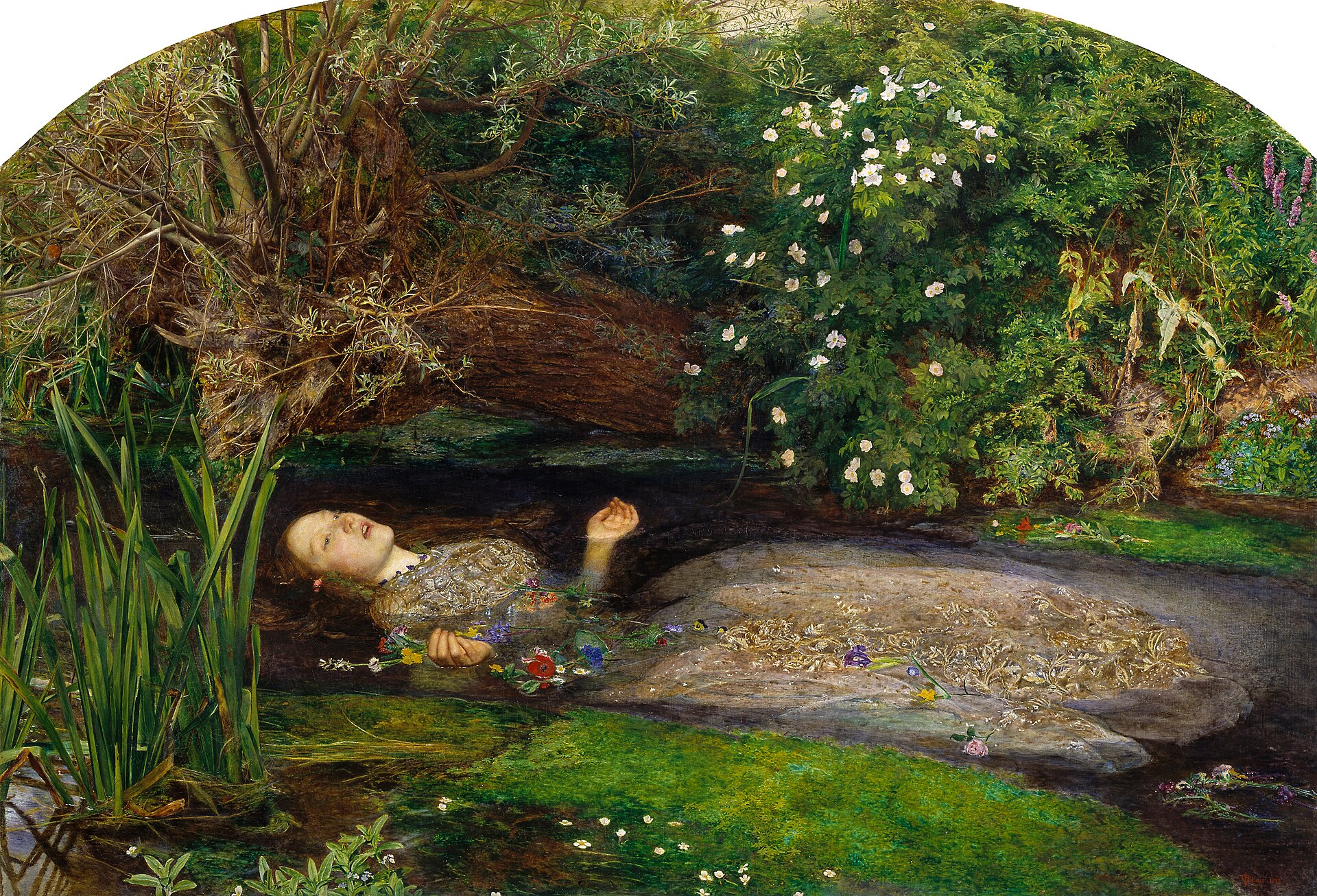

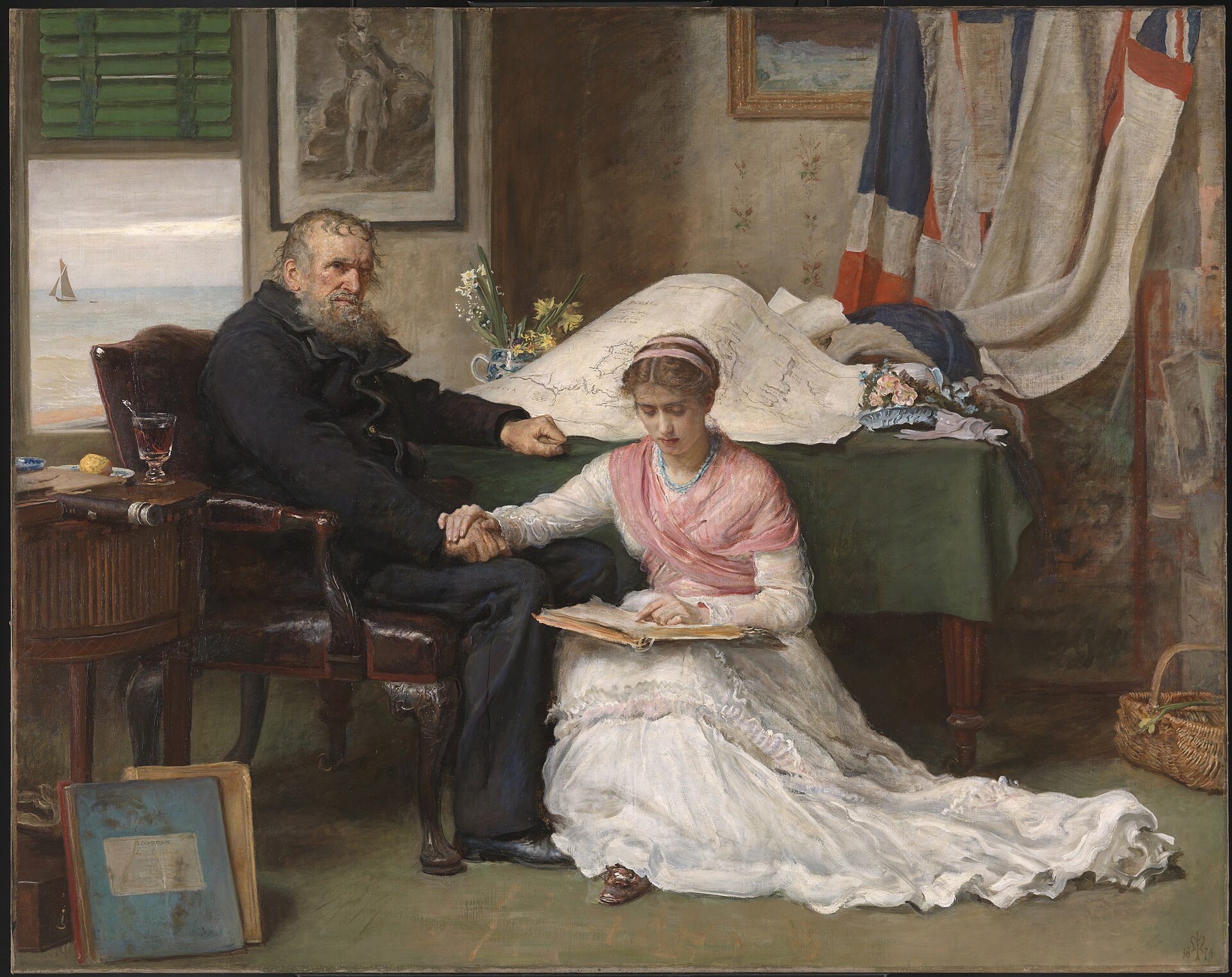
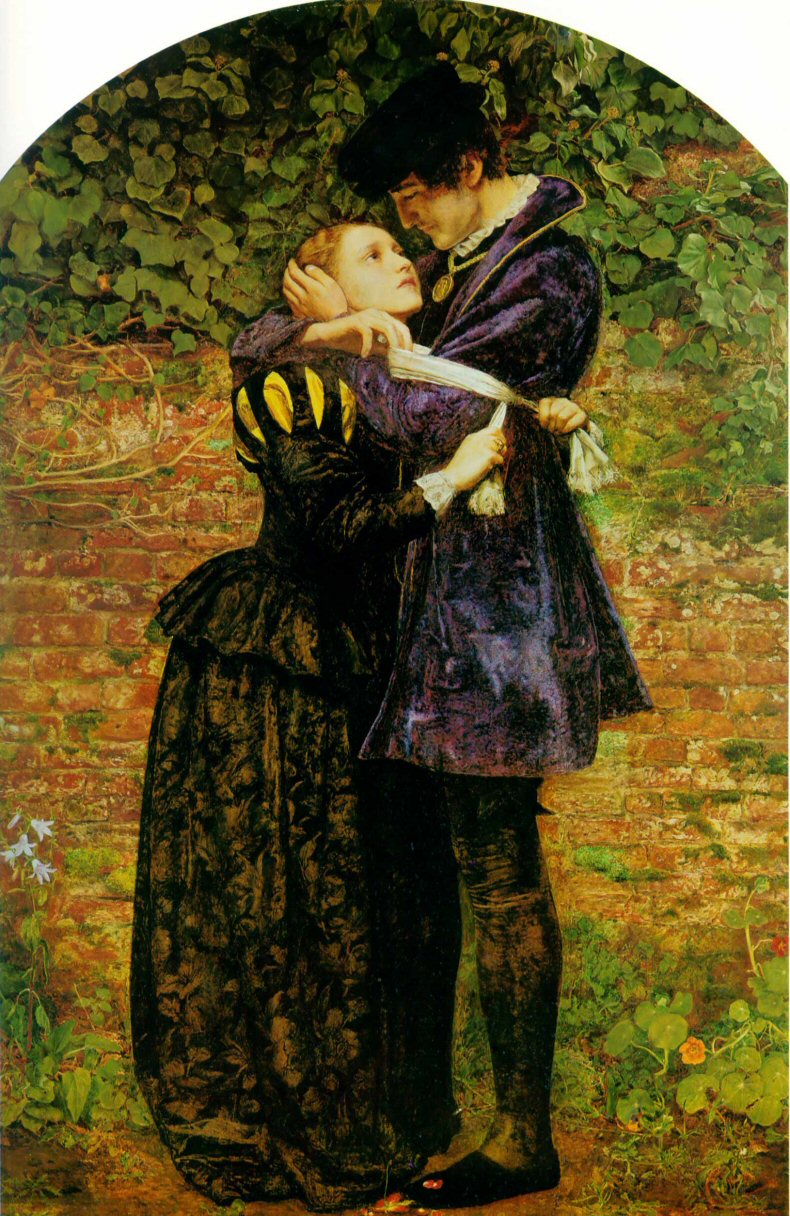
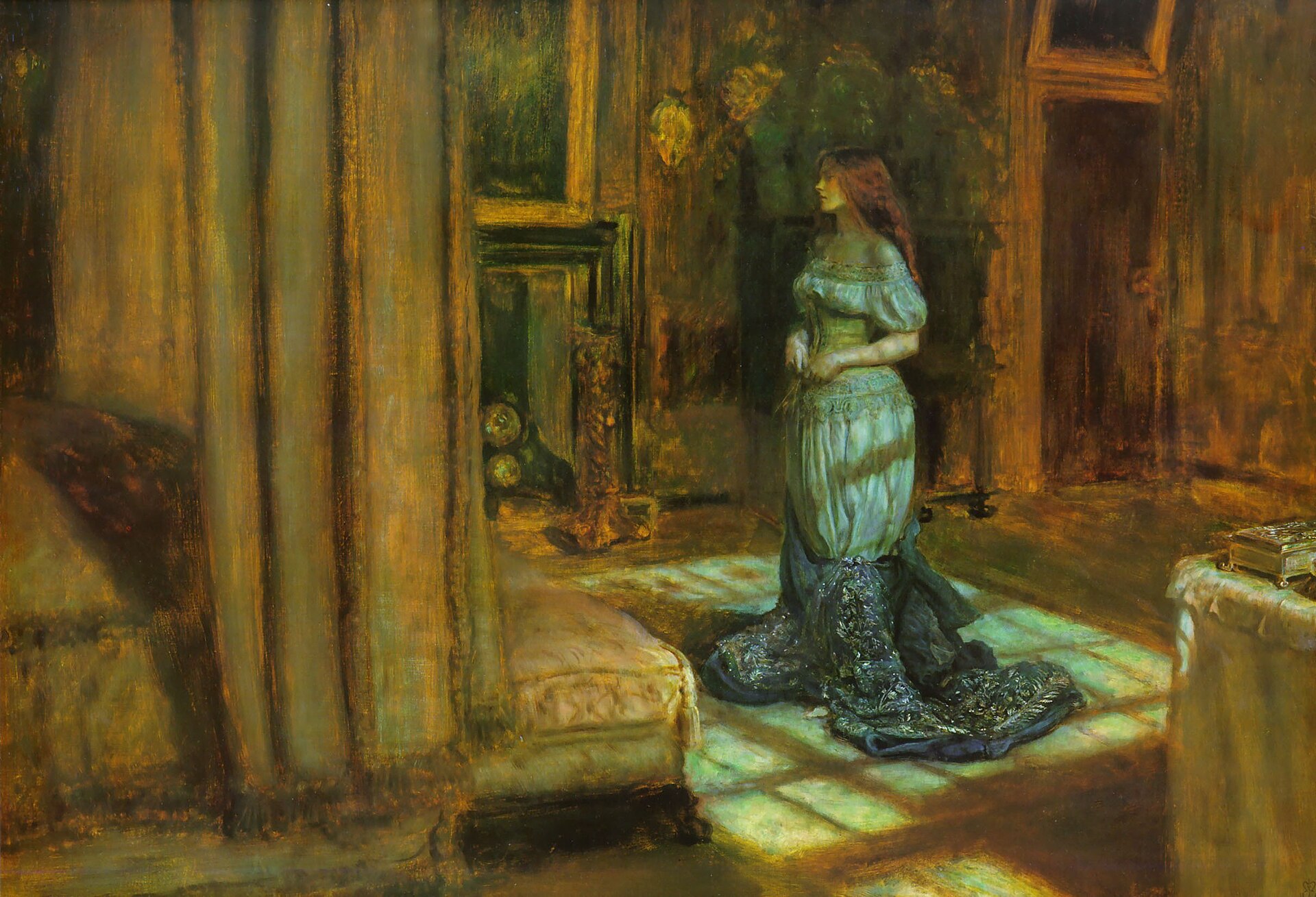

John Everett Millais is buried in St. Paul’s Cathedral, London, England.
If you would like this series to visit late 19th century American artists, you can donate to cover ther required expenses here. Jesse Talbot is in Calverack, New York and Stephen Parrish (father of Maxwell) is in Cornish, New Hampshire. Previous posts in this series are archived here and here.