
This Day in Labor History: May 30, 1925
 By
By 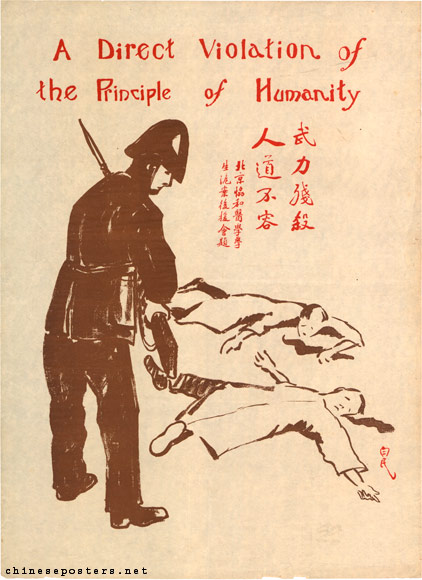
On May 30, 1925, police opened fire on workers and students in Shanghai. This began the May Thirtieth Movement, a major moment of anti-imperialist struggle in China and one that was led by workers. This is one example of how work and the struggle for freedom from imperialist powers were intertwined, as they would often be in Asia and Africa during these years.
China was not exactly colonized, but it was effectively shared by the colonial powers, with the treaty ports giving effective control to whoever had that port. Shanghai had a large French concession, but there were lots of Americans and British there in 1925 as well. It was the most international of Chinese cities, which did not really help the average Chinese reach any sort of freedom. With the general rise of nationalism and the failure of the European powers to take Asia seriously during the Treaty of Versailles at the end of World War I, a lot of anger was about to bubble over, including in China. That nation was very much a mess in 1925, with the tensions between nationalists and the communists under Mao about to boil over into civil war. Meanwhile, in early 1925, Sun Yat-Sen died. The death of the great republican hero manifested itself in an organizing principle.
Now, in Shanghai, the post-Sun KMT under Chiang Kai-Shek (not completely yet, but functionally as he controlled the entire military side of it) and the CCP under Mao were working together, both funded by the Soviets. Shanghai University was a leftist stronghold in education. Moreover, the workers of Shanghai had much stronger unions than just about anywhere else in China. Strikes grew in Shanghai in 1925. Part of the imperialist domination of China was through work. That’s maybe not surprising, but the Japanese brought modern work relations to China, not just the kind of agricultural imperialism or forced labor for gold or minerals that characterized so much of European imperialism. The Japanese saw China as a great place for cheap labor, so industrialists opened textile mills and ran them with the brutality that textile mills were run in Manchester or Fall River or anywhere else in the global apparel industry, all the way to the present.
Those workers started to protest and on May 15, a guard–who was also Japanese–shot a worker named Ku Chen-hung. Students came out in solidarity with the workers and the two groups began to work together. This started to take on more of an anti-imperialist and anti-elite tone. They decided to have a mass funeral for Ku. The government tried to suppress that, especially as workers and other anti-imperialist groups started to travel to Shanghai for it. This led to the police opening fire on protestors in Shanghai on May 30, killing five, in what became known as the Nanjing Road Incident. The police were holding trials of the student movement. They arrested more and crowds descended on the police station to demand their release. Meanwhile, inside, British police were beating the shit out of these students.
That then led to the May Thirtieth Movement. At the core of this was a general strike. Now, the general strike was a common tactic of anti-colonial movements. Workers movements in this era could not be disconnected from these larger political struggle. Unlike the American style of strike, usually about wages and hours, these strikes were about showing that colonized people could stand together and force a response from the occupiers. For example, in Algeria in the 1950s, a general strike in Algiers was a key moment that led to the French violently suppressing it and forcing workers back to their shops and jobs. That wasn’t a union movement per se or arguably even a workers’ movement so much as it was using work as a way to demonstrate anti-imperialist solidarity. This was led by the Communist Party, who called for the general strike, but the KMT was right there too.
The next day, about 1,500 workers and students gathered with a list of demands. That included not only punishing the murderous officers, but ending the Shanghai International Settlement. The general strike was to start June 1. In response, the Shanghai Municipal Council, with the support of all the western powers, declared martial law. By this time, the movement had spread to Beijing. There, about 60 workers and students were killed. Many of the leading students were forced out of school. But by June 10, there were about 130,000 workers on strike in China, making it the most significant anti-imperialist resistance movement since the Boxer Rebellion. Students went around to local shops to try and get them to boycott selling international products, with a serious threat that if they didn’t, something might happen to them. Moreover, dock workers joined the strike, except for those that only dealt in Chinese cargo. So foreign shipping began to shut down.
The aftermath was that this all had some positive long-term impact. Western powers did back away from some of their most extreme positions. The arrested students were either freed or given light sentences. The chairman of the settlement police and other leading English officials were forced out of their jobs. The strikes began to relax as well due to internal pressure, particularly as the British began cutting off electricity to Chinese communities. By 1927, the KMT and the communists were no longer working together and the KMT allied itself mostly with liberal forces among the western powers. Of course, it was a long time before this was settled and China went through a lot.
Still, the May Thirtieth Movement is an important moment connecting workers to the larger anti-imperialist struggle.
This is the 605th post in this series. Previous posts are archived here.