
Erik Visits an American Grave, Part 2,150
 By
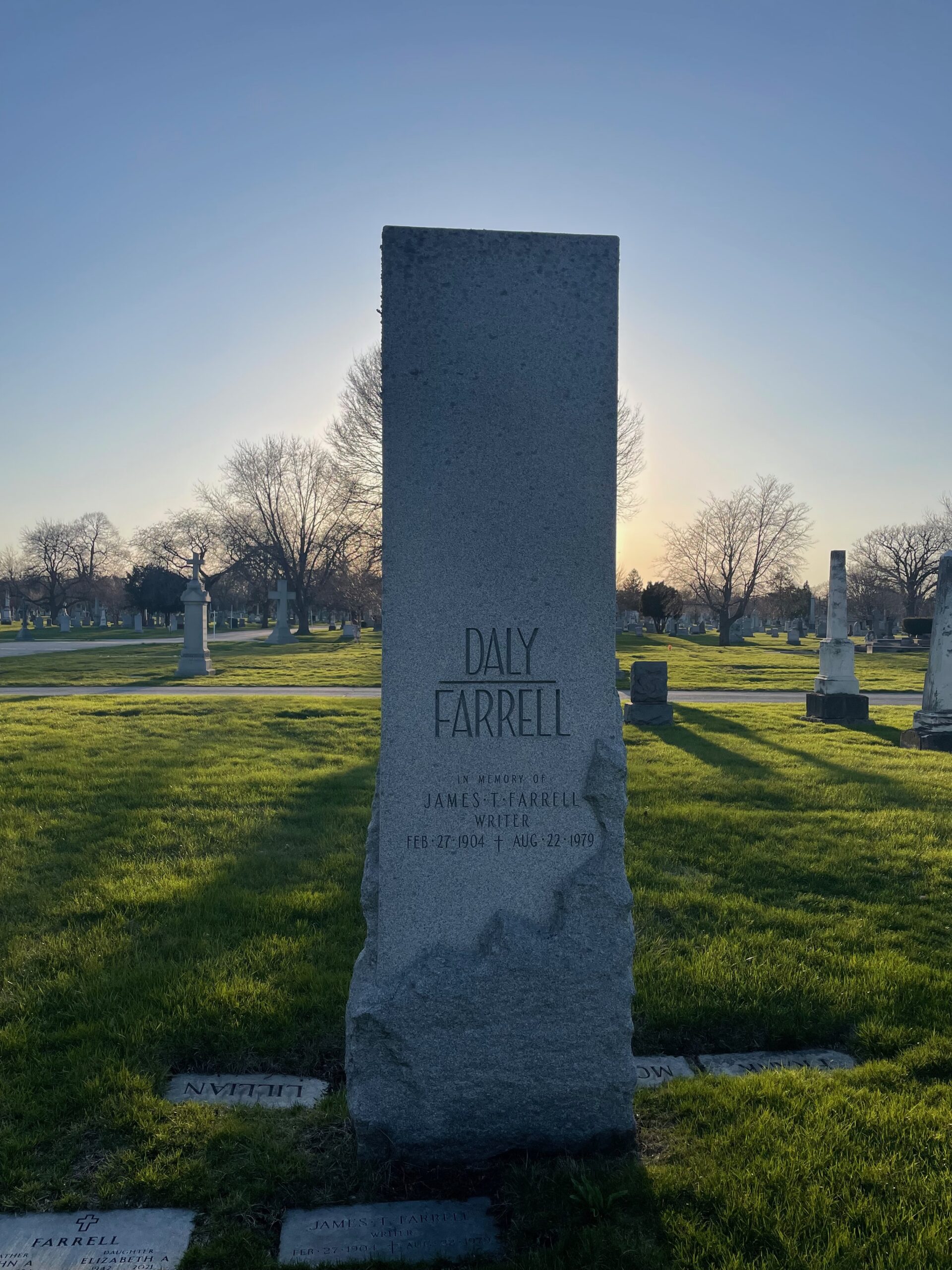
By This is the grave of James Farrell.
Born in 1904 in Chicago, Farrell grew up in a big Irish leftist family. His father was a teamster and his mother worked as a domestic. They were not happy with their lot and they taught their children that there should be a better way. He went to the local Catholic schools, but this very bright boy ended up not working like his father did but at the University of Chicago. But he didn’t lose his working class politics or his connections with his working class background just because he was at a fancy university.
Lonigan decided to become a writer. He had a great topic–his life. He was angry politically at a good time–the Great Depression. It gave him plenty of material for a trilogy. Young Lonigan came out in 1932, his debut novel, about a kid in Irish Chicago during the 1910s who is talented but deeply flawed because he desperately wants to be seen as the toughest kid on the block and will do anything to maintain that vision. 1934’s The Young Manhood of Studs Lonigan is a bit awkwardly and inartfully titled, but takes the character up through the late 20s and shows what a disaster he’s become. Then 1935’s Judgement Day takes Studs Lonigan into the Depression, where he continues to be a self-deluded wastrel and finally dies. The Studs Lonigan trilogy became among the most influential books of the era and made Farrell a literary star.
Farrell was deeply political through all of this, as I mentioned above. The novels are far from an Upton Sinclair vision, even if the politics aren’t. He knew his people too well to believe they would become socialists. He very much wanted them to, let’s be clear. But part of the book’s vision is his frustration with the politics of people who really do have nothing and no reason to believe in capitalism but they absolutely blindly follow dead-end paths to wealth that never work out for working class folks. Farrell also knew that these people would happily divide themselves by race and ethnicity instead of showing any kind of solidarity and the book goes deep into the ethnic hatreds of the period. Some have later said that the novels are racist because there are so many slurs in them, but this is the kind of stupid reading of fiction that is frankly too common in some circles this century–Farrell is depicting these characters as they actually lived, not setting up a world to make 21st century liberals comfortable.
It’s hard to overstate the reception the Studs Lonigan books had. A man no less than H.L. Mencken called Farrell the greatest novelist in America. Major writers such as Norman Mailer talked of them as the reason they became writers themselves, though given the awfulness of Mailer both personally and artistically, this might be the ultimate in damning with praise.
These were super influential books, but Farrell never really reached these heights again. He became one of these authors who make a huge and well-deserved splash early in their career and then he can never quite build on it. He moved on to continue these book cycles around a single character. He wrote five books between 1936 and 1953 around a character named Danny O’Neill and three books between 1946 and 1952 called the Bernard Carr trilogy. There were other books too and after the early 50s, he gave up that strategy and just wrote one-off novels.
But the thing is that Farrell was really at the end of an era with the Studs Lonigan novels. He sort of wrapped up the great age of the realist novel in America, closer to people such as Theodore Dreiser and Frank Norris than he would be to his own contemporaries such as Ernest Hemingway and John Steinbeck, not to mention the kind of literature that would rise in the 30s and 40s. So his work and his style just became out of fashion, especially if it wasn’t as good as the earlier work, which evidently is a widely held opinion, though I haven’t explored any of it myself. Still, it’s hard to overestimate what a splash he made. For one, his brutal writing about sex and violence and race led to a bunch of obscenity prosecutions after publication. A lot of Americans just weren’t willing to go where he was in accurately describing American behavior.
Lonigan also spent a lot of his energy on leftist politics. He was a full on Trotskyite, an active member of the Socialist Workers Party through the 30s and mid 40s, only starting to break from it in 1946, with the realization of just bad the Soviet Union’s version of communism was. But unlike quite a few ex-communists who ended up drifting farther and farther right and became outright frothing quasi-fascists as they aged, Lonigan only moved toward a democratic socialism. He came to the position that Soviet communism must be defeated first and the only power that could do that was capitalism, so we had to support what we had to support until then, at which point we could fight for socialism. Also, Soviet critics hated the Studs Lonigan books when they were translated. Not sure if that had any impact on Farrell or if he just rolled his eyes. He did engage in some overt anti-communism when, between 1954 and 1956, he headed the American Committee for Cultural Freedom. But he never fit in and was forced to resign when he wrote an op-ed that also opposed much of the Cold War, which of course was not acceptable to those who saw agencies like this as pure propaganda.
Farrell published 52 books. He never stopped writing, even as they didn’t sell well and he did not make any compromises with modern fiction. He just did his thing. Mostly it was fiction, but there’s at least one baseball book, which could be interesting.
Farrell died of a heart attack in 1979. He was 75 years old. Back in 1962, he wrote his own obituary as a poem that he published a few years later. So it closes the New York Times obituary for Farrell. Let’s read it:
My Obituary
One James (T. for Thomas) Farrell
Who might have been this,
And who might have been that,
But who might have been
Neither this nor that,
And who wrote too much,
And who fought too much,
And who kissed too much,
For all of his friends,
(He needed no enemies)
That man, J.T.F.
Died last night
Of a deprivation of time.
He willed his dust
To the public domain.
And yes, if you were wondering, Studs Terkel took his nickname from Studs Lonigan.
James Farrell is buried in Calvary Catholic Cemetery, Evanston, Illinois.
The Studs Lonigan Trilogy is in the Library of America as Volume 148. If you would like this series to visit other LOA authors, you can donate to cover the required expenses here. Isaac Bashevis Singer is in Paramus, New Jersey and James Agee is in Hillsdale, New York. Previous posts in this series are archived here and here.