
Erik Visits an American Grave, Part 2,143
 By
By This is the grave of Caroline Healey Dall.
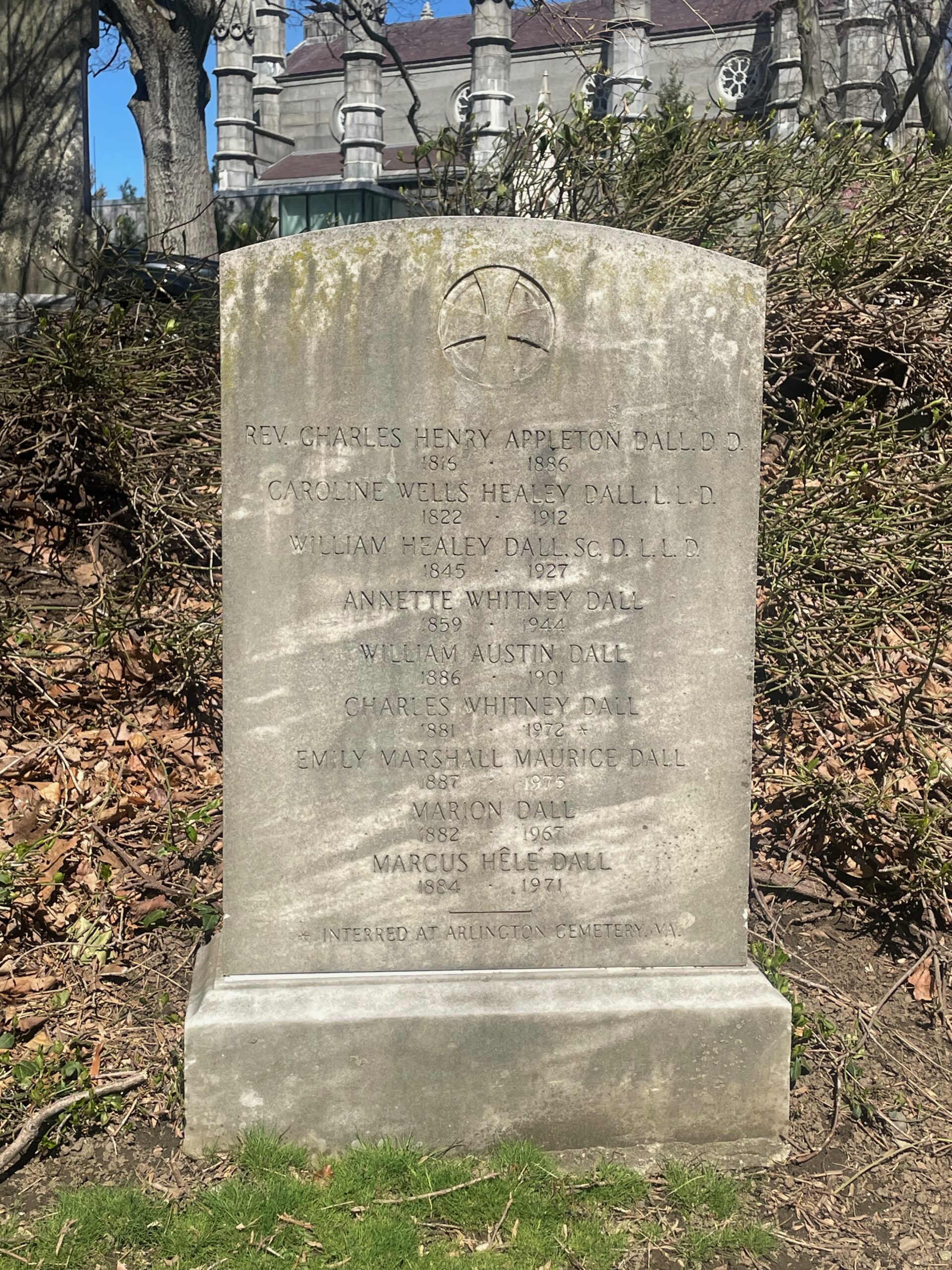
Born in Boston in 1822, Caroline Healey was the daughter of a merchant and pretty well off. Her parents believed in educating girls and so she got a good one. She went to private schools and was encouraged by her father to engage in political questions of the time. She had writing talent and so was encouraged in this endeavor as well. However, she was pulled from school at the age of 15, which was normal even in progressive families, and she was not happy about that. She would spend her life continuing to educate herself.
By 1842, Healey was teaching herself, at Lydia S. English’s Female Seminary in Washington, D.C. That was because her father’s finances had collapsed and he was having to declare bankruptcy, so she had to support herself. A Unitarian minister named Charles Henry Appleton Dall showed up to be the minister there. She didn’t like him much at all. But he proposed marriage a month later. Although she was at first revolted, in part because he was 16 years older than she, she took it seriously, spent some time with him, and decided to marry him. They stayed in Washington for the next dozen years.
The family had returned to Boston from Washington in 1854 because Charles Dall had a mental breakdown of some kind and so being around family was important. One cannot know any marriage, probably including your own, but 19th century marriages are a whole different deal. That he would soon go to Calcutta to serve as a missionary and she refused to go complicates that even further. He wasn’t out of the picture or anything, they would remain married and had a few children too. But his wandering around gave her plenty of time to continue writing. Much of that was channeled into women’s rights and she became an active suffragist in the late 1840s.
This was very early to be a suffragist. It’s hard to understand today how radical a position it was for advocate for women’s voting. To put it in context, while there was plenty of crossover between abolitionism and women’s rights, even many abolitionists found women voting to be outlandish. And abolitionists were seen as freaks by the majority of Americans in the 1840s, so imagine how women’s rights advocates were viewed. But Dall lived in Boston at least, which had a sort of San Francisco circa 1967 vibe for the rest of Americans. It was a year after their return that Charles headed to Calcutta. He spent the next 13 years there, except for a few short visits.
Dall got to know all the leading figures of the Boston literary and political scene. She saw Margaret Fuller as something of a hero. She knew Ralph Waldo Emerson, Theodore Parker, Bronson Alcott, and all these other guys. She also was the first woman that we know of to preach from a Unitarian pulpit, so for those of you who are really into Unitarian history, hey this is your day! She got to know these folks, even though she was pretty young in the 1840s, when she came under the mentorship of Elizabeth Palmer Peabody, an older woman who was connected to these people. It’s always important to mention lesser known people when you can, I think at least, so I wanted to mention her.
Dall was not much of an organizer. She basically didn’t like being around a lot of people, which many of us can understand. But she was committed. So she decided to make change by writing and sometimes lecturing. Notably, and very much not speaking for Dall here, but I personally find lecturing the most natural thing in the world to do and find chit chat with people before and after to be the most challenging thing in the world to do. So I sympathize with Dall here on how she went about this. In any case, she got a good amount of attention for three lectures she gave in 1859 called “Woman’s Right to Labor, or, Low Wages and Hard Work,” which were published as a pamphlet in 1860. She did very well in 1867 with another gathered set of lectures titled The College, the Market, and the Court; or Woman’s Relation to Education, Labor, and Law. This argued for women in the political realm and got quite a bit of positive attention. She also wrote little biographies of women she thought were forgotten in history, which was published in 1861 as Historical Pictures Retouched: a Volume of Miscellanies.
But….Dall was not as radical as some. Her focus was very much on women in the public sphere and women in the workforce. It was not about women breaking out of traditional marriage bonds. This eventually caused her to get a lot of guff from other suffragists for being too conservative and in fact she would drift away from the movement later in life. Susan B. Anthony stated of Dall, “Cautious, careful people, always casting about to preserve their reputation and social standing, never can bring about a reform.” Given this is Anthony, maybe Dall didn’t want to demonized black men over the 15th Amendment like she and Stanton were so happy to do. But it is clear that Dall was uncomfortable with topics such as divorce, which were really important for lots of early feminists and for very good reason.
So later in life, Dall felt herself somewhat alienated from political feminism and she started writing more about the Transcendentalist movement, which she was around as a young woman. She wrote a book about Margaret Fuller in 1895 and another book about Transcendentalism in 1897. Even back in the 1860s, she was writing about forgotten women in history, making her an early women’s historian, which among others Elizabeth Cady Stanton really appreciated. In fact, she had always written pretty broadly. She had a children’s book about the Civil War that she published in three volumes in 1869 and 1870–there’s a happy topic for kids! She had also written a book way back in 1868 about Egypt, which she hadn’t visited, but she was into ancient Egyptian history. So she was just kind of an interesting person, even outside her politics, but of course very much because of her politics.
Dall died in 1912. She was 90 years old.
Caroline Healey Dall is buried in Mount Auburn Cemetery, Cambridge, Massachusetts.
If you would like this series to visit other women’s rights activists, you can donate to cover the required expenses here. Wilhelmina Kekelaokalaninui Widemann Dowsett is in Honolulu and Nina Otero-Warren is in Santa Fe, New Mexico. Previous posts in this series are archived here and here.