
Erik Visits an American Grave, Part 2,134
 By
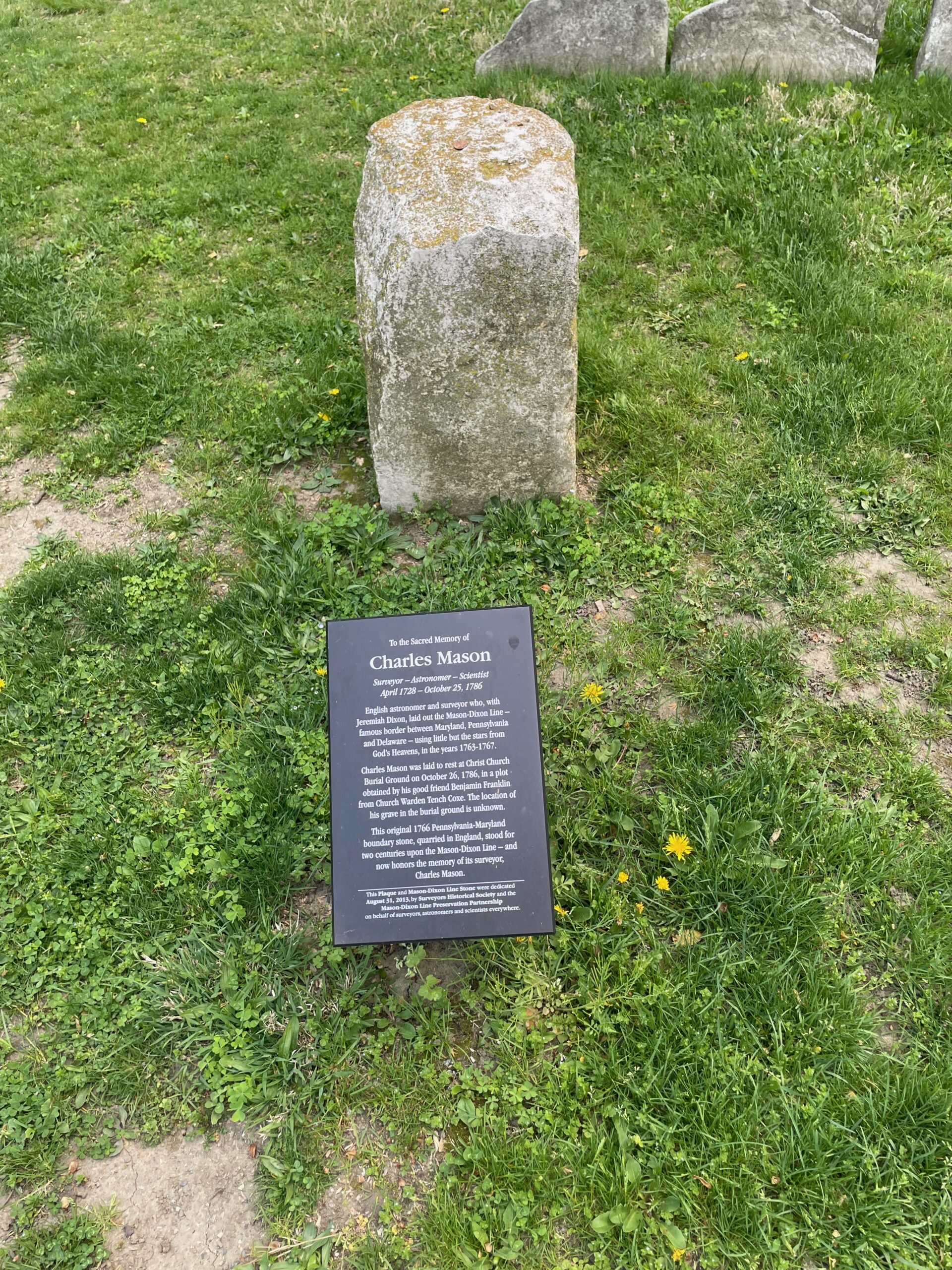
By This is the grave of Charles Mason.
Born in 1728 in Oakridge, Stroud, Gloucestershire, England, Mason got some kind of an education and then ended up working as an astronomer in the Royal Greenwich Observatory. So presumably that was a good education. That began in 1756. He stayed there for four years. While there, he got really into the German astronomer Tobias Mayer, who had published something called Tables of the Moon, so that sailors could pinpoint their location on the high seas using star charts. Useful. Mason wanted to perfect this. He was good at it too. It’s absolutely not what he is known for in the American context, but it’s for sure the most important part of his life. In fact, in 1787, he won a big royal prize for this that got him 750 pounds, a not insignificant sum of that money for that era.
Mason’s American story begins not in the colonies but in Sumatra, in what is today Indonesia. The British government sent him there in 1761 as part of an expedition to follow the path of Venus in order to nail down just how far the Earth is the from the Sun. On that boat was another surveyor who was also part of the expedition, a fellow by the name of Jeremiah Dixon. They never made Sumatra. This was the era of near constant warfare between the English and French after all. So their ship was harassed by the French and they ended up getting no farther than the Dutch Cape Colony, today’s South Africa. They did take some observations though.
Well, Mason and Dixon became friends. They got hired to figure out the border between Maryland and Pennsylvania in the American colonies in 1763. The two colonies were disputatious as you can possibly imagine. This was no easy task either. A lot of this land was undeveloped and filled with vines and swamps and forests. It’s not like they could just move around these things. The border had to be measured with perfection, wherever the line way. So it took five years to get it done. They weren’t quite able to complete the entire task because the Proclamation of 1763 had made it illegal for the English to cross the crest of Appalachia without Crown approval and they didn’t have that. But it did settle basic border disputes between Pennsylvania and not only Maryland but Virginia, which of course owned at that time what is today West Virginia.
The Mason-Dixon Line, as it became known, wasn’t really that important per se at the time except for its stated purpose. It became vastly more important in American life after the Revolution, when northern states banned slavery and southern states didn’t and thus the Mason-Dixon Line was also the line between slavery and freedom.
After this, Mason returned to England for awhile to work more on astronomy. He then came back to the colonies sometime before 1786. We have no idea why. All that is known is that close to the end of his life, during that year, he wrote to Benjamin Franklin about some astronomy project. Mason died in October 1786, at the age of 58.
Charles Mason is buried in Christ Church Cemetery, Philadelphia, Pennsylvania. An interesting note–the site of his grave was unknown until 2013. Some surveyors discovered it and moved one of the old Mason-Dixon Line stones to mark it. So that’s kind of cool.
If you would like this series to visit other American surveyors, you can donate to cover the required expenses here. Jeremiah Dixon is in Staindrop, Durham, England, if you have some extra pounds lying around. Otherwise, Andrew Ellicott is in West Point, New York and David Rittenhouse is also in Philadelphia, but at a different cemetery than this one. Previous posts in this series are archived here and here.