
Iran Does Not Have Nuclear Weapons
 By
By 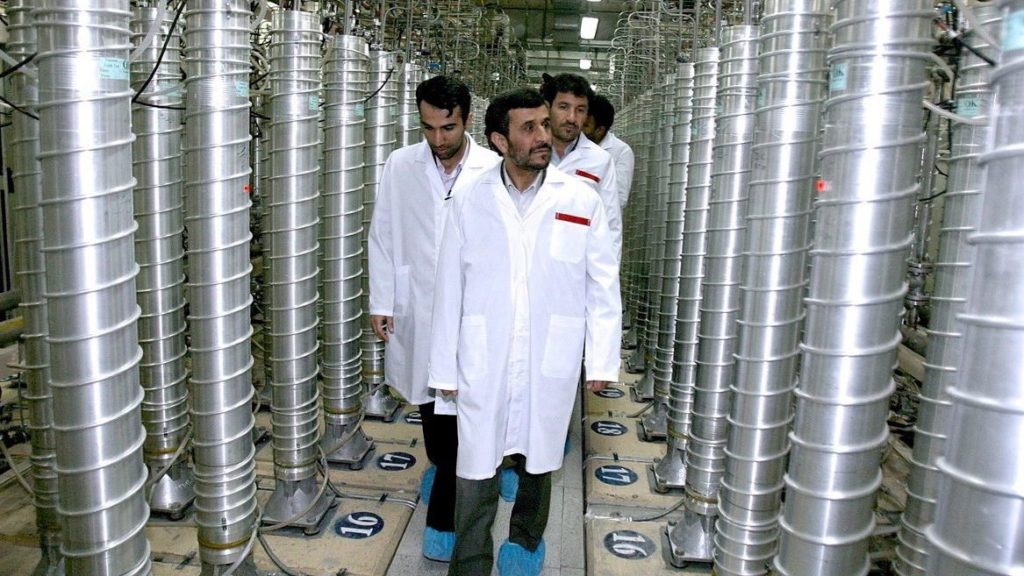
The tall cylinders are centrifuges for enriching uranium. This photo appears in an article from 2013 with the title
“Are Iran’s Centrifuges Just Few Turns From A Nuclear Bomb?”
It’s time to say it again: It’s highly doubtful that the Iranians were pursuing a nuclear weapon. And they certainly don’t have any.
Donald Trump says that (one of the purposes/ the purpose) of his attack on Iran is to make sure they never get a nuclear weapon. He has also tried to look reasonable by saying “All they have to do is say they will not build a nuclear weapon.”
Iran has done that second thing already, by ratifying the Nuclear Nonproliferation Treaty. When North Korea decided to build nuclear weapons, they withdrew from the treaty. Iran has threatened to withdraw, but they haven’t. This is a signal of their intention not to build nuclear weapons.
Trump’s insistence seems more like that of a middle-school boy sitting on another, hollering “Say uncle.” Big strong ayatollahs must come to Trump with tears in their eyes and say it.
Iran had a nuclear weapons program up until 2003 and then gave it up. Iran has said that. Western intelligence services have said that. From then until 2015, several attempts were made to give the world a better look into Iran’s nuclear program. When I say “nuclear program,” I am referring to their general studies and development of production of nuclear materials. When I say “nuclear weapons program,” I am talking about a directed effort to make a nuclear weapon. That distinction is not always made in the current discussion.
In 2015, the Joint Comprehensive Plan of Action (JCPOA) was negotiated between Iran and the US, the EU, Russia, and China. It was a much more comprehensive agreement than most of us expected. The negotiation required hundreds of people from the US, including scientists and engineers from the national laboratories. The International Atomic Energy (IAEA)Agency signed on to inspect Iran’s facilities, because that was part of the agreement. The IAEA would certify that Iran was doing what it said it would do.
Until 2018, all sides did what they pledged to do in the JCPOA.
Then Donald Trump withdrew the US from the agreement. He could get a much better agreement, he said.
In response, Iran increased its enrichment by measured amounts, which it announced. This was a negotiating tactic to push the US to return to the agreement. The amounts were small at first. Over time, the enrichment increased, and now Iran has – somewhere – 400 kilograms of 60 percent enriched uranium. The best guess is that it was buried during the US strikes in June 2025.
That uranium is probably in the form of UF6, which could be further enriched. Bomb-grade uranium is 90 percent enriched or more.
All along, there have been factions within Iran that wanted a bomb, mainly in the IRGC. But Ayatollah Khamanei has said several times that nuclear weapons are forbidden by Islam, another expression of that statement Donald Trump says he wants.
I have seen reports that the current negotiators, whose expertise is in real estate, not nuclear issues, may have misunderstood Iran’s recent offers and seemed not to know what the IAEA was. It’s a subject for specialists, which is why specialists were included in the 2014-2015 negotiations.
Iran hasn’t been working toward a bomb. They have played a negotiation based on an understanding that a bomb could be one outcome of their work. The subtlety of that produced the JCPOA. It doesn’t work with a regime whose basic mode of operation is that of gangsters.
Cross-posted to Nuclear Diner