
Erik Visits a (Non) American Grave, Part 2,098
 By
By This is the grave of Arthur Sullivan.
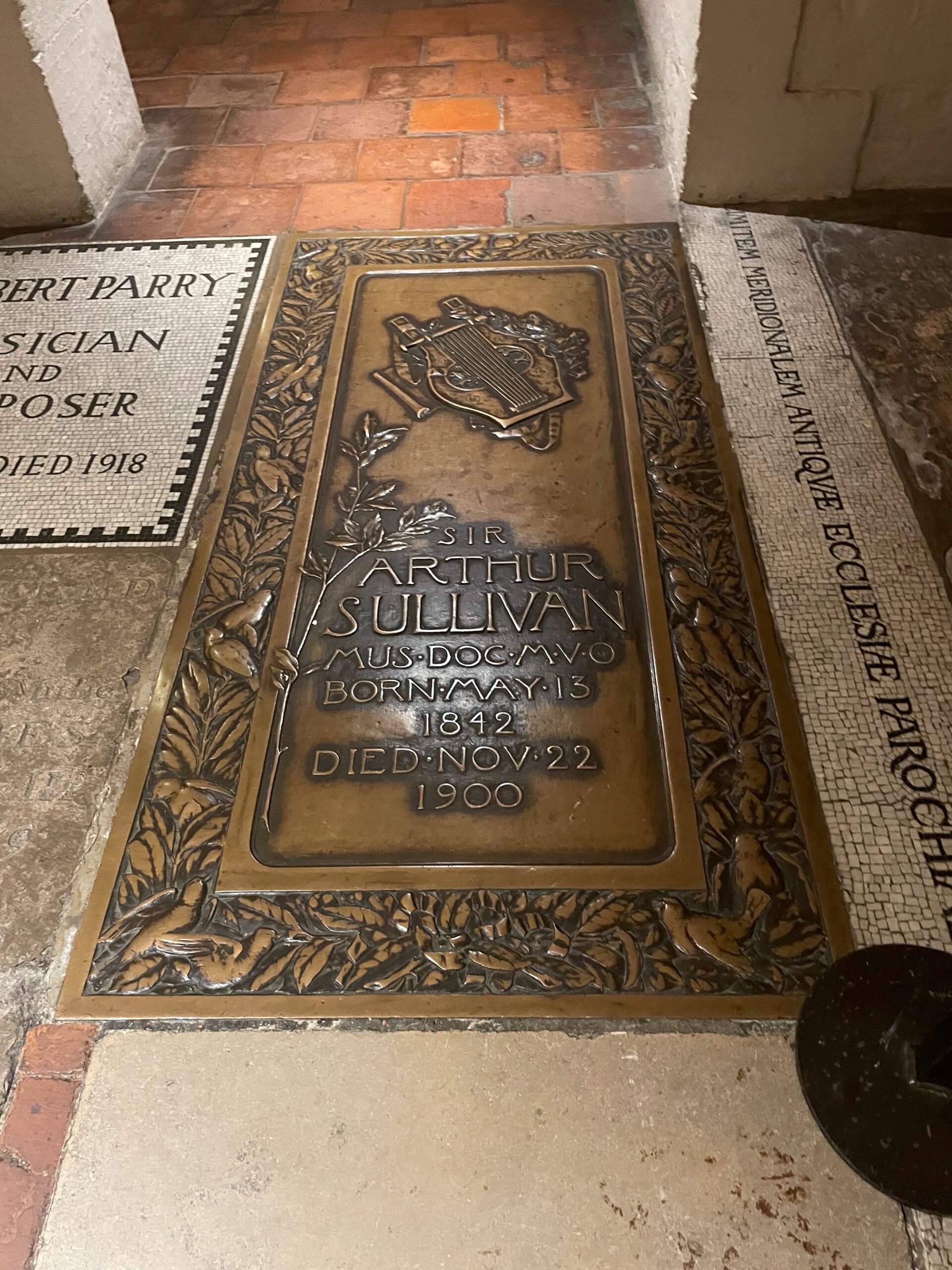
Born in 1842 in Lambeth, London, Sullivan grew up around music. His father was a clarinet player and led a military band. The boy was expected to go into music and he started writing his own tunes by the time he was 8. He became a prodigy and a soloist in the Boys’ Choir at the Chapel Royal. So when he was 14, there was a new scholarship at the Royal Academy of Music, named for Felix Mendelssohn, created by the composer’s friends to honor him. Sullivan applied and won the first one. This was binational and allowed him to study at the Leipzig Conservatory as well.
At first, Sullivan was a composer of “serious” music, by which I mean traditional types of classical pieces. His senior thesis was based on The Tempest. People liked it when it was first performed in London in the early 1860s and there was a lot of promise. He went down this path for awhile. In 1864, he wrote L’Île Enchantée, a ballet. He was already working as the organist for the Royal Italian Opera at Covent Garden, so it made sense he would write for it. The way this worked is that opera concerts at this time frequently had a short ballet sequence after they completed. I guess the opera wasn’t long enough for the crowds. So that’s what Sullivan wrote for. Again, people were impressed, it was performed over a dozen times in the next year, and was included in a concert at the Crystal Palace in 1865. He wrote a symphony and a cello concerto and next got a lot of attention in 1870 for his Overture di Ballo, an overture and which became Sullivan’s most frequently performed piece for orchestra. I think it is still occasionally performed today.
But none of this is really what makes Sullivan famous. It’s of course his work with W.S. Gilbert to write the legendary musicals of late 19th century Britain. Comic opera would make these two a ton of money and make them famous. Applying the standards of so-called serious music to popular music worked wonderfully. Gilbert wrote the words and Sullivan the music to these plays. They started working together in 1871, when they wrote something called Thepsis that not only did nothing but the music for it has been lost. But they kept going. In 1875, they were asked to write again and they did a one-act comic opera called Trial by Jury. This was very popular.
It was in 1878 that Gilbert and Sullivan really hit it super huge with H.M.S. Pinafore. If nothing else, anyone my age knows the H.M.S. Pinafore from the legendary episode of The Simpsons parodying Cape Fear, where Bart buys time by challenging Sideshow Bob that he can’t sing the entire soundtrack to the play, which of course insults Bob. But really, this is one of the most important plays ever written because it effectively established English musical theater as an international phenomenon. Of course the Pinafore has been adapted over and over again on Broadway, by Hollywood, and naturally across English theater.
Now, I am not a musicals guy. The appeal of the entire convention of musical theater is almost completely lost on me, though I do enjoy watching My Fair Lady every five years or so. But whatever, my personal preferences are irrelevant when it comes to evaluating someone’s historical significance. In creating said conventions, Gilbert and Sullivan are two of the most important cultural figures of all time.
What’s interesting to me is how British critics considered Sullivan a traitor and sellout. They had talked him up so much in the 1860s. The British have long had an inferiority complex about their composers and compared to the Italians and Germans it’s hard to argue that they’ve really matched them. So in the 1860s, critics talked about Sullivan as the Great British Composer. So when he started working with Gilbert, it was a serious betrayal for these stuffy men.
Sullivan didn’t seem to care much what these critics said. He was making money hand over fist and the crowds loved what he and Gilbert did. After Pinafore came The Pirates of Penzance in 1879, The Mikado in 1885, and The Gondoliers in 1889. Sullivan poured the money from this into the Savoy Theater. Gilbert did too, but with some more hesitation. The idea behind the Savoy was to own the building where they would put on their comic operas, being able to control the production of them and the sound and everything else directly. An expensive proposition, no question about that. In fact, it was the first public building in the entire world powered completely by electricity when it opened in 1881. It would be over running the Savoy that Gilbert and Sullivan largely broke in 1890. They did come back together later for a couple new compositions, but like Lennon and McCartney, they were never going to be as popular on their own as they were together. And the pieces they did write together in the later 1890s kind of fell flat.
Sullivan did write a few “serious” pieces in the 1880s, but mostly he left that world behind. He did write a traditional opera. Ivanhoe was pretty well-received when it debuted in 1891, but is mostly forgotten today. He was not a healthy man. He developed kidney issues in his 30s, bad enough that he had to conduct while seated. Whatever this was, it probably would have been solvable today. When he died in 1900, at the age of 58, it was technically from heart failure brought on by severe bronchitis, but it was really from just being sickly. He last piece, Te Deum Laudamus, was composed for performance in St. Paul’s Cathedral when the British won the Boer War. Glad to know he was patriotic for stupid imperialist wars and all, not that this is remotely surprising.
So it makes sense that Sullivan is buried in St. Paul’s Cathedral, London, England.
If you would like this series to visit American composers, you can donate to cover the required expenses here. Aaron Copland is at Tanglewood Music Center in Massachusetts and Charles Ives is in Danbury, Connecticut. Previous posts in this series are archived here and here.