
The Ancient Bird Trade
 By
By 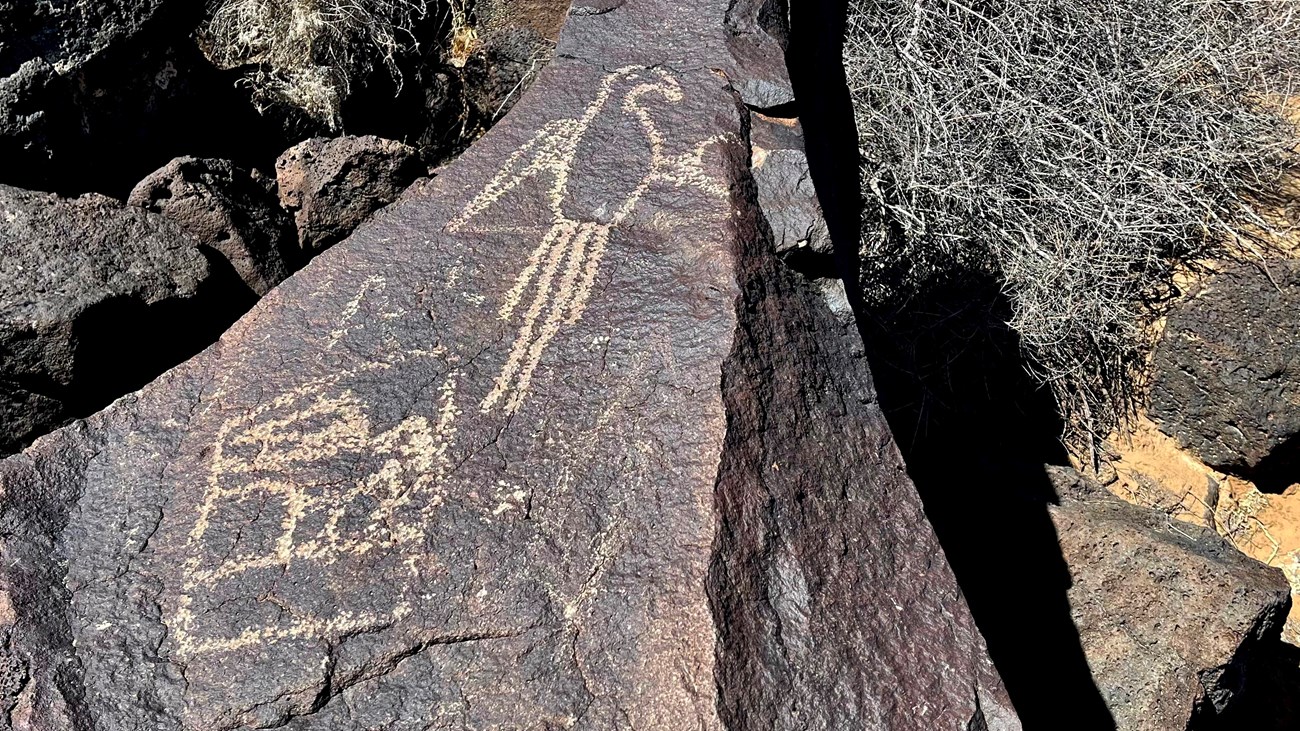
Sometimes I wonder about the academic pieces that get attention from larger news sources. Usually this is “economists or political scientists discover something that historians have written about for 25 years” and the like. But while this story about figuring out that birds were traded across South America is kinda cool, I can’t for the life of me figure out why this is news. An example: at Petroglyph National Monument in New Mexico, there is a pre-Columbian drawing of a macaw. Of course macaws do not live in New Mexico. But there was a long trading network going well down into modern Mexico and farther south. New Mexico’s main contribution to this trade was turquoise. Evidently, someone received a macaw back and someone drew it on a rock, as you can see above. Makes sense. So I flag this both because, sure, it’s cool, but also because common sense and comparison between other known cases (even cases I know just from being someone who knows this country’s historical sites well) makes me wonder why this matters:
About 15 years ago, George Olah, a conservation ecologist at the Australian National University, was conducting research in the Amazon, dangling from the rainforest canopy and collecting blood and feather samples from macaws for his doctoral thesis. Between field seasons, he often explored the archaeological sites along the coast of northern Peru, where the climate was dry and unforested.
One day, at a field museum hundreds of miles from his study site, he spotted macaw feathers tucked inside a reconstruction of an ancient tomb. He was perplexed. “It’s all desert. It’s the other side of the Andes. There’s no rainforest there,” he said. How did the feathers get there?
The question led to a yearslong side project. In a new study published on Tuesday in the journal Nature Communications, Dr. Olah and his colleagues have concluded that live parrots were traded far and wide across the Andes for their plumage. The feathers that Dr. Olah saw, which were originally recovered from a tomb dating back 600 to 1,000 years, point to a complex trade network that predates the Inca Empire.
“This is one of those papers that’s going to be a modern classic,” said Rich George, an anthropologist at the University of California, Santa Barbara, who was not involved with the research. “I’m a little jealous, to be honest — it’s a great paper.”
For the ancient cultures of coastal Peru, parrot feathers held a high value. Their colors, ranging from bright red to deep blue, represented elite status and power. In recent decades, many feathered artifacts have emerged from ancient tombs, raising questions about which species they came from and whether the birds were brought to the coast alive.
Feathers would have required little maintenance if they had merely been plucked and traded as goods. But live birds captured in the rainforest would have required food, water and protection during the journey — and such movement and trade would probably have relied on a vast network of operation across the Andes.
Why is this a great paper? Again, we know this happened all over the place. Sure, you want to know more about how this would have happened in South America specifically. The more we know, the better. But this is groundbreaking precisely how now?